Zeroth law of thermodynamics
NCERT Class 11 Physics Chapter 11 Section 11.3
Quick answer
The zeroth law of thermodynamics says that if two systems are each in thermal equilibrium with a third system, they are in thermal equilibrium with each other. It shows there is a quantity, temperature, that is equal for all systems in thermal equilibrium. That is why a thermometer works: it comes to equilibrium with a body and then shares its temperature.
With your textbook
NCERT Physics Part II (Class 11), Chapter 11 “Thermodynamics”, Section 11.3 “Zeroth law of thermodynamics”, page 228.
Open the official NCERT chapter (PDF, 1.8 MB, ncert.nic.in) (opens in a new tab)
Checked against the 2026-27 reprint on .
What is the zeroth law of thermodynamics?
Zeroth law of thermodynamics
If two systems A and B are each in thermal equilibrium with a third system C, then A and B are in thermal equilibrium with each other.
So there is a quantity, temperature, that has the same value for all systems in thermal equilibrium with one another. If TA = TC and TB = TC, then TA = TB. (NCERT Section 11.3, page 228.)
two systems in thermal equilibrium with a third system separately are in thermal equilibrium with each other
NCERT Physics Part II (Class 11), Section 11.3, page 228
In plain words: if your thermometer reads the same in a bucket of water and in a bath, then pouring the bucket into the bath causes no net heat transfer, assuming no other energy inputs or mixing effects. You never had to put the bucket and the bath in contact to know that. The thermometer, playing the part of system C, told you. That everyday fact is the zeroth law, and it is what makes thermometers work.
The experiment behind it
NCERT describes it in two steps (page 228; NCERT Fig. 11.2):
- Systems A and B are separated by an adiabatic (insulating) wall, but each touches a third system C through a conducting wall. The states of A and B change until each is in thermal equilibrium with C.
- Now the wall between A and B is made conducting, and C is cut off from both by an adiabatic wall. The states of A and B do not change any further: they are already in thermal equilibrium with each other.
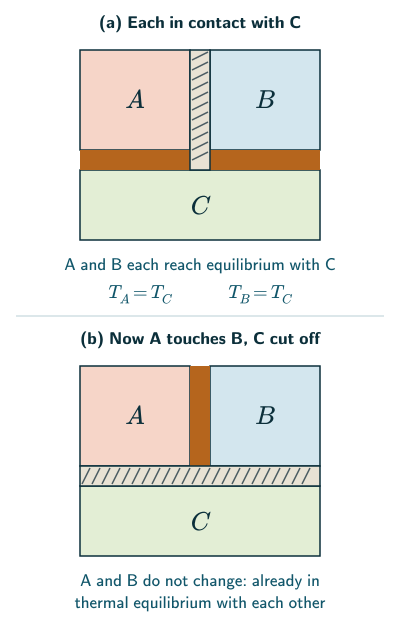
This may sound too obvious to need a law, but it is a fact about nature, found by experiment, not something that follows from logic. NCERT attributes its formulation to R. H. Fowler in 1931, after the first and second laws had already been numbered (page 228). Because it comes logically before those laws, it was called the zeroth law.
Temperature from the zeroth law
The zeroth law says that systems in thermal equilibrium share something that has the same value for all of them.
This thermodynamic variable whose value is equal for two systems in thermal equilibrium is called temperature
NCERT Physics Part II (Class 11), Section 11.3, page 228
This is the thermodynamic meaning of temperature. Two systems are in thermal equilibrium exactly when their temperatures are equal, and then no net heat flows between them. If the temperatures differ, heat flows from the hotter to the colder until they are equal (see heat as energy in transit).
The law also tells us how to measure temperature. Let a small body C, a thermometer, come to thermal equilibrium with a system. A property of C that changes with temperature, such as the length of a mercury column or the pressure of a gas at fixed volume, then tells us the system’s temperature. Assigning and realising numerical temperatures is the job of thermometry; fixed points calibrate instruments, while the modern SI kelvin is defined through Boltzmann’s constant (a modern clarification beyond NCERT page 228; see thermometers and fixed points).
Solved examples
Assume stable equilibrium readings, constant heat capacities where used, no phase changes, and negligible external losses. The thermometer reads the final shared temperature; its heat capacity can alter the sample’s original temperature.
Example 1: Using a thermometer as system C
A thermometer reads 52.0 °C when dipped in liquid A and 52.0 °C when dipped in liquid B. The two liquids, in thin metal cans, are then placed in contact. Does heat flow between them? What if B had read 48.0 °C?
The thermometer (system C) is in thermal equilibrium with A and, separately, with B, at the same reading. By the zeroth law, A and B are in thermal equilibrium with each other: no net heat flows when they touch.
If B read 48.0 °C, the two would be at different temperatures, and heat would flow from A to B until both reached a common temperature between 48 °C and 52 °C.
Answer: no net heat flows in the first case; in the second, heat flows from A to B.
Example 2: A constant-volume gas thermometer
The gas in a constant-volume gas thermometer has a pressure of 1.000 atm in equilibrium with water at its triple point (approximately 273.16 K), and 1.366 atm in equilibrium with water boiling at 1 atm. Treating the gas as ideal, so that its pressure is proportional to its absolute temperature (see the gas thermometer), find the temperature of the boiling water.
T = 273.16 K × (P/Ptr), where Ptr is the pressure at the triple point. T = 273.16 K × (1.366/1.000), about 373.1 K.
Answer: about 373.1 K, that is about 100 °C. The gas reaches equilibrium with each system, and its pressure then reports that system’s temperature.
Example 3: Equal temperatures, unequal energies
A 1 kg copper block and a 10 kg copper block are both at 50 °C. Taking s = 386.4 J kg K (NCERT Table 10.3), how much heat did each need to warm from 0 °C? Does heat flow when they touch?
Small block: 1 × 386.4 × 50, about 19.3 kJ. Large block: 10 × 386.4 × 50, about 193 kJ.
Answer: about 19.3 kJ and 193 kJ, yet no net heat flows when they touch. Thermal equilibrium depends on temperature, not on how much internal energy each body holds.
Example 4: The thermometer takes some heat
A thermometer with heat capacity 10 J K, at 20 °C, is put into 50 g of water at 60 °C. Ignoring other losses, what does it read when it reaches equilibrium? Take s = 4186 J kg K for water.
Water’s heat capacity: 0.050 × 4186 = 209.3 J K.
Heat lost by the water = heat gained by the thermometer:
209.3 × (60 − T) = 10 × (T − 20)
so 219.3T = 209.3 × 60 + 10 × 20, and T = 12 758/219.3, about 58.2 °C.
Answer: about 58.2 °C, about 1.8 °C below the water’s original temperature. The thermometer reports the shared equilibrium temperature, which it has itself changed. A good thermometer has a heat capacity much smaller than that of the system it measures.
Common mistakes to avoid
Common mistake
Treating the zeroth law as too obvious to matter
It is an experimental fact, and it is what allows temperature to be defined and thermometers to be trusted.
Common mistake
Equating temperature with heat content
Bodies at the same temperature are in thermal equilibrium even if one holds far more internal energy (Example 3).
Common mistake
Thinking it was discovered first
It is numbered zero because it logically comes before the first and second laws, not because it was stated first; it was named after them.
Quick revision summary
- Zeroth law: if A and B are each in thermal equilibrium with C, then A and B are in thermal equilibrium with each other.
- It defines temperature: the quantity that has the same value for systems in thermal equilibrium.
- If TA = TC and TB = TC, then TA = TB; no net heat flows between bodies at equal temperatures.
- A thermometer is the system C: it comes to equilibrium with a body and a temperature-dependent property gives the reading.
- It is called the zeroth law because it comes logically before the first and second laws, though it was named after them.
Formula sheet
- TA = TC and TB = TC ⇒ TA = TB
- T = 273.16 K × (P/Ptr), Ptr = pressure at the triple point of water
Questions students ask
What is an example of the zeroth law of thermodynamics in daily life?
A common example of the zeroth law of thermodynamics is two objects left in the same room: a closed bottle of water and a steel bowl kept there overnight are each in thermal equilibrium with the room air, the third system. By the zeroth law they are then in thermal equilibrium with each other, so pouring the water into the bowl causes no net heat flow, although the two were never in contact before.
What is the difference between the zeroth law and the first law of thermodynamics?
The zeroth law of thermodynamics is about temperature and the first law is about energy. The zeroth law says that two systems each in thermal equilibrium with a third are in thermal equilibrium with each other, which lets temperature be defined and measured. The first law, ΔQ = ΔU + ΔW, is conservation of energy: it says how the heat supplied to a system is shared between changing its internal energy and the work it does. The zeroth law tells you when no heat will flow (equal temperatures); the first law tells you where the energy goes when it does.
Does the zeroth law of thermodynamics have a formula?
The zeroth law of thermodynamics has no equation of its own; it is a statement about thermal equilibrium. Written with temperatures it reads: if TA = TC and TB = TC, then TA = TB. In logic this makes thermal equilibrium a transitive relation, like equality of numbers, and that is what allows one number, the temperature, to label all the systems that are in thermal equilibrium with one another.
Is the zeroth law of thermodynamics in the JEE Main and NEET syllabus?
Yes, the zeroth law of thermodynamics is named in both the JEE Main 2027 and NEET (UG) 2026 Physics syllabuses: Unit 8, Thermodynamics, begins with thermal equilibrium, the zeroth law and the concept of temperature. It is a short topic, so learn the exact statement and how it lets temperature be defined and measured with a thermometer.
Practice questions
Try each question first, then open the answer to check your working.
-
Q1. State the zeroth law of thermodynamics.
Show answerHide answer
Two systems that are each in thermal equilibrium with a third system are in thermal equilibrium with each other.
-
Q2. How does the zeroth law justify using a thermometer?
Show answerHide answer
The thermometer comes to thermal equilibrium with the body, so its temperature equals the body’s. By the zeroth law, any two bodies that give the same reading are at the same temperature and would have no net heat transfer if placed in contact.
-
Q3. Why is this law called the “zeroth” law?
Show answerHide answer
It was named after the first and second laws had already been numbered, but it is more basic than both, since it defines temperature. So it was given the number zero.