Heat, internal energy and work
NCERT Class 11 Physics Chapter 11 Section 11.4
Quick answer
Internal energy is the total kinetic and potential energy of a system’s molecules, not counting the motion of the system as a whole, and it depends only on the system’s state. Heat and work are the two ways of changing it: heat flows because of a temperature difference, while work is energy transferred by other means, such as moving a piston. Heat is energy in transit, so a body has internal energy but does not contain heat.
With your textbook
NCERT Physics Part II (Class 11), Chapter 11 “Thermodynamics”, Section 11.4 “Heat, internal energy and work”, pages 229–230.
Open the official NCERT chapter (PDF, 1.8 MB, ncert.nic.in) (opens in a new tab)
Checked against the 2026-27 reprint on .
What are internal energy, heat and work?
Internal energy, heat and work
- Internal energy U is the sum of the kinetic and potential energies of a system’s molecules, excluding organised bulk translation, rotation or flow and the system’s external potential energy. For the stationary equilibrium systems here, NCERT describes this in the centre-of-mass frame. It depends only on the state of the system.
- Heat is energy that flows into or out of a system because of a temperature difference between the system and its surroundings.
- Work is energy transferred by other means, such as a piston pushed in or out, that do not need a temperature difference.
Heat and work are two ways of changing a system’s internal energy; they are not things a system contains. (NCERT Section 11.4, pages 229–230.)
Internal energy is simply the sum of the kinetic energies and potential energies of these molecules.
NCERT Physics Part II (Class 11), Section 11.4, page 229
In plain words: a gas is a crowd of molecules flying about and tugging on one another. Add up all that jiggling energy and you have its internal energy. You can raise it in two ways: put the gas next to something hotter (heat), or squash it with a piston (work). For a fixed-composition ideal gas with no compensating energy transfer, its temperature rises, and the gas cannot “remember” which way it was done.
Internal energy
Internal energy counts only the disordered energy of the molecules’ random motion and of their mutual forces. The kinetic energy of the system moving as a whole is not part of it. A box of gas on a moving train has the same internal energy as the same box at rest, if its state is the same (NCERT Fig. 11.3, page 229). Nor does U include the potential energy of the system as a whole, such as the gravitational potential energy of a raised box. The potential energy in U is that of the forces between the molecules.
In a dilute ideal-gas model, intermolecular interaction energy is neglected. Internal energy includes random translational motion and any active internal molecular modes; molecular vibration has both kinetic and intramolecular potential energy. That motion is not only translational (moving from place to place); molecules also rotate and vibrate, and these motions count too (page 229). So for a given amount of ideal gas, where these forces are neglected, U depends on temperature alone: if its temperature does not change, ΔU = 0.
A state variable. The internal energy of a system depends only on its state, given for a gas by its pressure, volume and temperature, not on how it reached that state (page 229). Pressure, volume, temperature and internal energy are all state variables. So when a gas goes from one state to another, the change in its internal energy, ΔU, is the same whatever path it takes (Example 4).
Heat and work
Take a gas in a cylinder with a movable piston (NCERT Fig. 11.4, page 229). There are two ways to change its state, and so its internal energy (page 230):
- put the cylinder in contact with a hotter body: heat flows into the gas because of the temperature difference; if less energy leaves as work than enters as heat, its internal energy rises;
- push the piston down, doing work on the gas: its internal energy rises if there is no compensating heat loss, with no temperature difference needed.
Both can run the other way. If the surroundings are colder, heat flows out of the gas; if the gas pushes the piston up, it does work on the surroundings.
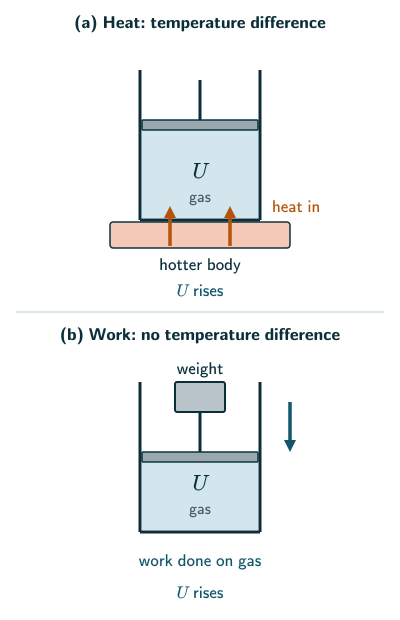
In short, heat and work are two different modes of altering the state of a thermodynamic system and changing its internal energy.
NCERT Physics Part II (Class 11), Section 11.4, page 230
Heat is energy in transit
Heat is certainly energy, but it is the energy in transit.
NCERT Physics Part II (Class 11), Section 11.4, page 230
This is not just a play on words (page 230). A system in a given state has a definite internal energy, but it does not “have” a certain amount of heat, any more than it “has” a certain amount of work. Saying “heat was supplied to the system” or “work was done by the system” is perfectly meaningful; saying “the gas contains 500 J of heat” is not. Heat and work are not state variables: they describe energy crossing the boundary, and the amounts depend on the path taken. Everyday language often mixes up heat and internal energy, but in thermodynamics the difference is essential (page 230).
A little history. Heat was once pictured as an invisible fluid, called caloric, that filled the pores of a substance (NCERT Section 11.1, page 226). In that picture caloric flowed from the hotter body to the colder one until their “caloric levels”, the temperatures, were equal, just as water flows between two tanks until the levels match. NCERT’s text says the caloric flowed “from the colder to the hotter body”, which is a slip: its own tank analogy shows the flow goes from hotter to colder. In 1798 Count Rumford (Benjamin Thomson) found that boring a brass cannon produced enough heat to boil water. The heat depended on the work done by the horses turning the drill, not on how sharp the drill was, although in the caloric picture a sharper drill should have scooped more caloric out of the pores. The natural explanation was that heat is a form of energy, and that work had been turned into it (page 226; see also heat as energy in transit).
Solved examples
Take s = 4186 J kg K for water (NCERT Table 10.3) and g = 9.8 m s.
Example 1: Warming water with work
A paddle stirs 0.50 kg of water in an insulated container, doing 10.5 kJ of work on it. No heat flows in or out. By how much does the water’s temperature rise?
Neglect container heat capacity and any residual bulk motion. All the work goes into internal energy: ΔU = 10 500 J.
ΔT = 10 500/(0.50 × 4186), about 5.0 K.
Answer: about 5.0 K. Heating the water by 5.0 K with a burner would need 0.50 × 4186 × 5.0, about 10.5 kJ, of heat. The water ends in the same state either way.
Example 2: Water falling down a waterfall
Water falls 50 m. If all its loss of potential energy goes into its internal energy, how much warmer is it at the bottom?
Potential energy lost per kilogram: 9.8 × 50 = 490 J kg.
ΔT = 490/4186, about 0.117 K.
Answer: about 0.12 K. Work done by gravity becomes internal energy; the rise is small because water’s specific heat is large.
Example 3: A moving flask
A sealed flask holds 0.50 kg of water and moves with a car at 20 m s. Is the water’s kinetic energy part of its internal energy?
Kinetic energy of the water as a whole: ½ × 0.50 × 20 = 100 J.
Answer: no. Internal energy is measured in the frame in which the water is at rest as a whole, so the 100 J is not part of it. Gentle braking can transfer most of this energy to the car and brakes; sloshing and viscous dissipation can put some into the water and flask. The distribution depends on how the flask stops. If all 100 J were dissipated in the water alone, its temperature would rise by 100/(0.50 × 4186), about 0.048 K.
Example 4: Same change, different paths
A gas goes from state 1 to state 2 in three different ways: (A) 500 J of heat is added and no work is done; (B) no heat flows and a paddle wheel inside does 500 J of work on the gas; (C) 800 J of heat is added and the gas does 300 J of work. Find ΔU for each.
Rule used: ΔU = (heat added) − (work done by the gas). Work done on the gas counts as negative work by it.
(A) ΔU = 500 − 0 = 500 J. (B) ΔU = 0 − (−500) = 500 J. (C) ΔU = 800 − 300 = 500 J.
Answer: ΔU = 500 J every time, because U is a state variable. The heat and the work differ from path to path, which is why “the heat in the gas” has no meaning. (This bookkeeping is the first law of thermodynamics.)
Common mistakes to avoid
Common mistake
Saying a body contains heat
A body contains internal energy. Heat is energy on the move because of a temperature difference.
Common mistake
Counting the motion of the whole system
The kinetic energy of a system moving as a whole is not internal energy (Example 3). Only random molecular motion and molecular potential energy count.
Common mistake
Thinking only heat can warm a body
Work can raise internal energy, and so temperature, just as well (Examples 1 and 2).
Common mistake
Thinking heat always raises the temperature
When ice melts at 0 °C, the heat supplied raises its internal energy (the molecules’ potential energy) but not its temperature.
Common mistake
Treating heat and work as state variables
ΔU depends only on the end states; the heat and the work depend on the path (Example 4).
Quick revision summary
- Internal energy U: the sum of molecular kinetic and potential energies, in the frame where the system’s centre of mass is at rest. It excludes the bulk motion of the system.
- U is a state variable: ΔU depends only on the initial and final states.
- Heat is energy transferred because of a temperature difference; work is energy transferred by other means, such as moving a piston.
- Heat and work are modes of energy transfer, not state variables; a body has internal energy, not heat.
- Rumford’s cannon-boring showed that work turns into heat, so heat is a form of energy.
Formula sheet
- U = microscopic kinetic + potential energy (excluding organised bulk and external potential energy)
- ΔU depends only on the initial and final states
Questions students ask
What is the difference between heat and work in thermodynamics?
Heat and work are both energy in transit and both are measured in joules, but heat flows because of a temperature difference, while work is energy transferred by other means, such as a force moving a piston, with no temperature difference needed. Work can be turned completely into internal energy, as when a car’s brakes heat up through friction. Heat cannot be turned completely into work by an engine working in a cycle: some of it must be given out to a colder body, as the second law states.
What does the internal energy of an ideal gas depend on?
The internal energy of a given amount of ideal gas depends only on its temperature, because the forces between its molecules are neglected and only the energy of the molecules’ own motion counts (moving about and, for molecules of two or more atoms, also rotating and vibrating). For μ moles, ΔU = μCvΔT in any process if C is approximately constant; otherwise integrate μC(T) dT, where Cv is the molar specific heat at constant volume, so an ideal gas compressed or expanded at constant temperature has ΔU = 0. For a monatomic ideal gas, U = (3/2)μRT (see monatomic gases in kinetic theory).
What is the difference between internal energy and thermal energy?
Internal energy is the total kinetic and potential energy of a system’s molecules, measured in the frame in which its centre of mass is at rest, while “thermal energy” is a looser everyday term, usually for the part tied to the random motion of the molecules, which rises with temperature. Thermal energy has no single agreed definition, so in thermodynamics, and in the first law, use internal energy, U, the quantity NCERT defines in Section 11.4.
What is the SI unit of heat, work and internal energy?
Heat, work and internal energy all have the same SI unit, the joule (J), because all three are amounts of energy, with the dimensional formula [M L T]. Heat was once measured in calories, defined through the heating of water; 1 historical 15 °C cal ≈ 4.186 J. Rates of heat flow or of doing work, such as a heater’s output, are measured in watts: 1 W = 1 J s.
Practice questions
Try each question first, then open the answer to check your working.
-
Q1. Why is the statement “a gas has 200 J of heat” meaningless, while “a gas has 200 J of internal energy” is meaningful?
Show answerHide answer
Internal energy belongs to the state of the gas. Heat is energy in transit, defined only while it crosses the boundary because of a temperature difference. Transferred heat can change internal energy or be balanced by work; it is not a stored substance.
-
Q2. An electric stirrer does 2.0 kJ of work on 0.20 kg of water in an insulated flask. Find the rise in temperature.
Show answerHide answer
ΔT = 2000/(0.20 × 4186), about 2.4 K.
-
Q3. When you rub your palms together on a cold day, they feel warm. Is this heat or work?
Show answerHide answer
Work. Your muscles push each palm along against kinetic friction, and that work becomes internal energy of the skin at the rubbing surfaces. Both palms start at the same temperature, so no heat flow starts the warming. (The warm skin then loses heat to the cooler air.) NCERT uses this example in Section 11.1, page 226.