Relative velocity
Beyond NCERT In the JEE Main and NEET syllabus; the Class 11 book has no section for it.
Quick answer
Relative velocity is the velocity one body appears to have to an observer moving with another: the velocity of A relative to B is vAB = vA − vB, with both velocities measured in the same frame. In one dimension, the relative speed is the difference of the speeds for bodies moving the same way and their sum for bodies moving in opposite directions; in two dimensions the velocities are subtracted as vectors. River-crossing and rain problems apply the same rule to a boat relative to the water and to rain relative to a moving person.
What is relative velocity?
Relative velocity
The velocity of A relative to B is the velocity A appears to have to an observer moving with B:
using the classical, non-rotating-frame description appropriate to everyday speeds, where both velocities are measured in the same frame of reference, such as the ground. It follows that v⃗BA = −v⃗AB. In one dimension the arrows can be dropped and the signs give the directions.
Finally, to understand the relative nature of motion, we introduce the concept of relative velocity.
NCERT Physics Part I (Class 11), Section 2.1, page 13
Both the JEE Main 2027 and the NEET (UG) 2026 syllabuses list relative velocity in Unit 2, Kinematics. The 2026–27 NCERT book still promises it in its introduction (above) and lists “2.5 Relative velocity” on the chapter’s first page, but the section itself is no longer in the book. What remains is NCERT Exercise 2.14 (page 25), the police-van problem solved below as Example 2, and Points to Ponder 5 in Chapter 3 (page 46). That point writes v12 = v1 − v2 but calls it the “velocity of object 1 relative to velocity of object 2”; it should say relative to object 2. This page covers the topic in full.
In plain words: sitting in a train that is passing a slower train, you see the other train drift slowly backwards, though both are moving forwards over the ground. What you see is the relative velocity: the difference of the two velocities.
Relative velocity in one dimension
Take two objects A and B moving along the x-axis with velocities vA and vB (signed, measured from the ground).
- The position of B relative to A is xB − xA. It changes at the rate vBA = vB − vA.
- Same direction: the relative speed is the absolute difference of the speeds. Two cars at 20 m/s and 15 m/s in the same direction separate (or close) at 5 m/s.
- Opposite directions: the relative speed is the sum of the speeds. The same cars approaching each other close at 35 m/s.
- If vA = vB, the relative velocity is zero: the two stay the same distance apart, and each sees the other at rest.
On position-time graphs, the relative velocity is the difference of the slopes of the two lines. Parallel lines mean equal velocities (zero relative velocity, constant separation); lines that cross mean the objects meet there.
Relative motion is also why the same event looks different from different frames: a ball sliding on the smooth floor of a braking train moves forward relative to the train but keeps its speed relative to the ground (see the law of inertia examples).
Relative velocity in two dimensions
When the velocities are not along one line, the subtraction is a vector subtraction: v⃗AB = v⃗A + (−v⃗B). Reverse v⃗B and add it to v⃗A by the triangle or parallelogram rule. If the angle between v⃗A and v⃗B is θ:
Magnitude of relative velocity
The minus sign appears because −v⃗B makes an angle 180° − θ with v⃗A. For perpendicular velocities (θ = 90°) it reduces to Pythagoras’ theorem.
Rain and a moving person. Rain falling vertically at vr looks slanted to someone moving horizontally at vm, because what they see is v⃗rm = v⃗r − v⃗m: the rain’s velocity plus a horizontal part opposite to their own motion. The rain seems to come from ahead, at an angle α to the vertical with tan α = vm/vr, so an umbrella should be tilted forwards by α.
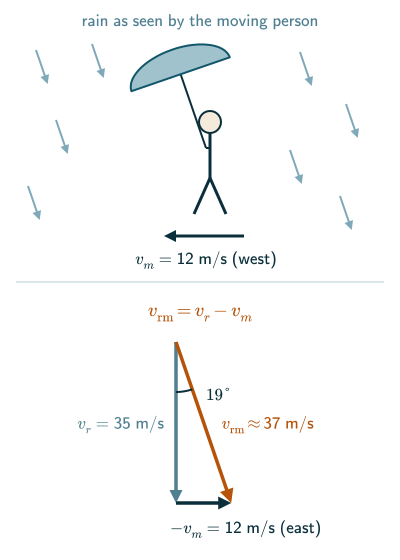
NCERT’s Example 3.1 (page 31) uses the same numbers for a different situation: a boy standing still while a wind blows the rain towards the west at 12 m/s. There the rain’s ground velocity itself is slanted, so the umbrella tilts towards the east, the side the wind comes from. Rain problems always come down to the rain’s velocity relative to the person.
River crossing
A boat moves at speed u relative to the water, and the river flows at v relative to the banks. The boat’s velocity relative to the bank is the vector sum v⃗boat, bank = v⃗boat, water + v⃗water, bank. The formulas below assume straight parallel banks a distance d apart, a steady uniform current along the banks, and a fixed boat speed u relative to the water. The boat maintains its chosen heading throughout the crossing:
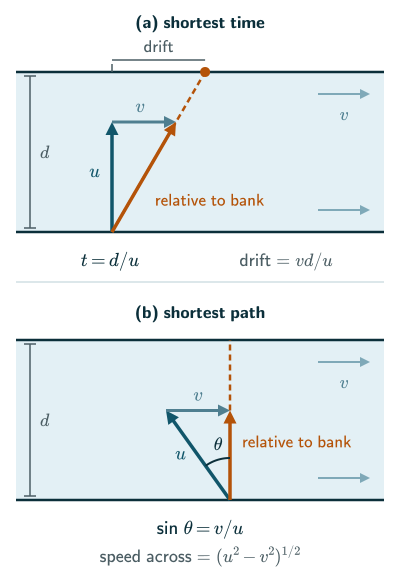
- Shortest time: point the boat straight across. Only the across component carries it over, so t = d/u. Meanwhile the current carries it downstream by the drift vd/u.
- Shortest path (landing directly opposite): point the boat upstream at an angle θ to the straight-across direction, with sin θ = v/u, so that its upstream component cancels the current. Its speed across is √(u − v), and t = d/√(u − v). A finite-time crossing directly opposite is possible only if u > v. If u = v, exactly cancelling the current uses all the boat’s speed upstream and leaves zero speed across the river.
- Least drift when u < v: the boat cannot land directly opposite, but it drifts least if it heads upstream at an angle θ to the straight-across direction, with sin θ = u/v. Its velocity relative to the bank is then at right angles to its heading, and the drift is d√(v − u)/u.
Solved examples
Example 1: Two trains on parallel tracks
Train A moves east at 54 km/h and train B east at 90 km/h on parallel tracks. Find the velocity of B relative to A. What if B moves west instead?
Taking east as positive: vA = 15 m/s, vB = 25 m/s. vBA = 25 − 15 = +10 m/s (east).
If B moves west: vB = −25 m/s, and vBA = −25 − 15 = −40 m/s.
Answer: 10 m/s east; 40 m/s west. Seen from A, B moves at the difference of the speeds in the first case and at their sum in the second.
Example 2: The police van and the thief (NCERT Exercise 2.14, page 25)
A police van moving at 30 km/h fires a bullet at a thief’s car moving away in the same direction at 192 km/h. The muzzle speed of the bullet is 150 m/s. With what speed does the bullet hit the car?
The muzzle speed is relative to the van, so the bullet’s ground speed is 150 + 30/3.6 ≈ 158.3 m/s. The car’s speed is 192/3.6 ≈ 53.3 m/s.
Speed of the bullet relative to the car = 158.3 − 53.3 = 105 m/s.
Answer: 105 m/s, the speed that matters for the damage to the car.
Example 3: Time to overtake
A train 200 m long moving at 20 m/s overtakes a train 300 m long moving at 15 m/s on a parallel track in the same direction. How long does the overtaking take? How long would they take to pass each other if moving in opposite directions?
To overtake, the faster train must gain 200 + 300 = 500 m on the slower one. Relative speed 20 − 15 = 5 m/s, so t = 500/5 = 100 s.
In opposite directions the relative speed is 20 + 15 = 35 m/s, so t = 500/35 ≈ 14.3 s.
Answer: 100 s; about 14.3 s.
Example 4: Rain and a cyclist
Rain falls vertically at 35 m/s. A woman rides a bicycle westwards at 12 m/s. At what angle should she hold her umbrella, and how fast does the rain seem to fall to her?
Relative to her, the rain has 35 m/s downwards and 12 m/s eastwards. Speed = √(35 + 12) = √1369 = 37 m/s. Angle to the vertical: tan α = 12/35 ≈ 0.343, so α ≈ 19°.
Answer: tilted forward, towards the west, at about 19° to the vertical; the rain seems to fall at 37 m/s.
Example 5: Crossing a river
A river 400 m wide flows at 3 m/s. A boat can move at 5 m/s relative to the water. Find (a) the least time to cross and the drift, and (b) the heading and time for crossing straight across.
(a) Head straight across: t = 400/5 = 80 s. Drift = 3 × 80 = 240 m downstream.
(b) sin θ = 3/5, so θ ≈ 37° upstream of the straight-across direction. Speed across = √(25 − 9) = 4 m/s, so t = 400/4 = 100 s.
Answer: (a) 80 s, landing 240 m downstream; (b) about 37° upstream, taking 100 s.
Example 6: Relative velocity at right angles and closest approach
Car A moves north at 20 m/s and car B east at 15 m/s. (a) Find the velocity of A relative to B. (b) At this instant A is 100 m due south of B. How close do the cars come, and when?
(a) v⃗AB = v⃗A − v⃗B: 20 m/s north plus 15 m/s west. Magnitude √(20 + 15) = 25 m/s; direction tan(15/20) ≈ 37° west of north.
(b) In B’s frame, B is at rest and A moves in a straight line at 25 m/s, starting 100 m south of B. This line makes an angle θ with north, where cos θ = 20/25 = 0.8 and sin θ = 15/25 = 0.6. Of the 100 m, 100 × 0.8 = 80 m lies along A’s path and 100 × 0.6 = 60 m at right angles to it. The least distance is 60 m, reached after 80/25 = 3.2 s.
Answer: (a) 25 m/s, about 37° west of north. (b) 60 m, after 3.2 s. Relative speed is not generally the rate at which separation decreases: at closest approach the separation is momentarily stationary, even though the relative speed is still 25 m/s.
Common mistakes to avoid
Common mistake
Getting the order of subtraction wrong
vAB = vA − vB is A as seen from B. Swapping the order reverses the direction: vBA = −vAB.
Common mistake
Subtracting speeds for objects moving towards each other
For opposite directions, signs matter: 20 − (−15) = 35 m/s. The relative speed is the sum, not the difference.
Common mistake
Subtracting magnitudes in two dimensions
In two dimensions, subtract the vectors, not their sizes: cars at 20 m/s north and 15 m/s east have a relative speed of 25 m/s, not 5 m/s.
Common mistake
Using the boat’s speed relative to the bank
The boat’s stated speed is relative to the water. Add the current as a vector to get its velocity relative to the bank.
Common mistake
Tilting the umbrella the wrong way
Use the rain’s velocity relative to the person. For a person running through vertical rain, the rain comes from ahead, so the umbrella tilts forward.
Common mistake
Adding the muzzle speed to the wrong frame
A muzzle speed is relative to the gun. If the gun is moving, add its velocity to get the bullet’s ground velocity first.
Quick revision summary
- Velocity of A relative to B: v⃗AB = v⃗A − v⃗B, both measured in the same frame; v⃗BA = −v⃗AB.
- One dimension: same direction, speeds subtract; opposite directions, speeds add.
- Two dimensions: subtract as vectors; |v⃗AB| = vA2 + vB2 − 2vAvB cos θ.
- Rain: use the rain’s velocity relative to the person; tan α = vm/vr for vertical rain.
- River: shortest time, head across, t = d/u, drift vd/u; shortest path, sin θ = v/u, t = d/√(u − v).
Formula sheet
- vAB = vA − vB
- vBA = −vAB
- vAB2 = vA2 + vB2 − 2vA vB cos θ
- rain: tan α = vm/vr
- river, shortest time: t = d/u; drift = vd/u
- river, shortest path: sin θ = v/u; t = d/√(u − v)
- river, least drift (u < v): sin θ = u/v; drift = d√(v − u)/u
Questions students ask
Is relative velocity still in the JEE Main and NEET syllabus, though NCERT dropped it?
Yes, relative velocity is still in the syllabus: both the JEE Main 2027 and the NEET (UG) 2026 syllabuses name it in Unit 2: Kinematics. The 2026–27 NCERT book still lists “2.5 Relative velocity” on the first page of Chapter 2, Motion in a Straight Line, but no longer has the section; only Exercise 2.14 (page 25) and Points to Ponder 5 of Chapter 3 (page 46) still use the idea.
Does relative velocity have a unit, or is it dimensionless?
Relative velocity has the same unit and dimensions as any velocity, m s in SI and [M L T]: it is the difference of two velocities, vA − vB, not a ratio, so it is not dimensionless. The word “relative” only says from whose point of view it is measured, here an observer moving with B. Relative quantities that are ratios, such as relative density, are the ones without a unit.
What is the difference between relative speed and relative velocity?
Relative speed is the magnitude of the relative velocity, so it has no direction: the velocity of A relative to B and that of B relative to A are opposite, vBA = −vAB, but have the same relative speed. For two bodies with speeds vA and vB, the relative speed lies between |vA − vB|, when they move the same way, and vA + vB, when they move in opposite directions, so it can exceed both speeds. For two cars at 12 m s and 9 m s, it is 3 m s if they move the same way, 21 m s head-on and 15 m s at right angles.
What is relative acceleration, and what is it for two freely falling bodies?
The acceleration of A relative to B is aAB = aA − aB, defined like relative velocity, and for two bodies freely moving in the same uniform gravitational field it is zero, because they share the same acceleration vector g (air resistance neglected). So each sees the other move in a straight line at constant velocity, which makes meeting problems quick: if a ball is dropped from a height of 40 m at the moment another is thrown straight up at 20 m s from the ground directly below, they close at a steady 20 m s and meet after 40/20 = 2 s. The value of g does not enter the meeting time, as long as both are still in the air.
Does relative velocity depend on the frame of reference?
No, the velocity of one body relative to another is the same in every frame of reference that moves without rotating, even an accelerating one, because changing to such a frame shifts both velocities at each instant by the frame’s own velocity, which cancels in vA − vB. The separate velocities do depend on the frame: a train at 25 m s and a car at 18 m s, both heading east, move at 20 m s and 13 m s as seen by a cyclist riding east at 5 m s, yet the train gains on the car at 7 m s in both frames. This simple rule holds at everyday speeds; near the speed of light, special relativity replaces it.
What are upstream and downstream speeds in river boat problems?
In river boat problems, downstream means moving with the current and upstream against it: a boat with speed u relative to the water, in a river flowing at v, moves at u + v relative to the bank downstream and at u − v upstream, which is possible only if u > v. A round trip of length L each way therefore takes L/(u + v) + L/(u − v) = 2Lu/(u − v), longer than the 2L/u it would take in still water. For example, with u = 4 m s, v = 2 m s and L = 1200 m, the boat takes 200 s down and 600 s back, 800 s in all instead of 600 s.
Practice questions
Try each question first, then open the answer to check your working.
-
Q1. Two cars move in the same direction along a straight road at 72 km/h and 54 km/h. Find the velocity of the faster car relative to the slower one.
Show answerHide answer
20 m/s − 15 m/s = 5 m/s (18 km/h) in the direction of motion.
-
Q2. Two toy cars move towards each other along a straight track at 8 m/s and 6 m/s, starting 28 m apart. When do they meet?
Show answerHide answer
Relative speed 8 + 6 = 14 m/s, so they meet after 28/14 = 2 s.
-
Q3. Why can a boat whose speed relative to the water is less than the river’s speed never land directly opposite its starting point?
Show answerHide answer
To land opposite, the boat’s upstream component must cancel the current, which needs u sin θ = v. If u < v, no angle can do this, so the boat always drifts downstream.