Scalars and vectors
NCERT Class 11 Physics Chapter 3 Section 3.2
Quick answer
A scalar is described by a single value and unit, such as mass or temperature, and combines by ordinary algebra. A vector combines by the triangle law and, when non-zero, has both magnitude and direction, as displacement and force do. Equal vectors have matching components in the same coordinate system; two non-zero vectors therefore have the same magnitude and direction, while zero vectors are equal without a specified direction.
With your textbook
NCERT Physics Part I (Class 11), Chapter 3 “Motion in a Plane”, Section 3.2 “Scalars and vectors”, pages 27–29.
Open the official NCERT chapter (PDF, 2.2 MB, ncert.nic.in) (opens in a new tab)
Checked against the 2026-27 reprint on .
What are scalars and vectors?
Scalars and vectors
- A scalar has magnitude only: a single number with its unit, such as mass, time, temperature or the distance between two points. Scalars are combined by ordinary algebra.
- A vector has magnitude and direction and adds by the triangle law (or the equivalent parallelogram law). Displacement, velocity, acceleration and force are vectors.
(NCERT Section 3.2, pages 27–28.)
A scalar quantity is a quantity with magnitude only.
NCERT Physics Part I (Class 11), Section 3.2, page 27
A vector quantity is a quantity that has both a magnitude and a direction and obeys the triangle law of addition or equivalently the parallelogram law of addition.
NCERT Physics Part I (Class 11), Section 3.2, page 28
In plain words: “5 kg” says everything about a mass, but “5 km” is not enough to say where you have walked: you also need “towards the north-east”. In one dimension a + or − sign carries the direction; in a plane you need vectors.
On this page, as in NCERT, a vector is written in bold, A, and its magnitude in italics, A = |A|. In handwriting an arrow over the letter, A⃗, does the same job (page 28).
Scalars
Scalars are added, subtracted, multiplied and divided like ordinary numbers. NCERT’s examples (page 28):
- the perimeter of a rectangle 1.0 m by 0.5 m is 1.0 + 0.5 + 1.0 + 0.5 = 3.0 m;
- a day’s maximum and minimum temperatures, 35.6 °C and 24.2 °C, differ by 11.4 °C (in the NCERT PDF the degree signs show as blank spaces);
- a cube of aluminium of side 10 cm and mass 2.7 kg has volume 10 m and density 2.7 × 10 kg m.
Only quantities of the same physical kind can be added or subtracted, after converting to a common unit. Matching dimensions is necessary but not sufficient: work and torque, for example, share dimensions but are different quantities. Scalars with different units can be multiplied and divided (NCERT footnote, page 28). A scalar can be negative, like a temperature of −5 °C, without having a direction.
Direction is not enough
A vector needs a direction and the triangle law of addition. Electric current has a sense along the wire, but currents do not add by the triangle law. If two wires bring steady currents of 3 A and 4 A into a junction, with no charge accumulating there, a single outgoing wire carries 3 + 4 = 7 A regardless of the angles between the wires, not the 5 A the triangle law would give. Currents add as ordinary numbers, so current is a scalar (Example 2 below; NCERT Exercise 3.2, page 46). The test is how the quantity combines, not whether a direction can be named.
Large rotations are the classic trap. A rotation has a size and an axis, but two rotations about different axes give different results in different orders, so they do not add like vectors. Infinitesimal rotations can be treated as vectors to first order in the rotation angle; finite rotations do not obey vector addition in general. Angular velocity is a vector.
Position and displacement vectors
To give the position of an object in a plane, choose an origin O. If the object is at P at time t, the arrow OP = r is its position vector: its length is the distance from O, and its direction is the direction of P as seen from O. If the object moves to P′ by time t′, with position vector r′, the arrow PP′ from the old position to the new one is the displacement vector (NCERT Section 3.2.1, page 28).
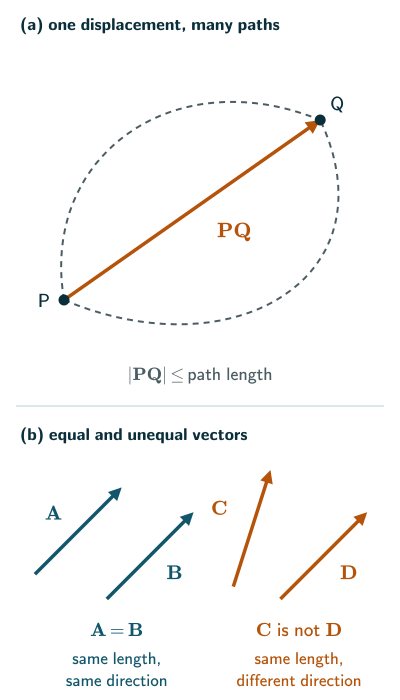
The displacement is the straight arrow joining the initial and final positions, whatever path was actually followed (NCERT Fig. 3.1, page 28). In panel (a) of the figure, an object can go from P to Q along either dashed curve or straight along the arrow; the displacement is PQ every time. So:
- many different paths between the same two points have the same displacement;
- the magnitude of the displacement is less than or equal to the path length, and equal only for straight-line motion without turning back;
- if the object returns to its starting point, its displacement is zero.
NCERT adds that this fact was emphasised in the previous chapter (page 28). In the 2026–27 book, Chapter 2 uses position and displacement but no longer has a section defining them or comparing displacement with path length. The fact survives there only as a summary point (average speed ≥ magnitude of average velocity, page 21), in NCERT Exercise 2.9 (page 25) and in the end-of-chapter table (page 22).
Equality of vectors
Two non-zero vectors A and B are equal if and only if they have the same magnitude and the same direction (NCERT Section 3.2.2, page 28). The zero vector has no specified direction; two zero vectors are equal. Equivalently, equal vectors have matching components in the same coordinate system. To check, slide one parallel to itself until the tails meet: if the tips also meet, the vectors are equal. Two arrows of the same length pointing in different directions are not equal, like C and D in panel (b) of the figure (NCERT Fig. 3.2, page 29).
Vectors that can be moved parallel to themselves without change are free vectors; this is how vectors are used in this chapter. When the point or line of action matters, as for a force turning a body about an axis, the vector is called a localised vector (NCERT footnote, page 28).
A vector can be multiplied by a number, which stretches, shrinks or reverses it. Two vectors can also be multiplied together. One way gives a scalar: the scalar product, used to define work.
Solved examples
Example 1: Scalar or vector? (NCERT Exercise 3.1, page 46)
Classify: volume, mass, speed, acceleration, density, number of moles, velocity, angular frequency, displacement, angular velocity.
Scalars (magnitude only): volume, mass, speed, density, number of moles, angular frequency.
Vectors (magnitude, direction and the triangle law): acceleration, velocity, displacement, angular velocity.
Answer: six scalars and four vectors, as listed.
Example 2: The two scalars (NCERT Exercise 3.2, page 46)
Pick out the two scalars: force, angular momentum, work, current, linear momentum, electric field, average velocity, magnetic moment, relative velocity.
Work is a scalar: it is the scalar product of force and displacement. Current has a direction along the wire but adds algebraically at a junction, so it is a scalar. All the others are vectors.
Answer: work and current.
Example 3: The only vector (NCERT Exercise 3.3, page 46)
Pick out the only vector: temperature, pressure, impulse, time, power, total path length, energy, gravitational potential, coefficient of friction, charge.
Impulse is the change in momentum. For a constant force it equals force × time and points along that force; for a varying force it is the time integral of the force, still a vector. Pressure, though it pushes on surfaces, has no direction of its own: the force it produces is along the normal to whatever surface it acts on. In a fluid at rest, pressure acts equally in all directions at a point. The other eight quantities are scalars too.
Answer: impulse.
Example 4: Displacement and path length (NCERT Exercise 3.8, page 47)
Three girls skate on a circular ice ground of radius 200 m from a point P on the edge to the point Q diametrically opposite, by different paths: one straight along the diameter, two curved. Find the magnitude of each displacement. For whom does it equal the path length?
The displacement is PQ for all three, of magnitude equal to the diameter, 2 × 200 = 400 m.
Answer: 400 m for each; it equals the path length only for the girl who skates straight along the diameter.
Example 5: A round trip in a park (NCERT Exercise 3.9, page 47)
A cyclist starts from the centre O of a circular park of radius 1 km, rides to the edge at P, cycles along the circumference to Q (in NCERT Fig. 3.20, OP and OQ are at right angles, so this is a quarter circle), and returns to O along QO. The trip takes 10 min. Find the net displacement, the average velocity and the average speed.
He ends where he started, so the displacement is zero and so is the average velocity.
Path length = 1 + (2π × 1)/4 + 1 = 2 + π/2 ≈ 3.57 km. Average speed = 3.57 km/(10/60 h) ≈ 21.4 km/h.
Answer: displacement 0, average velocity 0, average speed about 21.4 km/h.
Example 6: The dishonest cabman (NCERT Exercise 3.11, page 47)
A hotel is 10 km from the station along a straight road, but a cabman takes a 23 km route and arrives in 28 min. Find the average speed and the magnitude of the average velocity.
Average speed = 23 km/(28/60 h) ≈ 49.3 km/h. Magnitude of average velocity = 10 km/(28/60 h) ≈ 21.4 km/h.
Answer: about 49.3 km/h and 21.4 km/h. They are not equal, because the path was not straight.
Common mistakes to avoid
Common mistake
Calling anything with a direction a vector
A vector must also add by the triangle law. Current has a direction along the wire but is a scalar.
Common mistake
Thinking a negative quantity must be a vector
Temperature can be −5 °C and charge can be negative, but neither has a direction in space. The sign of a scalar is not a direction.
Common mistake
Taking the size of the displacement as the distance travelled
The displacement joins the start to the end in a straight line. The path length is never less than its magnitude, and is usually more.
Common mistake
Comparing vectors by their lengths alone
Two vectors are equal only if their magnitudes and directions both match. Equal lengths are not enough.
Common mistake
Thinking equal vectors must start at the same point
Free vectors can be moved parallel to themselves. Two equal vectors can be drawn at quite different places.
Quick revision summary
- Scalar: magnitude only (mass, time, temperature, speed, work, current); combine by ordinary algebra.
- Vector: magnitude, direction and the triangle (parallelogram) law of addition (displacement, velocity, acceleration, force).
- Notation: bold A for a vector, A = |A| for its magnitude.
- Position vector r = OP; displacement PP′ joins the start to the end, whatever the path; its magnitude ≤ path length.
- Equal vectors: same magnitude and same direction; free vectors can be moved parallel to themselves.
Formula sheet
- |A| = A (magnitude of vector A)
- displacement = PP′ (initial position to final position)
- |displacement| ≤ path length
- A = B iff corresponding components are equal
Questions students ask
Are vectors in the JEE Main 2027 and NEET (UG) 2026 syllabus?
Yes, vectors are in both the JEE Main 2027 and the NEET (UG) 2026 syllabuses, though the two list them in different places. The NEET (UG) 2026 syllabus names scalars and vectors, vector addition and subtraction, the scalar and vector products, the unit vector and resolution of a vector in Physics Unit 2: Kinematics. The JEE Main 2027 syllabus does not name them in Physics, but its Maths Unit 12 (Vector Algebra) covers vectors and scalars, vector addition, components and the two products, and its Physics Unit 2 lists motion in a plane, projectile motion and uniform circular motion, which all need vectors.
Is weight a scalar or a vector quantity?
Weight is a vector quantity: it is the force of gravity on a body, mg, directed vertically downwards, and it combines with other forces by the triangle law. Mass, by contrast, is a scalar. A 60 kg student has the same mass everywhere, but a weight of about 590 N on the Earth (g = 9.8 m s) and only about one-sixth of that on the Moon.
Is time a scalar or a vector?
Time is a scalar quantity: it has magnitude only, and time intervals add as ordinary numbers, so 20 min followed by 15 min is 35 min. Its flow from past to future is not a direction in space, so time cannot point north or upwards and is never added by the triangle law. Only in the theory of relativity, well beyond Class 11, is time treated as one component of a four-dimensional space-time vector.
Is area a scalar or a vector quantity?
Area is a scalar when only its size matters, such as the 12 m of a floor, but a flat surface can also be represented by an area vector, of magnitude equal to the area and directed along the normal (perpendicular) to the surface. The area vector records how the surface is tilted, which matters when something passes through it: in Class 12, the electric flux through a small surface is E·ΔS. For a closed surface, the normal is taken pointing outwards.
Practice questions
Try each question first, then open the answer to check your working.
-
Q1. Is speed a scalar or a vector? Is velocity?
Show answerHide answer
Speed is a scalar (magnitude only). Velocity is a vector: it has a magnitude, the speed, and a direction.
-
Q2. A man walks 3 km east and then 4 km north. What is his path length, and what is the magnitude of his displacement?
Show answerHide answer
Path length 3 + 4 = 7 km. Displacement magnitude √(3 + 4) = 5 km, less than the path length.
-
Q3. Two vectors each have magnitude 5 units. Must they be equal?
Show answerHide answer
No. They are equal only if they also point in the same direction.