LED, photodiode and solar cell
Beyond NCERT In the JEE Main and NEET syllabus; the Class 12 book has no section for it.
Quick answer
An LED emits light in forward bias; a photodiode detects light in reverse or zero bias; a solar cell delivers power without an external bias source. Band-gap photon energy gives the approximate interband cut-off λmax = hc/Eg, while photocurrent scales with light intensity at a fixed spectrum within the linear range. A power-producing solar cell lies in the fourth quadrant on diode I-V axes; 0.6 V is an example voltage, not a universal maximum.
What are an LED, a photodiode and a solar cell?
Optoelectronic junction devices
An LED (light-emitting diode), a photodiode and a solar cell are p-n junction diodes in which light and charge carriers exchange energy. An LED gives out light when it is forward biased; a photodiode detects light, often with reverse bias but also in zero-bias mode; a solar cell supplies electrical power from light with no external bias source. The US Navy’s public-domain Navy Electricity and Electronics Training Series (NEETS), Module 7, page 3-27, puts it in one line: “OPTOELECTRONIC devices either produce light or use light in their operation.”
The 2026–27 NCERT textbook has no section on these devices: its Chapter 14, still the 2025–26 reprint, ends with rectifiers in Section 14.7. It does describe the two processes they rest on, in an intrinsic semiconductor:
It may be noted that apart from the process of generation of conduction electrons and holes, a simultaneous process of recombination occurs in which the electrons recombine with the holes.
NCERT Physics Part II (Class 12), Section 14.3, page 328
In an LED, recombination gives out light; in a photodiode and a solar cell, light does the generating. The JEE Main 2027 and NEET (UG) 2026 syllabuses list the I-V characteristics of the LED, the photodiode and the solar cell in Unit 19. This page follows NEETS Module 7 and, for facts in our own words, the Wikipedia articles named below, with a Kingbright LED datasheet for the reverse-voltage rating.
In plain words: in an LED an electron that falls into a hole gives up its energy as a flash of light, so the colour depends on the size of the band gap. A photodiode and a solar cell run the same process backwards: light knocks electrons free, and the junction’s field pushes them out as a current. The photodiode uses that current to measure light; the solar cell uses it to deliver power.
Light, photons and the band gap
- Light comes in photons of energy E = hν = hc/λ (NCERT Chapter 11, page 283). A handy form, used on the photon page: E in eV ≈ 1240/λ in nm.
- An electron that drops from the conduction band into a hole in the valence band gives up about the band gap energy Eg. In an LED this comes out as a photon, so the wavelength of the light depends on the band gap (Wikipedia, “Light-emitting diode”).
- The other way round, a photon can free an electron, making an electron-hole pair, in the simple single-photon band-to-band model if hν ≥ Eg (Wikipedia, “Theory of solar cells”). This is an approximate interband threshold; indirect-gap materials also require phonon assistance, and sub-gap absorption by other mechanisms is outside this model (reasoned).
Photon energy and wavelength
Longest wavelength that makes pairs (reasoned)
Light-emitting diode and its I-V characteristic
- An LED is a diode that produces light when forward biased; the colour, such as red, green or amber, depends on the material it is made of (NEETS Module 7, page 3-27).
- How it works: forward bias injects electrons into the p-side and holes into the n-side, as in any forward-biased diode. Near the junction they recombine, and in an LED material the energy given up appears as light, a process called electroluminescence (Wikipedia, “Light-emitting diode”). Within its rated operating range and at controlled temperature, more current generally gives more light; efficiency and heating prevent unlimited proportional growth (reasoned).
- Materials: compound semiconductors such as gallium arsenide (GaAs) for infrared and gallium arsenide phosphide (GaAsP) for red (Wikipedia, “Light-emitting diode”). Ordinary bulk Si and Ge are inefficient band-edge light emitters because their gaps are indirect, and their band-edge photons are infrared: photons of their band gaps, 1.1 eV and 0.7 eV (NCERT page 332), are in the infrared (reasoned; see Example 1).
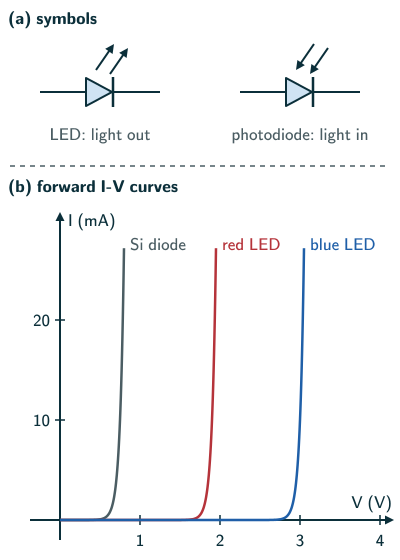
- I-V characteristic: the same shape as a silicon diode’s, but the current starts to rise at a larger voltage. NEETS gives about 1.6 V at about 10 mA (Module 7, page 3-27); Wikipedia’s table gives about 1.6 V to 2.0 V for red LEDs and about 2.5 V to 3.7 V for blue (“Light-emitting diode”). The bluer the light, the larger the photon energy and the larger the threshold: roughly, e times the threshold voltage is about Eg, so a red LED with photons of about 1.9 eV (Example 1) starts to conduct near 1.9 V (reasoned).
- Reverse bias: an LED lights only in forward bias. Its reverse breakdown voltage is low, typically about 5 V, and above it a large current flows and damages the LED (Wikipedia, “Light-emitting diode”). Strictly, the 5 V printed on a datasheet is an absolute-maximum reverse-voltage rating, not a measured breakdown voltage: the Kingbright WP7113ID datasheet lists 5 V as the maximum reverse voltage and allows at most 10 μA of reverse current at 5 V. Follow the manufacturer’s limits.
- In a circuit an LED needs current control, typically a series resistor or a regulated current driver (reasoned; see Example 2). The NCERT Laboratory Manual (Physics, Class 12) suggests plotting the I-V curve of an LED with the circuit of Experiment 16 and comparing the threshold voltages of different coloured LEDs (page 124).
- Advantages over a filament lamp: lower power use, less waste heat, longer life, more robust, smaller and faster to switch (Wikipedia, “Light-emitting diode”). NEETS gives a life of over 105 hours (Module 7, page 3-27); real lifetimes depend on the device, its operating current and temperature (reasoned).
- Symbol: a diode symbol with two arrows pointing away from it, for the light leaving (NEETS Module 7, page 3-27).
Photodiode in reverse bias and its I-V characteristic
- A photodiode is a light-sensitive junction diode operated in reverse bias, with a transparent window over the chip so that light can reach the junction; it conducts in direct proportion to the intensity of the light (NEETS Module 7, page 3-30). Strictly, it can also be used at zero external bias, its photovoltaic mode (Wikipedia, “Photodiode”), and its photocurrent is proportional to the incident optical power only at a fixed spectrum, temperature and active area, within the detector’s linear range (reasoned).
- How it works: a photon with hν ≥ Eg, absorbed in or near the depletion region, creates an electron-hole pair. The junction’s field sweeps the electron to the n-side and the hole to the p-side, giving a photocurrent (Wikipedia, “Photodiode”). The total current is the small dark current, which flows with no light, plus the photocurrent.
- Why reverse bias (reasoned from NCERT pages 335–336): the reverse current is carried by minority carriers and is limited by how many there are. Light creates electron-hole pairs, which multiplies the number of minority carriers many times over while hardly changing the number of majority carriers. So the reverse current changes by a large fraction and is easy to measure; in forward bias, the large current of majority carriers would hide the change. Reverse bias also widens the depletion layer and lowers the junction capacitance, so the response is faster, but it adds dark current and with it more noise, which is why zero bias suits low-noise measurements (Wikipedia, “Photodiode”).
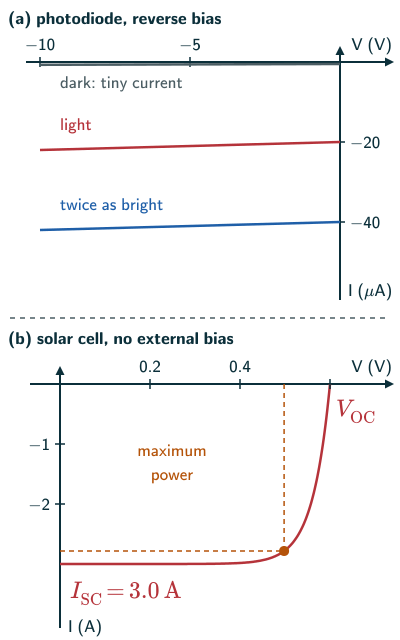
- I-V characteristic (third quadrant): for each light intensity the reverse current is almost independent of the reverse voltage, and it rises in step with the light: at fixed spectrum and within the linear range, double the intensity and the photocurrent doubles (Wikipedia, “Photodiode”; NEETS Module 7, page 3-30).
- Approximate interband cut-off: in the single-photon model, photons with hν ≥ Eg give a photocurrent, so a photodiode responds only to wavelengths up to λmax = hc/Eg: about 1130 nm for silicon (see Example 3).
- Uses: light meters, optical scanners and card readers, because it responds quickly to changes in light (NEETS Module 7, page 3-30). Symbol: a diode symbol with two arrows pointing towards it.
Solar cell and its I-V characteristic
- A solar cell (photovoltaic cell) is a p-n junction that converts light energy into electrical energy (NEETS Module 7, page 3-32). It works with no external bias; in effect it is a photodiode with a very large junction area (Wikipedia, “Photodiode”).
- How it works: a photon with hν ≥ Eg makes an electron-hole pair; the junction’s field drives the electron to the n-side and the hole to the p-side (Wikipedia, “Theory of solar cells”). Charge builds up, the p-side positive and the n-side negative, and this voltage forward biases the junction (Wikipedia, “Photodiode”). Joined to a load, the cell drives a current through it, leaving by the p-side terminal, like a battery.
- One cell gives about 0.45 V; as with batteries, cells are connected in series for a larger voltage and in parallel for a larger current. They power communications satellites and solar-powered homes (NEETS Module 7, page 3-32). NCERT gives no figure. Wikipedia puts an ordinary single-junction silicon cell at about 0.5–0.6 V open-circuit (“Solar cell”), a typical value but not an upper limit: silicon heterojunction cells, whose surfaces are very well passivated, consistently give over 0.7 V (Wikipedia, “Heterojunction solar cell”). The voltage also depends on the light, the temperature and recombination (reasoned).
- I-V characteristic (fourth quadrant): the voltage is positive (p-side positive) but the current is negative, because it flows out of the p-side, opposite to the current of a forward-biased diode. The curve runs from the short-circuit current ISC at V = 0 to the open-circuit voltage VOC at I = 0. The cell gives no power at either end (Wikipedia, “Theory of solar cells”). Many books turn the curve over and draw it in the first quadrant, with the current taken as positive.
- Maximum power is drawn at the knee of the curve, where the rectangle from the origin to a point on the curve, of area VmIm, is largest. The fill factor is the ratio of this maximum delivered power to VOCISC, using positive current magnitudes in the power and fill-factor formulas (Wikipedia, “Solar cell”):
Fill factor of a solar cell
- Light intensity: ISC is the light-generated current, so it grows in proportion to the intensity, while VOC grows only slowly, with its logarithm (Wikipedia, “Theory of solar cells”).
- Material: semiconductors with band gaps between about 1 eV and 1.5 eV are the best for a single-junction cell (Wikipedia, “Solar cell”). Silicon, with 1.1 eV (NCERT page 332), lies in that range.
Solved examples
Example 1: Colour from the band gap
(a) An LED is made from a semiconductor with a band gap of 1.9 eV. Estimate the wavelength of its light. (b) What band gap does a blue LED of 460 nm need? (c) Why can a silicon diode not be a visible LED?
Answer: (a) λ ≈ 1240/1.9 ≈ 650 nm, red light. (b) Eg ≈ 1240/460 ≈ 2.7 eV. (c) Ordinary bulk silicon’s band-edge photons are infrared and its indirect gap makes radiative recombination inefficient: Example 3 on the metals, insulators and semiconductors page finds about 1130 nm (reasoned; E = hc/λ from NCERT page 283).
Example 2: A resistor for an LED
A red LED drops 1.8 V at a current of 15 mA. What series resistor sets that current from a 6.0 V supply?
Answer: The resistor takes 6.0 − 1.8 = 4.2 V, so R = 4.2/0.015 = 280 Ω (reasoned, as for an ordinary diode).
Example 3: Which photodiode sees 1550 nm?
Infrared of 1550 nm is used in optical fibres. Can a silicon photodiode (Eg = 1.1 eV) detect it? A germanium one (0.7 eV)?
Answer: E ≈ 1240/1550 ≈ 0.80 eV. Silicon: 0.80 eV < 1.1 eV, so no; its cut-off is about 1130 nm. Germanium: 0.80 eV > 0.7 eV, so yes: 1550 nm lies within its cut-off (gaps from NCERT page 332; the rest reasoned).
Example 4: Brighter light, more reverse voltage
A photodiode carries 15 μA at a reverse bias of 4 V. The light becomes three times as intense and the reverse bias is raised to 8 V. Estimate the new current.
Answer: About 45 μA: the photocurrent is proportional to the intensity, and almost independent of the reverse voltage (Wikipedia, “Photodiode”; NEETS Module 7, page 3-30). The dark current is small enough to ignore.
Example 5: Power from a solar cell
A solar cell has VOC = 0.60 V and ISC = 3.0 A; its maximum power point is at 0.50 V and 2.8 A. Find the maximum power and the fill factor. What open-circuit voltage do 36 such cells in series give?
Answer: Pmax = 0.50 × 2.8 = 1.4 W. FF = 1.4/(0.60 × 3.0) = 1.4/1.8 ≈ 0.78. In series the voltages add: 36 × 0.60 = 21.6 V, with the same 3.0 A short-circuit current for identical cells under the same illumination and temperature (reasoned; NEETS Module 7, page 3-32, on cells in series).
Common mistakes to avoid
Common mistake
Reverse biasing an LED to make it glow
An LED gives light only in forward bias. Its reverse breakdown is low, typically about 5 V (Wikipedia, “Light-emitting diode”), and beyond it a large current can damage the LED. Strictly, a datasheet’s 5 V is the reverse voltage not to be exceeded, not a measured breakdown voltage (Kingbright WP7113ID datasheet).
Common mistake
Using a photodiode in forward bias
Reverse bias is a common detection mode, but zero-bias photovoltaic operation is also valid. The usual forward current can mask the photocurrent.
Common mistake
Drawing the solar cell curve in the wrong quadrant
A solar cell has no external bias source and supplies power; its own photovoltage forward biases the junction: its voltage is positive and its current negative, so on the usual diode axes its curve is in the fourth quadrant, from ISC to VOC, not in the third like a photodiode’s.
Common mistake
Thinking any light gives a photocurrent
In the introductory single-photon interband model, hν ≥ Eg is the approximate threshold. Raising ordinary sub-threshold illumination does not overcome this energy condition; defect, phonon-assisted and multiphoton processes need a more detailed treatment.
Quick revision summary
- LED: forward biased; electrons and holes recombine and give out light of photon energy about Eg; threshold about 1.6–2.0 V for red and 2.5–3.7 V for blue; low reverse breakdown, typically about 5 V (a datasheet’s 5 V is a reverse-voltage rating, not a measured breakdown).
- Photodiode: commonly reverse biased, or operated at zero external bias; light with hν ≥ Eg makes electron-hole pairs; the reverse current is nearly independent of the reverse voltage and proportional to the intensity.
- Solar cell: no external bias source; the I-V curve is in the fourth quadrant, from ISC (proportional to intensity) to VOC (material- and condition-dependent; 0.6 V is an example, not a maximum); maximum power at the knee.
- Silicon, with a 1.1 eV gap, makes photodiodes for visible light and solar cells, but not visible LEDs, whose band-edge photons are infrared; LEDs use compound semiconductors such as GaAsP.
Formula sheet
- E = hν = hc/λ
- E (eV) ≈ 1240/λ (nm)
- λmax = hc/Eg
- Pmax = Vm Im
- FF = Pmax/(VOC ISC)
Questions students ask
Are the LED, photodiode and solar cell in the JEE Main and NEET syllabus?
Yes, the LED, the photodiode and the solar cell are in both syllabuses: Unit 19, Electronic Devices, of the JEE Main syllabus lists the “I-V characteristics of LED, the photodiode, solar cell”, and the NEET (UG) 2026 syllabus lists the same three in its Unit 19. The current NCERT Class 12 Physics Part II, still the 2025–26 reprint, has no section on any of them; the nearest it comes is the generation and recombination of electrons and holes in Section 14.3 (page 328). Their I-V curves are not Unit 20 experiments, though the LED is one of the parts in Unit 20’s identification activity.
What is the difference between an LED and an ordinary diode?
An LED differs from an ordinary silicon diode, beyond the NCERT text, in its material: in a compound semiconductor such as gallium arsenide phosphide the energy given up when an electron and a hole recombine comes out as light, while in silicon it goes mostly into heat. Its wider band gap also gives it a larger forward threshold, about 1.6–2.0 V for red, against NCERT’s 0.7 V for silicon (page 337), and its allowed reverse voltage can be much lower than a rectifier’s, as its reverse breakdown voltage is low (Wikipedia, “Light-emitting diode”).
What is the difference between an LED and a photodiode?
An LED and a photodiode do opposite jobs, beyond the NCERT text: an LED is forward biased and turns electrical energy into light as electrons and holes recombine, while a photodiode is operated in reverse or zero bias and turns light into a current, its reverse current growing in proportion to the light (US Navy, NEETS Module 7, pages 3-27 and 3-30; Wikipedia, “Photodiode”). The two often work as a pair: in an optical coupler an LED’s light drives a photodiode, so a signal passes between two circuits that have no electrical connection (NEETS page 3-32). Reverse biased, an LED can itself work as a light sensor, picking up only a narrow range of wavelengths (Wikipedia, “Light-emitting diode”).
What is the difference between a photodiode and a solar cell?
A photodiode and a solar cell differ, beyond the NCERT text, in use rather than principle: in both, light makes electron-hole pairs that the junction’s field separates, but photodiodes are optimised to measure light (in reverse or zero bias), while solar cells are optimised to deliver power with no external bias source; physical size alone does not define the distinction (Wikipedia, “Photodiode”). Reverse bias makes the photodiode respond fast, with its curve in the third quadrant; the solar cell sets up its own forward voltage and works near the knee of its fourth-quadrant curve. At zero bias, in photovoltaic mode, a photodiode is in effect a tiny solar cell.
What is the efficiency of a solar cell, and why is it low?
The efficiency of a solar cell, beyond the NCERT text, is the electrical power it delivers divided by the light power falling on it (US DOE, “Solar Photovoltaic Cell Basics”): a cell of area 0.0225 m in sunlight of 1000 W m receives 22.5 W, so if it gives 4.05 W at its maximum power point its efficiency is 18%. The band gap sets the main limit: sub-gap photons do not produce usable band-to-band carriers in the ideal model, and photons above it lose their extra energy as heat, so the detailed-balance ideal single-junction limit under unconcentrated terrestrial sunlight is about 33%, the Shockley–Queisser limit, at Eg ≈ 1.34 eV (Wikipedia, “Shockley–Queisser limit”). Cells stacking several band gaps exceed it, some above 45% (US DOE).
Practice questions
Try each question first, then open the answer to check your working.
-
Q1. Why is a photodiode operated in reverse bias?
Show answerHide answer
In reverse bias the current is carried by minority carriers and is small. Light creates electron-hole pairs, which multiplies the minority carriers many times over, so the reverse current changes by a large fraction and measures the light. In forward bias the large current of majority carriers would hide the change (reasoned from NCERT pages 335–336).
-
Q2. In which quadrant does the I-V characteristic of a solar cell lie, and why?
Show answerHide answer
The fourth: the voltage across the cell is positive, with the p-side positive, but the current flows out of the p-side into the load, so it is negative. The cell is a source of power, not a load.
-
Q3. An LED gives yellow light of 590 nm. What is the energy of each photon, in eV?
Show answerHide answer
E ≈ 1240/590 ≈ 2.1 eV.