Determinant of a square matrix
NCERT Class 12 Mathematics Chapter 4 Sections 4.1–4.2
Quick answer
The determinant |A| of a square matrix is a number: for a 2 × 2 matrix with rows a, b and c, d it is ad − bc, and for order 3 it is found by expanding along any row or column, multiplying each element by the 2 × 2 determinant left after deleting its row and column, with signs following a chessboard pattern that starts with + in the top left. Every row or column gives the same value, so choose the one with the most zeros. For a matrix of order n, |kA| = k|A|.
With your textbook
NCERT Mathematics Part I (Class 12), Chapter 4 “Determinants”, Sections 4.1–4.2 “Introduction” and “Determinant”, pages 76–82.
Open the official NCERT chapter (PDF, 2.1 MB, ncert.nic.in) (opens in a new tab)
Checked against the 2026-27 reprint on .
What is a determinant?
Determinant
To every square matrix A = [a] of order n, we can associate a number (real or complex) called determinant of the square matrix A, where a = (i, j)th element of A.
NCERT Mathematics Part I (Class 12), Section 4.2, page 76
- The determinant of A is written |A|, det A or Δ. It is read “determinant of A”, not “modulus of A” (NCERT page 77).
- Only square matrices have determinants.
In plain words: a determinant turns a square array of numbers into a single number. For the equations ax + by = c and ax + by = c, the number ab − ab decides whether there is exactly one solution, that is whether the two lines meet in exactly one point: there is when it is not 0 (NCERT Section 4.1, page 76). That number is the determinant of the coefficient matrix.
Determinants of order 1 and 2
For a 1 × 1 matrix, |[a]| = a (NCERT Section 4.2.1). For a 2 × 2 matrix, multiply along the diagonals and subtract:
Determinant of order 2
|a b; c d| = ad − bc
Here the matrix with rows a, b and c, d is written inside straight bars. NCERT Example 1 (page 77):
NCERT Example 2: the determinant with rows x, x + 1 and x − 1, x is x2 − (x2 − 1) = 1, whatever x is.
Determinants of order 3
A 3 × 3 determinant is expanded along a row or a column, using 2 × 2 determinants (NCERT Section 4.2.3, pages 77–80). Along the first row,
|A| = a11D1 − a12D2 + a13D3,
where D1, D2 and D3 are the 2 × 2 determinants left when row 1 and the column of a11, a12 or a13 are deleted:
Each element aij is multiplied by the 2 × 2 determinant left when its row and column are deleted, and by the sign (−1)i + j: + when i + j is even, − when it is odd. The signs form a chessboard pattern, starting with + in the top left corner.
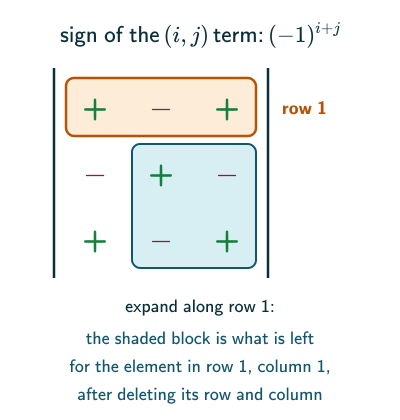
Hence, expanding a determinant along any row or column gives same value.
NCERT Mathematics Part I (Class 12), Section 4.2.3, page 80
So choose the row or column with the most zeros (NCERT’s Remark (i), page 80). NCERT Example 3 (page 80): the determinant with rows 1, 2, 4; −1, 3, 0; 4, 1, 0 has two zeros in column 3, so only one term survives:
The determinant of kA
Multiplying a matrix by k multiplies every row by k, and each row contributes one factor k. So for a square matrix of order n:
Determinant of a scalar multiple
|kA| = k |A|
NCERT’s Remark (iii) (page 80): A with rows 2, 2 and 4, 0 is 2B, where B has rows 1, 1 and 2, 0. Then |A| = 0 − 8 = −8 and |B| = 0 − 2 = −2, and indeed −8 = 22 × (−2). It is 22, not 2: a common mistake is to write |2A| = 2|A|.
Properties of determinants (JEE)
Beyond the NCERT text: the 2026–27 book omits the former general section on properties of determinants, although it still gives individual results such as |kA| = kn|A| and the determinant of a product. The JEE Main 2027 syllabus (Unit 3) lists the evaluation of determinants, and these properties make it quicker. Each can be checked by expanding.
NCERT slip (pages 76 and 101): the Introduction still says “we will study various properties of determinants”, and the Summary prints “For any square matrix A, the |A| satisfy following properties.” with no properties after it. These are remnants of the removed section; individual results still appear elsewhere in the chapter.
- |A′| = |A|: transposing exchanges all rows with the corresponding columns without changing the determinant.
- Interchanging two rows (or two columns) changes the sign of the determinant.
- If two rows (or two columns) are equal, the determinant is 0.
- A factor common to every element of a row (or column) can be taken outside the determinant.
- Adding k times one row to another row (or k times one column to another column) does not change the determinant.
For example, the determinant with rows 1, 2, 3; 4, 5, 6; 7, 8, 9 is 0: subtracting row 2 from row 3 and row 1 from row 2 leaves two equal rows 3, 3, 3.
Solved examples
Example 1: Order-two determinants (NCERT Exercise 4.1, Q1 and Q2)
Evaluate (i) the determinant with rows 2, 4 and −5, −1; (ii) the determinant with rows cos θ, −sin θ and sin θ, cos θ; (iii) the determinant with rows x2 − x + 1, x − 1 and x + 1, x + 1.
(i) 2(−1) − 4(−5) = −2 + 20. (ii) cos2 θ + sin2 θ. (iii) (x2 − x + 1)(x + 1) − (x − 1)(x + 1) = (x3 + 1) − (x2 − 1).
Answer: (i) 18; (ii) 1; (iii) x3 − x2 + 2.
Example 2: A zero sum of products (NCERT Example 4, pages 80–81)
Evaluate the determinant Δ below.
Along row 1, the first term is 0. The second is −sin α (0 − sin β cos α) = sin α sin β cos α. The third is −cos α (sin α sin β − 0) = −cos α sin α sin β.
Answer: Δ = 0. (The matrix is skew symmetric of odd order; beyond the NCERT text, every such determinant is 0, because |A| = |A′| = |−A| = (−1)3|A|.)
Example 3: Solving for x (NCERT Example 5, page 81)
Find x if the determinant with rows 3, x and x, 1 equals the determinant with rows 3, 2 and 4, 1.
3 − x2 = 3 − 8, so x2 = 8.
Answer: x = ±2√2.
Example 4: Expanding along a convenient line (NCERT Exercise 4.1, Q5 (i) and (ii))
Evaluate the two determinants below.
(i) Row 2 has two zeros. Its only term is −1 in position (2, 3), with sign (−1)5 = −1 and minor (3)(−5) − (−1)(3) = −12. So Δ = (−1)(−1)(−12) = −12.
(ii) Along row 1: 3(1 + 6) + 4(1 + 4) + 5(3 − 2) = 21 + 20 + 5.
Answer: (i) −12; (ii) 46.
Example 5: |3A| = 27|A| (NCERT Exercise 4.1, Q4)
A has rows 1, 0, 1; 0, 1, 2; 0, 0, 4. Show that |3A| = 27|A|.
A is upper triangular, so expanding down column 1 again and again gives |A| = 1 × 1 × 4 = 4. 3A has rows 3, 0, 3; 0, 3, 6; 0, 0, 12, so |3A| = 3 × 3 × 12 = 108.
Answer: |3A| = 108 = 27 × 4 = 33|A|.
Common mistakes to avoid
Common mistake
Writing |kA| = k|A|
Each of the n rows carries a factor k, so |kA| = kn|A|. For a 3 × 3 matrix, |2A| = 8|A|.
Common mistake
Forgetting the minus sign in the middle
Along row 1 the signs are +, −, +. Leaving out the − on the a12 term is the commonest slip in 3 × 3 expansions. Use the chessboard of signs for other rows and columns: row 2 starts with −.
Common mistake
Taking |A| as a modulus
|A| can be negative, as in NCERT Example 3 (−52). The bars here mean determinant, not absolute value.
Quick revision summary
- Only square matrices have determinants; |A|, det A and Δ all mean the determinant.
- Order 2: ad − bc. Order 3: expand along any row or column, with signs (−1)i + j in a chessboard pattern; choose the line with the most zeros.
- |kA| = kn|A| for a matrix of order n.
Formula sheet
- |a b; c d| = ad − bc
- order 3: expand along any row or column; each term is an element times its 2 × 2 determinant
- sign of the (i, j) term: (−1)i+j
- |kA| = k|A| for A of order n
Questions students ask
What does the determinant of a matrix represent geometrically?
Beyond the NCERT text, the determinant of a 2 × 2 matrix is a signed area: its absolute value is the area of the parallelogram with a corner at the origin and the two rows as its sides, and it is positive when the shorter turn from the first row to the second is anticlockwise (Wikipedia, “Determinant”). For rows 4, 1 and 2, 3 it is 12 − 2 = 10, the area of the parallelogram with vertices (0, 0), (4, 1), (6, 4) and (2, 3), and swapping the rows gives −10. Likewise a 3 × 3 determinant is, up to sign, the volume of the box (parallelepiped) on its three rows, and the area of a triangle is half the absolute value of one with rows x, y, 1.
When is the determinant of a matrix zero?
Beyond the NCERT text, the determinant of a square matrix is 0 exactly when one row (or column) is a sum of multiples of the others, as when a row is all zeros or two rows are equal or proportional (Wikipedia, “Determinant”); such a matrix is singular and has no inverse. The matrix with rows 2, 1, 3; 1, 0, 2 and 3, 1, 5 has determinant 2(0 − 2) − 1(5 − 6) + 3(1 − 0) = 0, because its third row is the sum of the first two.
How do you find the determinant of a 4 × 4 matrix?
A 4 × 4 determinant, beyond NCERT and the JEE Main syllabus’s “order two and three”, is found by the same expansion as order 3: multiply each element of one row or column by its cofactor, now a 3 × 3 determinant with the sign (−1)i + j, and add the four products. For rows 2, 0, 0, 0; 1, 3, 1, 0; 4, 2, 1, 1 and 5, 1, 0, 2, row 1 leaves only 2 times the determinant with rows 3, 1, 0; 2, 1, 1 and 1, 0, 2, which is 3(2 − 0) − 1(4 − 1) = 3, so it is 6. A full expansion has 24 products, so create zeros first with the properties.
What is the difference between a determinant and a discriminant?
A determinant is a number found from a square matrix, while the discriminant D = b2 − 4ac of a quadratic ax2 + bx + c with real coefficients decides the nature of its roots: real and different for D > 0, real and equal for D = 0, non-real for D < 0. Beyond the NCERT text, the two are linked, as D is −4 times the determinant of the matrix with rows a, b/2 and b/2, c: for x2 + 6x + 5 that matrix has rows 1, 3 and 3, 5, and −4(5 − 9) = 16, which is D = 36 − 20. A determinant and a matrix are compared on the matrix page.
Are the properties of determinants deleted from NCERT Class 12, and are they in the JEE Main 2027 syllabus?
Yes, the properties of determinants were deleted from NCERT Class 12 Mathematics: NCERT’s 2022 list of rationalised content (page 43) drops the old Section 4.3, Properties of Determinants, from Chapter 4, and the 2026–27 reprint has no section on them, although its Introduction still promises them (page 76). The JEE Main 2027 syllabus, Unit 3, does not name them either; it lists “determinants and matrices of order two and three, evaluation of determinants”. They are often the quickest way to evaluate a determinant, which makes the main properties worth learning for JEE, such as |A′| = |A| and the change of sign when two rows are interchanged.
Practice questions
Try each question first, then open the answer to check your working.
-
Q1. Evaluate the determinants with rows (i) 0, 1, 2; −1, 0, −3; −2, 3, 0 and (ii) 2, −1, −2; 0, 2, −1; 3, −5, 0 (NCERT Exercise 4.1, Q5 (iii) and (iv)).
Show answerHide answer
(i) Along row 1: 0 − 1(0 − 6) + 2(−3 − 0) = 6 − 6 = 0. (It is skew symmetric of order 3.) (ii) Along row 1: 2(0 − 5) + 1(0 + 3) − 2(0 − 6) = −10 + 3 + 12 = 5.
-
Q2. Find |A| for A with rows 1, 1, −2; 2, 1, −3; 5, 4, −9 (NCERT Exercise 4.1, Q6).
Show answerHide answer
Along row 1: 1(−9 + 12) − 1(−18 + 15) − 2(8 − 5) = 3 + 3 − 6 = 0.
-
Q3. Find x if (i) the determinants with rows 2, 4; 5, 1 and 2x, 4; 6, x are equal; (ii) the determinants with rows 2, 3; 4, 5 and x, 3; 2x, 5 are equal (NCERT Exercise 4.1, Q7).
Show answerHide answer
(i) 2 − 20 = 2x2 − 24, so x2 = 3 and x = ±√3. (ii) 10 − 12 = 5x − 6x, so −2 = −x and x = 2.
-
Q4. If the determinant with rows x, 2 and 18, x equals the one with rows 6, 2 and 18, 6, then x is (A) 6; (B) ±6; (C) −6; (D) 0 (NCERT Exercise 4.1, Q8).
Show answerHide answer
x2 − 36 = 36 − 36 = 0, so x = ±6: (B).