Minors and cofactors
NCERT Class 12 Mathematics Chapter 4 Section 4.4
Quick answer
The minor M of an element a is the determinant left after deleting row i and column j, and its cofactor is A = (−1) M, so the two differ only in sign, and only when i + j is odd. A determinant equals the sum of the products of the elements of any row or column with their own cofactors, while the elements of one row times the cofactors of another row add up to 0.
With your textbook
NCERT Mathematics Part I (Class 12), Chapter 4 “Determinants”, Section 4.4 “Minors and Cofactors”, pages 84–87.
Open the official NCERT chapter (PDF, 2.1 MB, ncert.nic.in) (opens in a new tab)
Checked against the 2026-27 reprint on .
What are minors and cofactors?
Minor and cofactor
Minor of an element a of a determinant is the determinant obtained by deleting its ith row and jth column in which element a lies.
NCERT Mathematics Part I (Class 12), Section 4.4, page 84
- The minor of aij is written Mij. For a determinant of order n (n ≥ 2), every minor is a determinant of order n − 1 (NCERT’s Remark, page 84).
- The cofactor of aij is Aij = (−1)i + j Mij (NCERT Definition 2, page 84).
In plain words: the minor is what is left of the determinant when the element’s row and column are covered up, and the cofactor is that minor with a sign attached. The sign is + when i + j is even and − when it is odd, the same chessboard of signs used to expand a 3 × 3 determinant. So in a 3 × 3 determinant a cofactor equals its minor at positions (1, 1), (1, 3), (2, 2), (3, 1) and (3, 3), and is its negative at the other four.
Finding minors and cofactors
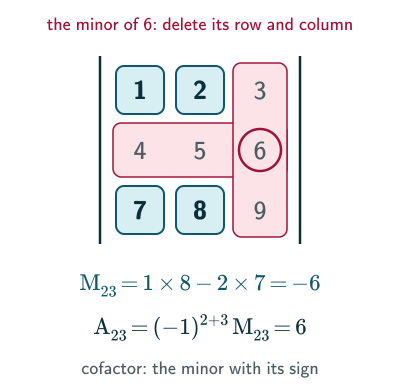
NCERT Example 8 (page 84) asks for the minor of the element 6 in
The 6 is in row 2 and column 3. Deleting them leaves 1, 2 and 7, 8, so M23 = 1 × 8 − 2 × 7 = −6. Since 2 + 3 = 5 is odd, its cofactor is A23 = (−1)5(−6) = 6.
In a 2 × 2 determinant each minor is a single element, the one diagonally opposite. NCERT Example 9 (page 84): for the determinant with rows 1, −2 and 4, 3, the minors are M11 = 3, M12 = 4, M21 = −2 and M22 = 1, and the cofactors are A11 = 3, A12 = −4, A21 = 2 and A22 = 1.
Expanding a determinant with cofactors
Each term in the expansion of a determinant along a row is an element times its minor times a sign, that is, an element times its cofactor. So along row 1 (NCERT’s Remark, page 85):
Expansion by cofactors
Δ = aA + aA + aA
The same holds along any of the six rows and columns: Δ is the sum of the products of the elements of any row (or column) with their own cofactors (NCERT page 85). For NCERT Example 10 (page 85), the general 3 × 3 determinant with elements aij, this gives M11 = A11 = a22a33 − a23a32, while M21 = a12a33 − a13a32 and A21 = −M21.
NCERT slip (page 85): the Remark begins “Expanding the determinant Δ, in Example 21”; Chapter 4 has only 19 examples, and the determinant meant is the one of Example 10 just above it.
Elements times the wrong cofactors give 0
If elements of a row (or column) are multiplied with cofactors of any other row (or column), then their sum is zero.
NCERT Mathematics Part I (Class 12), Section 4.4, page 85
The reason: the cofactors of row 2 do not involve row 2 at all. So a11A21 + a12A22 + a13A23 is the expansion along row 2 of the determinant whose row 2 has been replaced by a copy of row 1. That determinant has two equal rows, so it is 0.
NCERT slip (page 85): in the Note, this sum is labelled Δ, although it is 0 and not the determinant Δ, and its terms carry the signs (−1)1 + 1, (−1)1 + 2, (−1)1 + 3. Cofactors of row 2 carry (−1)2 + 1, (−1)2 + 2, (−1)2 + 3, which changes the sign of every term. Since the sum is 0 either way, NCERT’s conclusion stands.
This fact is what makes the adjoint of a matrix work, in the next section of NCERT.
Solved examples
Example 1: All nine cofactors (NCERT Example 11, page 86)
Find the minors and cofactors of the elements of the determinant below, and verify that a11A31 + a12A32 + a13A33 = 0.
For example, M11 = 0(−7) − 4(5) = −20 and M12 = 6(−7) − 4(1) = −46. Row by row, the minors are −20, −46, 30; −4, −19, 13; −12, −22, 18. Changing the sign where i + j is odd, the cofactors are −20, 46, 30; 4, −19, −13; −12, 22, 18. Then a11A31 + a12A32 + a13A33 = 2(−12) + (−3)(22) + 5(18) = −24 − 66 + 90.
Answer: the sum is 0. With the right cofactors, row 1 gives the determinant itself: 2(−20) + (−3)(46) + 5(30) = −28.
Example 2: A general 2 × 2 determinant (NCERT Exercise 4.3, Q1 (ii))
Write the minors and cofactors of the elements of the determinant with rows a, c and b, d.
Each minor is the element diagonally opposite: M11 = d, M12 = b, M21 = c, M22 = a. The cofactors at (1, 2) and (2, 1) change sign.
Answer: A11 = d, A12 = −b, A21 = −c, A22 = a.
Example 3: A symbolic determinant (NCERT Exercise 4.3, Q4)
Using cofactors of elements of the third column, evaluate the determinant below.
The cofactors of column 3 are A13 = +(z − y), A23 = −(z − x) = x − z and A33 = +(y − x). So Δ = yz(z − y) + zx(x − z) + xy(y − x). Grouping by powers of x: Δ = x2(z − y) + x(y2 − z2) + yz(z − y) = (z − y)[x2 − (y + z)x + yz] = (z − y)(x − y)(x − z).
Answer: Δ = (x − y)(y − z)(z − x).
Example 4: Choose the correct answer (NCERT Exercise 4.3, Q5)
If Δ is the determinant with elements aij and Aij is the cofactor of aij, then Δ is (A) a11A31 + a12A32 + a13A33; (B) a11A11 + a12A21 + a13A31; (C) a21A11 + a22A12 + a23A13; (D) a11A11 + a21A21 + a31A31.
(A) and (C) mix one row with another row’s cofactors, so they are 0. (B) pairs elements of row 1 with cofactors of column 1, which is not an expansion. (D) is column 1 times its own cofactors.
Answer: (D).
Example 5: A trigonometric determinant (beyond NCERT)
Evaluate the determinant with rows cos x, sin x, 0; sin y, cos y, 0; 0, 0, 1.
Expand along row 3, which has two zeros: only a33 = 1 contributes. Its sign is (−1)3 + 3 = +1, so its cofactor is the minor, A33 = cos x cos y − sin x sin y. By the formula for cos (x + y), this is cos (x + y).
Answer: Δ = 1 × A33 = cos (x + y).
Common mistakes to avoid
Common mistake
Forgetting the sign of the cofactor
The cofactor uses a + sign when i + j is even and a − sign when it is odd. A zero minor is unchanged by either sign. In NCERT Example 9, M12 = 4 but A12 = −4.
Common mistake
Deleting the wrong row and column
For M23, delete row 2 and column 3. In Example 1, M23 = 13 but M32 = −22, so swapping the two indices gives a different number.
Common mistake
Pairing a row with another row’s cofactors
Elements of one row times cofactors of a different row always give 0, not Δ. In Example 1, row 1 with the cofactors of row 3 gives 0, while row 1 with its own cofactors gives −28.
Quick revision summary
- The minor Mij of aij is the determinant left after deleting row i and column j; its cofactor is A = (−1) M.
- A determinant is the sum of the products of the elements of any row or column with their own cofactors.
- Elements of one row (or column) times the cofactors of another row (or column) add up to 0.
Formula sheet
- Aij = (−1)i+j Mij
- Δ = a11A11 + a12A12 + a13A13 (any row or column works the same way)
- a11A21 + a12A22 + a13A23 = 0 (a row with another row’s cofactors)
Questions students ask
What is the difference between a minor and a cofactor?
The minor Mij of aij is the plain determinant left after deleting its row and column, while the cofactor Aij = (−1)i + j Mij is that minor with the sign of its position attached, so the two are always equal or opposite. The minor is what you calculate and the cofactor what you use, since with the sign built in a determinant is just the sum of elements times cofactors along any row or column. For the determinant with rows 2, 1, 4; 3, 5, 1 and 0, 6, 2, the element 6 has minor 2 × 1 − 4 × 3 = −10 but cofactor 10, and the element 5 has minor and cofactor 2 × 2 − 4 × 0 = 4.
Does the cofactor of an element depend on the element itself?
No, the cofactor Aij does not depend on aij, or on any other element of row i or column j, because those are exactly the elements deleted to form the minor. So expanding along row i writes Δ as aijAij plus terms free of aij, and increasing aij by t increases Δ by tAij. For the determinant with rows 1, 2, 0; 3, 4, 1 and 0, 5, 2, Δ = 1(8 − 5) − 2(6 − 0) = −9 and A22 = 1 × 2 − 0 × 0 = 2, so changing the 4 to 7 gives −9 + 3 × 2 = −3, as expanding the new determinant confirms.
What is a principal minor of a matrix?
A principal minor, a term beyond the NCERT text, is the determinant left after deleting rows and columns with the same numbers, so that its diagonal lies on the diagonal of the matrix; the leading principal minors are the ones in the top left corner, of orders 1, 2, 3 and so on (Wikipedia, “Minor (linear algebra)”). In NCERT’s notation, the principal minors of order 2 of a 3 × 3 matrix are M11, M22 and M33, the minors of the diagonal elements. For the matrix with rows 2, 1, 0; 1, 3, 1 and 0, 1, 4, the leading principal minors are 2, 2 × 3 − 1 × 1 = 5 and the determinant itself, 18, while M11, M22 and M33 are 11, 8 and 5.
Can a non-square matrix have minors?
Yes, beyond the NCERT text, a minor of any matrix, square or not, is the determinant of a square block formed by choosing some of its rows and the same number of its columns (Wikipedia, “Minor (linear algebra)”), but only a square matrix has a minor and a cofactor for every element. A 2 × 3 matrix has three minors of order 2, one for each pair of columns: for rows 1, 3, 2 and 2, 1, 4 they are 1 × 1 − 3 × 2 = −5, 1 × 4 − 2 × 2 = 0 and 3 × 4 − 2 × 1 = 10, and the largest order of a non-zero minor is the matrix’s rank, here 2. Cofactors, the adjoint and expansion by cofactors all need a square matrix, since they come from its determinant.
Practice questions
Try each question first, then open the answer to check your working.
-
Q1. Write the minors and cofactors of the elements of the determinant with rows 2, −4 and 0, 3 (NCERT Exercise 4.3, Q1 (i)).
Show answerHide answer
M11 = 3, M12 = 0, M21 = −4, M22 = 2. A11 = 3, A12 = 0, A21 = 4, A22 = 2.
-
Q2. Write the minors and cofactors of the elements of the determinant with rows 1, 0, 4; 3, 5, −1; 0, 1, 2 (NCERT Exercise 4.3, Q2 (ii)).
Show answerHide answer
Minors, row by row: 11, 6, 3; −4, 2, 1; −20, −13, 5. Cofactors: 11, −6, 3; 4, 2, −1; −20, 13, 5. Check along row 1: 1(11) + 0(−6) + 4(3) = 23, and along column 2: 0(−6) + 5(2) + 1(13) = 23.
-
Q3. Using cofactors of elements of the second row, evaluate the determinant with rows 5, 3, 8; 2, 0, 1; 1, 2, 3 (NCERT Exercise 4.3, Q3).
Show answerHide answer
A21 = −(3 × 3 − 8 × 2) = 7, A22 = +(5 × 3 − 8 × 1) = 7, A23 = −(5 × 2 − 3 × 1) = −7. So Δ = 2(7) + 0(7) + 1(−7) = 7.
-
Q4. For the determinant of NCERT Example 8 (rows 1, 2, 3; 4, 5, 6; 7, 8, 9), find A11, A12 and A13, and use them to evaluate it.
Show answerHide answer
A11 = 45 − 48 = −3, A12 = −(36 − 42) = 6, A13 = 32 − 35 = −3. So Δ = 1(−3) + 2(6) + 3(−3) = 0. (Row 3 minus row 2 equals row 2 minus row 1, which is why it is 0: a property of determinants, beyond the NCERT text.)