Adjoint and inverse of a matrix
NCERT Class 12 Mathematics Chapter 4 Section 4.5
Quick answer
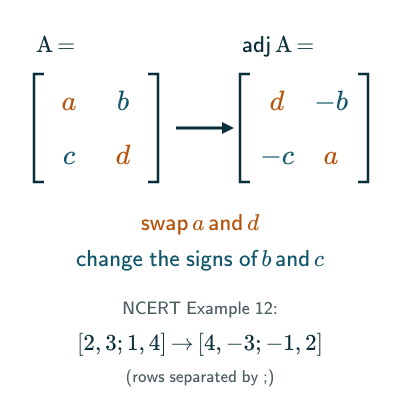
The adjoint adj A of a square matrix is the transpose of its matrix of cofactors, and A(adj A) = (adj A)A = |A| I. So A is invertible exactly when |A| ≠ 0, and then A = (1/|A|) adj A. For a 2 × 2 matrix, adj A comes from swapping the two diagonal elements and changing the signs of the other two.
With your textbook
NCERT Mathematics Part I (Class 12), Chapter 4 “Determinants”, Section 4.5 “Adjoint and Inverse of a Matrix”, pages 87–93.
Open the official NCERT chapter (PDF, 2.1 MB, ncert.nic.in) (opens in a new tab)
Checked against the 2026-27 reprint on .
What is the adjoint of a matrix?
Adjoint of a square matrix
The adjoint of a square matrix A = [a] × is defined as the transpose of the matrix [A] × , where A is the cofactor of the element a.
NCERT Mathematics Part I (Class 12), Section 4.5.1, page 87
- The adjoint is written adj A (NCERT Definition 3).
- A square matrix A is singular if |A| = 0 and non-singular if |A| ≠ 0 (NCERT Definitions 4 and 5, page 89).
In plain words: replace every element of A by its cofactor, then turn the rows into columns. For a 3 × 3 matrix, the cofactors of row 1 become column 1 of adj A:
The 2 × 2 shortcut. For a matrix of order 2, the cofactors are signed single entries, and adj A comes from swapping the two diagonal elements and changing the signs of the other two (NCERT’s Remark, page 88). NCERT Example 12: for A with rows 2, 3 and 1, 4, the cofactors are A11 = 4, A12 = −1, A21 = −3 and A22 = 2, so adj A has rows 4, −3 and −1, 2.
A(adj A) = |A| I
NCERT Theorem 1 (page 88): for any square matrix A of order n,
The adjoint identity
A(adj A) = (adj A)A = |A| I
Why: the (i, j)th element of A(adj A) is row i of A times column j of adj A, and column j of adj A holds the cofactors of row j of A. When i = j, this is a row times its own cofactors, which is |A|. When i ≠ j, it is a row times another row’s cofactors, which is 0. So every diagonal element is |A| and every other element is 0.
For the 2 × 2 matrix with rows a, b and c, d, A(adj A) has rows ad − bc, −ab + ba and cd − dc, −cb + da, that is (ad − bc)I.
Singular matrices and |AB| = |A||B|
NCERT’s examples (page 89): the matrix with rows 1, 2 and 4, 8 has determinant 8 − 8 = 0, so it is singular; the matrix with rows 1, 2 and 3, 4 has determinant 4 − 6 = −2 ≠ 0, so it is non-singular.
The determinant of the product of matrices is equal to product of their respective determinants
NCERT Mathematics Part I (Class 12), Section 4.5, page 89
That is, |AB| = |A||B| for square matrices of the same order (NCERT Theorem 3, stated without proof). So if A and B are non-singular, so are AB and BA (NCERT Theorem 2). Taking determinants of (adj A)A = |A| I for a 3 × 3 matrix gives |adj A||A| = |A|3, so |adj A| = |A|2 when |A| ≠ 0 (NCERT’s Remark, pages 89–90). In general, for a matrix of order n ≥ 2 (including singular matrices):
Determinant of the adjoint
|adj A| = |A|
For a singular matrix, cancellation by |A| is unavailable. The identity still holds because both sides are polynomials in the entries and agree for every nonsingular matrix; one may approach a singular matrix by nonsingular ones.
Beyond the NCERT text (JEE): |adj (adj A)| = |A|(n − 1)², and since each cofactor of kA is kn − 1 times that of A, adj (kA) = kn − 1 adj A. For a 3 × 3 matrix with |A| = 3, |adj A| = 9 and |adj (adj A)| = 81. But |A + B| is not |A| + |B|: for A = B = I of order 2, |A + B| = |2I| = 4.
The inverse from the adjoint
A square matrix A is invertible if and only if A is nonsingular matrix.
NCERT Mathematics Part I (Class 12), Section 4.5, page 90
NCERT Theorem 4 (page 90). If A is invertible, AB = I for some B, so |A||B| = |I| = 1 and |A| cannot be 0. Conversely, if |A| ≠ 0, divide A(adj A) = (adj A)A = |A| I by |A|:
Inverse of a matrix
A = (1/|A|) adj A, when |A| ≠ 0
As with an invertible function, the inverse undoes A from either side: AA = AA = I. For a 2 × 2 matrix with rows a, b and c, d and ad − bc ≠ 0, the formula gives 1/(ad − bc) times the matrix with rows d, −b and −c, a. Taking determinants of AA = I also gives |A| = 1/|A|.
Solved examples
Example 1: A 3 × 3 inverse (NCERT Example 13, pages 90–91)
For the matrix A below, verify that A(adj A) = |A| I and find A.
|A| = 1(16 − 9) − 3(4 − 3) + 3(3 − 4) = 7 − 3 − 3 = 1. The cofactors are A11 = 7, A12 = −1, A13 = −1, A21 = −3, A22 = 1, A23 = 0, A31 = −3, A32 = 0, A33 = 1. Writing the cofactors of each row as a column,
Row 1 of A times the columns of adj A gives 7 − 3 − 3 = 1, −3 + 3 + 0 = 0 and −3 + 0 + 3 = 0, and the other rows work out the same way, so A(adj A) = I = |A| I.
Answer: since |A| = 1, A = adj A, the matrix with rows 7, −3, −3; −1, 1, 0; −1, 0, 1.
Example 2: (AB) = BA (NCERT Example 14, page 91)
A has rows 2, 3 and 1, −4, and B has rows 1, −2 and −1, 3. Verify that (AB) = BA.
AB has rows 2 − 3, −4 + 9 and 1 + 4, −2 − 12, that is −1, 5 and 5, −14, with |AB| = 14 − 25 = −11. So (AB) = −(1/11) times the matrix with rows −14, −5 and −5, −1, which is (1/11) times the matrix with rows 14, 5 and 5, 1. Next, |A| = −11 and |B| = 1, so A = −(1/11) times the matrix with rows −4, −3 and −1, 2, and B has rows 3, 2 and 1, 1. Then BA = −(1/11) times the matrix with rows −12 − 2, −9 + 4 and −4 − 1, −3 + 2.
Answer: both sides equal (1/11) times the matrix with rows 14, 5 and 5, 1.
Example 3: An inverse from a matrix equation (NCERT Example 15, page 92)
A has rows 2, 3 and 1, 2. Show that A2 − 4A + I = O and use it to find A.
A2 has rows 4 + 3, 6 + 6 and 2 + 2, 3 + 4, that is 7, 12 and 4, 7. Subtracting 4A (rows 8, 12 and 4, 8) and adding I gives the zero matrix. Since |A| = 1 ≠ 0, A exists; multiplying A2 − 4A = −I by A gives A − 4I = −A.
Answer: A = 4I − A, the matrix with rows 2, −3 and −1, 2.
Example 4: An upper triangular matrix (NCERT Exercise 4.4, Q7)
Find the inverse of the matrix below.
|A| = 1 × 2 × 5 = 10, the product of the diagonal. The cofactors, row by row, are 10, 0, 0; −10, 5, 0; 2, −4, 2, so adj A has rows 10, −10, 2; 0, 5, −4; 0, 0, 2.
Answer: A = (1/10) adj A, with rows 1, −1, 1/5; 0, 1/2, −2/5; 0, 0, 1/5.
Example 5: Choose the correct answer (NCERT Exercise 4.4, Q17 and Q18)
(i) A is a non-singular square matrix of order 3 × 3. Then |adj A| is (A) |A|; (B) |A|2; (C) |A|3; (D) 3|A|. (ii) If A is an invertible matrix of order 2, then det (A) is (A) det (A); (B) 1/det (A); (C) 1; (D) 0.
(i) |adj A| = |A|n − 1 with n = 3. (ii) |A||A| = |I| = 1.
Answer: (i) (B); (ii) (B).
Common mistakes to avoid
Common mistake
Forgetting to transpose
adj A is the transpose of the cofactor matrix. In Example 1, A21 = −3 goes to row 1, column 2 of adj A, not row 2, column 1.
Common mistake
Using the formula when |A| = 0
A = (1/|A|) adj A needs |A| ≠ 0. Find |A| first: the matrix with rows 2, 3 and −4, −6 has |A| = −12 + 12 = 0, so it has no inverse, although its adjoint (rows −6, −3 and 4, 2) exists. Here A(adj A) = (adj A)A = O = |A| I, as NCERT Exercise 4.4, Q3 asks you to verify.
Common mistake
Writing |adj A| = |A|
For order n, |adj A| = |A|n − 1: |A|2 for a 3 × 3 matrix. The formula reduces identically to |A| for order 2; particular matrices of other orders may also have equal values, for example when |A| = 1.
Quick revision summary
- adj A is the transpose of the matrix of cofactors; for order 2, swap the diagonal elements and change the signs of the other two.
- A(adj A) = (adj A)A = |A| I, and |adj A| = |A| for a matrix of order n.
- A is invertible exactly when it is non-singular (|A| ≠ 0), and then A = (1/|A|) adj A; also |AB| = |A||B| and |A| = 1/|A|.
Formula sheet
- adj A = transpose of the matrix of cofactors Aij
- A(adj A) = (adj A)A = |A| I
- A = (1/|A|) adj A, for |A| ≠ 0
- |AB| = |A||B| (same-order square matrices); |adj A| = |A| (n ≥ 2)
Questions students ask
Is there a shortcut for the adjoint of a 3 × 3 matrix?
Beyond the NCERT text, each cofactor of a 3 × 3 matrix comes out with its sign if rows and columns are taken in cyclic order (1 after 3): for the element in row i, column j, take the two rows after i and the two columns after j, and in that 2 × 2 block subtract top right × bottom left from top left × bottom right. For rows 2, 1, 3; 4, 0, 1 and 1, 5, 2, the element 1 in row 1, column 2 takes rows 2, 3 and columns 3, 1, so A12 = 1 × 1 − 4 × 2 = −7, which is −(4 × 2 − 1 × 1). The cyclic order swaps the two rows only when i = 2 and the two columns only when j = 2, giving the sign (−1)i + j, and it works only for order 3; adj A is their transpose.
What is the difference between the adjoint and the inverse of a matrix?
The adjoint adj A exists for every square matrix, while the inverse A exists only when |A| ≠ 0, and then A = (1/|A|) adj A: the inverse is the adjoint divided by the determinant. So the two are equal only when |A| = 1 (and A = −adj A when |A| = −1), and they behave differently: A(adj A) = |A| I but AA = I, and |adj A| = |A| but |A| = 1/|A|. For the matrix with rows 3, 1 and 4, 2, |A| = 2, adj A has rows 2, −1 and −4, 3, and A has rows 1, −1/2 and −2, 3/2.
What is adj (adj A), the adjoint of the adjoint?
Beyond the NCERT text, adj (adj A) = |A| A for order n ≥ 3, with the order-2 case stated separately as adj (adj A) = A (even when A is singular): for order 2 it is A itself, and for order 3 it is |A| A. When |A| ≠ 0 it follows from the adjoint identity applied to adj A, whose determinant is |A|, after multiplying on the left by A and dividing by |A|. For the matrix with rows 1, 1, 0; 0, 1, 1 and 1, 0, 1, |A| = 2, adj A has rows 1, −1, 1; 1, 1, −1 and −1, 1, 1, and its adjoint has rows 2, 2, 0; 0, 2, 2 and 2, 0, 2, which is 2A.
Is the adjoint of a matrix the same as its adjugate or its transpose?
NCERT’s adjoint adj A, the transpose of the matrix of cofactors, is not the transpose A′ of A itself, and beyond the NCERT text many books call it the adjugate (or classical adjoint). The other name avoids a clash, since in university linear algebra “adjoint” usually means the conjugate transpose, which for a real matrix is just A′, so a “self-adjoint” matrix there is a symmetric (or Hermitian) one (Wikipedia, “Adjugate matrix” and “Hermitian matrix”). For the matrix with rows 6, 1 and 4, 3, A′ has rows 6, 4 and 1, 3, while adj A has rows 3, −1 and −4, 6.
How many 2 × 2 matrices with entries 0 or 1 are singular?
Of the 24 = 16 matrices of order 2 with every entry 0 or 1, 10 are singular and 6 are non-singular. The matrix with rows a, b and c, d is singular when ad = bc, and here both products are 0 or 1: ad = bc = 1 only for the matrix of four 1s, while ad = 0 in 3 ways, (a, d) = (0, 0), (0, 1) or (1, 0), and bc = 0 in 3 ways, giving 3 × 3 = 9 more. For order 3, a computer check of every such matrix finds 338 singular ones.
Practice questions
Try each question first, then open the answer to check your working.
-
Q1. Find the adjoint of the matrix with rows 1, 2 and 3, 4, and of the matrix with rows 1, −1, 2; 2, 3, 5; −2, 0, 1 (NCERT Exercise 4.4, Q1 and Q2).
Show answerHide answer
For the 2 × 2 matrix, adj A has rows 4, −2 and −3, 1. For the 3 × 3 matrix, the cofactors row by row are 3, −12, 6; 1, 5, 2; −11, −1, 5, so adj A has rows 3, 1, −11; −12, 5, −1; 6, 2, 5.
-
Q2. Find the inverses of the matrices with rows 2, −2 and 4, 3, and with rows −1, 5 and −3, 2 (NCERT Exercise 4.4, Q5 and Q6).
Show answerHide answer
|A| = 6 + 8 = 14, so A = (1/14) times the matrix with rows 3, 2 and −4, 2. For the second, |A| = −2 + 15 = 13, so A = (1/13) times the matrix with rows 2, −5 and 3, −1.
-
Q3. Find the inverse of the matrix with rows 1, −1, 2; 0, 2, −3; 3, −2, 4 (NCERT Exercise 4.4, Q10).
Show answerHide answer
Along row 1: |A| = 1(8 − 6) + 1(0 + 9) + 2(0 − 6) = 2 + 9 − 12 = −1. adj A has rows 2, 0, −1; −9, −2, 3; −6, −1, 2, so A = −adj A, with rows −2, 0, 1; 9, 2, −3; 6, 1, −2.
-
Q4. For A with rows 3, 2 and 1, 1, find the numbers a and b such that A2 + aA + bI = O (NCERT Exercise 4.4, Q14).
Show answerHide answer
A2 has rows 11, 8 and 4, 3. Comparing elements: (1, 2) gives 8 + 2a = 0, so a = −4; (1, 1) gives 11 + 3a + b = 0, so b = 1. Check (2, 2): 3 + a + b = 0. So a = −4, b = 1.