Area of a triangle using determinants
NCERT Class 12 Mathematics Chapter 4 Section 4.3
Quick answer
The area of the triangle with vertices (x, y), (x, y) and (x, y) is half the absolute value of the 3 × 3 determinant whose rows are x, y, 1; x, y, 1; x, y, 1. Three points are collinear exactly when this determinant is 0, which also gives the equation of the line through two distinct points. When the area is given and a vertex is unknown, use both signs of the determinant.
With your textbook
NCERT Mathematics Part I (Class 12), Chapter 4 “Determinants”, Section 4.3 “Area of a Triangle”, pages 82–83.
Open the official NCERT chapter (PDF, 2.1 MB, ncert.nic.in) (opens in a new tab)
Checked against the 2026-27 reprint on .
How do determinants give the area of a triangle?
Area of a triangle with a determinant
- The triangle with vertices (x, y), (x, y) and (x, y) has area |Δ|, the absolute value of Δ, where (NCERT Section 4.3, page 82)
Since area is a positive quantity, we always take the absolute value of the determinant in (1).
NCERT Mathematics Part I (Class 12), Section 4.3, page 82
In plain words: this is the Class 11 area formula written as a determinant. Expanding the determinant along its third column, the column of 1s, gives exactly the Class 11 bracket:
The same area without a determinant
Δ = ½[x(y − y) + x(y − y)
+ x(y − y)]
The determinant can come out negative, depending on the order in which the vertices are listed, so the area is its absolute value.
Finding an area
NCERT Example 6 (pages 82–83): the triangle with vertices (3, 8), (−4, 2) and (5, 1). Expanding the determinant along row 1, the three terms are 3(2 − 1) = 3, −8(−4 − 5) = 72 and 1(−4 − 10) = −14. So
Δ = ½(3 + 72 − 14) = 61/2,
and the area is 61/2 = 30.5 square units.
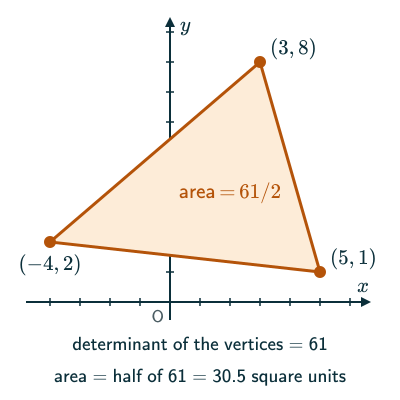
When the area is given and a vertex is unknown, the determinant can be either sign, so solve with both: ½ × (determinant) = ± area (NCERT’s Remark (ii), page 82).
Collinear points
The area of the triangle formed by three collinear points is zero.
NCERT Mathematics Part I (Class 12), Section 4.3, page 82
So three points lie on one line exactly when the determinant is 0. NCERT Exercise 4.2, Q2: the points A(a, b + c), B(b, c + a) and C(c, a + b) are collinear. Expanding along column 3 gives (ab + b2 − c2 − ca) − (a2 + ab − bc − c2) + (ca + a2 − b2 − bc) = 0. (Beyond the NCERT text, properties give it faster: adding column 1 to column 2 makes column 2 (a + b + c) times column 3, and a determinant with proportional columns is 0.)
The equation of a line through two points
For two distinct points A(x, y) and B(x, y), if P(x, y) is any point on their line, the triangle ABP has zero area. So the line is
Line through two points
|x y 1; x y 1; x y 1| = 0
(The rows are separated by semicolons.) The points A and B must be distinct; if they coincide the determinant is 0 for every P and does not specify a unique line.
NCERT Example 7 (page 83): through A(1, 3) and B(0, 0), the determinant with rows 0, 0, 1; 1, 3, 1; x, y, 1 is y − 3x, so the line is y = 3x. The same example asks for k if D(k, 0) makes triangle ABD have area 3 square units. The determinant with rows 1, 3, 1; 0, 0, 1; k, 0, 1 is 3k, so ½(3k) = ±3 and k = ±2.
NCERT slip (page 83): in Example 7, NCERT writes the half-determinant for triangle ABD as −3k/2. Expanding along row 1 gives 1(0 − 0) − 3(0 − k) + 1(0 − 0) = 3k, so it is 3k/2. Because the area condition is ±3, the answer is unchanged: NCERT’s k = ∓2 and our k = ±2 are the same two values, 2 and −2.
Solved examples
Example 1: Three areas (NCERT Exercise 4.2, Q1)
Find the area of the triangle with vertices (i) (1, 0), (6, 0), (4, 3); (ii) (2, 7), (1, 1), (10, 8); (iii) (−2, −3), (3, 2), (−1, −8).
Use the bracket x(y − y) + x(y − y) + x(y − y), whose three terms are listed below.
(i) 1(0 − 3) = −3, 6(3 − 0) = 18 and 4(0 − 0) = 0, so the bracket is 15.
(ii) 2(1 − 8) = −14, 1(8 − 7) = 1 and 10(7 − 1) = 60, so the bracket is 47.
(iii) −2(2 + 8) = −20, 3(−8 + 3) = −15 and −1(−3 − 2) = 5, so the bracket is −30, and the area is half its absolute value.
Answer: (i) 15/2; (ii) 47/2; (iii) 15 square units.
Example 2: An unknown vertex (NCERT Exercise 4.2, Q3)
Find k if the area of the triangle is 4 square units and its vertices are (i) (k, 0), (4, 0), (0, 2); (ii) (−2, 0), (0, 4), (0, k).
(i) The determinant is k(0 − 2) − 0 + 1(8 − 0) = 8 − 2k, so ½(8 − 2k) = ±4, that is 4 − k = ±4. (ii) The determinant is −2(4 − k) − 0 + 1(0 − 0) = 2k − 8, so k − 4 = ±4.
Answer: (i) k = 0 or 8; (ii) k = 0 or 8.
Example 3: Lines by determinants (NCERT Exercise 4.2, Q4)
Find, using determinants, the equations of the lines through (i) (1, 2) and (3, 6); (ii) (3, 1) and (9, 3).
(i) The determinant with rows x, y, 1; 1, 2, 1; 3, 6, 1 is x(2 − 6) − y(1 − 3) + (6 − 6) = −4x + 2y. (ii) With rows x, y, 1; 3, 1, 1; 9, 3, 1 it is x(1 − 3) − y(3 − 9) + (9 − 9) = −2x + 6y.
Answer: (i) y = 2x; (ii) x − 3y = 0.
Example 4: Choose the correct answer (NCERT Exercise 4.2, Q5)
The area of a triangle is 35 square units, with vertices (2, −6), (5, 4) and (k, 4). Then k is (A) 12; (B) −2; (C) −12, −2; (D) 12, −2.
The determinant is 2(4 − 4) + 6(5 − k) + 1(20 − 4k) = 50 − 10k. So ½(50 − 10k) = ±35, that is 25 − 5k = ±35, giving k = −2 or 12.
Answer: (D).
Common mistakes to avoid
Common mistake
Reporting a negative area
The determinant may be negative, as in Example 1 (iii), where it is −30. The area is half its absolute value, 15.
Common mistake
Using only one sign when the area is given
½ × determinant = ±(area). Using only + can lose valid answers: in Example 2 (i), k = 8 comes from one sign and k = 0 from the other.
Common mistake
Forgetting the factor ½
The absolute value of the determinant of the vertices with a column of 1s is twice the area. In NCERT Example 6 it is 61, and the area is 61/2.
Quick revision summary
- Area of the triangle with vertices (x, y), (x, y), (x, y) is half the absolute value of the 3 × 3 determinant with rows x, y, 1.
- If the area is given, use both signs of the determinant.
- Three points are collinear exactly when that determinant is 0, which also gives the equation of the line through two points.
Formula sheet
- area = ½ |x y 1; x y 1; x y 1|, taking the absolute value
- collinear points ⇔ the determinant = 0
- line through distinct (x, y), (x, y): |x y 1; x y 1; x y 1| = 0
Questions students ask
How do you find the area of a parallelogram using determinants?
The area of a parallelogram is the absolute value of the determinant of any three of its vertices (rows x, y, 1), without the ½, because those three vertices form a triangle of half its area, a diagonal cutting it into two equal triangles. For the parallelogram ABCD with A(1, 1), B(5, 2) and D(2, 4), the determinant with rows 1, 1, 1; 5, 2, 1; 2, 4, 1 is −2 − 3 + 16 = 11, so the area is 11 square units. Equivalently, with adjacent sides AB = 4î + ĵ and AD = î + 3ĵ, the area is |4 × 3 − 1 × 1| = 11, the plane form of the vector product area |a × b|.
Can you find the area of a triangle in 3D using determinants?
The 3 × 3 determinant with a column of 1s works only for vertices (x, y) in a plane; for a triangle in space the area is ½|AB × AC|, from the vector product, itself written as a determinant. Beyond the NCERT text, the components of AB × AC are, up to sign, twice the areas of the triangle’s shadows on the yz-, zx- and xy-planes, so the area squared is the sum of their squares. For A(1, 0, 0), B(0, 2, 0) and C(0, 0, 3) the shadows have areas 3, 3/2 and 1, and 9 + 9/4 + 1 = 49/4, so the area is 7/2 square units, as ½|6î + 3ĵ + 2k̂| = 7/2 confirms.
If two vertices and the area of a triangle are given, where can the third vertex lie?
With two distinct vertices A and B fixed and a positive area given, the third vertex P(x, y) can lie anywhere on two lines parallel to AB, one on each side of it, because ½ × (determinant) = ± area is a linear equation in x and y for each sign. For A(1, 2), B(5, 5) and an area of 10 square units, the determinant with rows 1, 2, 1; 5, 5, 1; x, y, 1 is 4y − 3x − 5, so 4y − 3x − 5 = ±20, that is 3x − 4y − 15 = 0 or 3x − 4y + 25 = 0. Both are at distance 20/5 = 4 from the line AB, 3x − 4y + 5 = 0, the height that gives ½ × 5 × 4 = 10, since AB = 5. If the prescribed area is zero, the two parallel lines merge into AB. If A = B, every third point gives zero area and none gives positive area.
Is the area of a triangle using determinants in the JEE Main 2027 syllabus?
Yes, the area of a triangle using determinants is in the JEE Main 2027 syllabus: Unit 3, Matrices and Determinants, lists “area of triangles using determinants” by name. It is taught in NCERT Mathematics Part I (Class 12), Section 4.3, pages 82–83, with collinear points and the line through two points, and the same area appears without a determinant in the Class 11 area formula. Unit 10, Co-ordinate Geometry, also lists the “conditions for concurrence of three lines”, which the concurrency test writes as a determinant of the coefficients.
Practice questions
Try each question first, then open the answer to check your working.
-
Q1. Find the area of the triangle with vertices (0, 0), (6, 0) and (2, 5).
Show answerHide answer
The three terms are 0(0 − 5) = 0, 6(5 − 0) = 30 and 2(0 − 0) = 0, so the area is ½(30) = 15 square units.
-
Q2. Check whether (1, −1), (2, 1) and (4, 5) are collinear.
Show answerHide answer
The three terms are 1(1 − 5) = −4, 2(5 + 1) = 12 and 4(−1 − 1) = −8, which add up to 0. The area is 0, so the points are collinear.
-
Q3. Find the equation of the line through (2, −1) and (−1, 5) using a determinant.
Show answerHide answer
The determinant with rows x, y, 1; 2, −1, 1; −1, 5, 1 is x(−1 − 5) − y(2 + 1) + (10 − 1) = −6x − 3y + 9. Setting it to 0: 2x + y = 3.
-
Q4. For which k are (k, 2), (3, 4) and (5, 6) collinear?
Show answerHide answer
The three terms are k(4 − 6) = −2k, 3(6 − 2) = 12 and 5(2 − 4) = −10, which add up to 2 − 2k. This is 0 when k = 1. (The points then lie on y = x + 1.)