Scalar and vector products of two vectors
NCERT Class 12 Mathematics Chapter 10 Section 10.6
Quick answer
The scalar product a · b = |a| |b| cos θ = ab + ab + ab is a number, zero for perpendicular vectors, and gives the angle and the projection a · b/|b| for b ≠ 0. The vector product a × b = |a| |b| sin θ n̂ has the perpendicular direction given by the right-hand rule when nonzero, with b × a = −(a × b), and in components it is a determinant. Its magnitude |a × b| is the area of the parallelogram on a and b, and half of it is the area of the triangle.
With your textbook
NCERT Mathematics Part II (Class 12), Chapter 10 “Vector Algebra”, Section 10.6 “Product of Two Vectors”, pages 355–369.
Open the official NCERT chapter (PDF, 5.0 MB, ncert.nic.in) (opens in a new tab)
Checked against the 2026-27 reprint on .
What are the two products of vectors?
Two products of vectors
NCERT compares vectors with functions, which can be multiplied in two ways (pointwise, and by composition):
Similarly, multiplication of two vectors is also defined in two ways, namely, scalar (or dot) product where the result is a scalar, and vector (or cross) product where the result is a vector.
NCERT Mathematics Part II (Class 12), Section 10.6, page 355
In plain words: both use the angle θ between the two vectors, taken with 0 ≤ θ ≤ π: the dot product uses cos θ and gives a number, the cross product uses sin θ and gives a vector.
The scalar (dot) product
For nonzero a and b, a · b = |a| |b| cos θ; if a = 0 or b = 0, θ is not defined and a · b = 0 (NCERT Definition 2, pages 355–356). Physics uses the same product for work done by a force.
Scalar product (NCERT pages 355–357)
a · b = |a| |b| cos θ, a real number
cos θ = a · b / (|a| |b|)
a · b = ab + ab + ab
NCERT’s observations (page 356):
- For nonzero vectors, a · b = 0 exactly when a and b are perpendicular.
- θ = 0 gives a · b = |a| |b|, so a · a = |a|2; θ = π gives −|a| |b|.
- î · î = ĵ · ĵ = k̂ · k̂ = 1 and î · ĵ = ĵ · k̂ = k̂ · î = 0.
- The scalar product is commutative and distributes over addition, and (λa) · b = λ(a · b) (Properties 1 and 2, pages 356–357). These give the component formula above.
Projection of a vector on a line
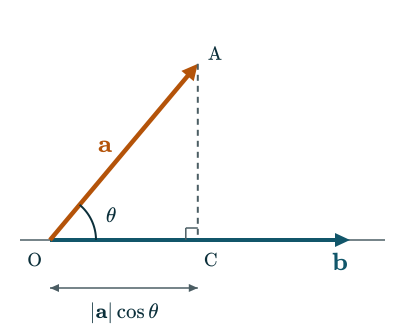
If a makes an angle θ with a directed line, its projection on the line has length |a| |cos θ| and points along the line or against it as cos θ is positive or negative (NCERT Section 10.6.2, pages 357–358, Fig 10.20). For the line of b ≠ 0:
Projection of a on b
projection = a · b̂ = a · b / |b|
This number is |a| cos θ: positive for an acute θ, 0 for a right angle and negative for an obtuse θ. NCERT names the length |p| “the projection” (page 358), but its Observation 2 gives the signed a · b̂, so keep the sign unless a question asks for a length.
NCERT Example 16 (page 359): the projection of 2î + 3ĵ + 2k̂ on î + 2ĵ + k̂ is (2 + 6 + 2)/√6 = 10/√6 = (5/3)√6.
Two inequalities
- Cauchy–Schwarz: |a · b| ≤ |a| |b|, since |cos θ| ≤ 1 (NCERT Example 19, page 360).
- Triangle inequality: |a + b| ≤ |a| + |b| (NCERT Example 20, page 360). If |AC| = |AB| + |BC|, equality in the triangle inequality, the points A, B, C are collinear (Remark, page 361).
NCERT Example 21 (page 361) uses this: for A(−2, 3, 5), B(1, 2, 3), C(7, 0, −1), |AB| = √14, |BC| = 2√14 and |AC| = 3√14, so A, B, C are collinear. NCERT’s Note there: AB + BC + CA = 0 although no triangle is formed.
The vector (cross) product
For nonzero, nonparallel a and b, a × b = |a| |b| sin θ n̂, where n̂ is the unit vector perpendicular to both, with a, b, n̂ a right-handed system; if the vectors are parallel, or either is 0, their cross product is 0 and no unique normal direction is assigned (NCERT Definition 3, page 363).
In a right handed coordinate system, the thumb of the right hand points in the direction of the positive z-axis when the fingers are curled in the direction away from the positive x-axis toward the positive y-axis (Fig 10.22(ii)).
NCERT Mathematics Part II (Class 12), Section 10.6.3, page 363
NCERT’s observations (pages 363–365):
- a × b is a vector, and for nonzero vectors a × b = 0 exactly when they are parallel (collinear); in particular a × a = 0.
- θ = π/2 gives |a × b| = |a| |b|.
- î × ĵ = k̂, ĵ × k̂ = î, k̂ × î = ĵ, and î × î = 0.
- The product is not commutative: b × a = −(a × b), so ĵ × î = −k̂.
- sin θ = |a × b| / (|a| |b|).
- It distributes over addition, and λ(a × b) = (λa) × b (Property 3, page 365).
NCERT slip (page 364): Observation 3 prints a × b = |a| |b| for θ = π/2, a vector set equal to a number. It is the magnitudes that are equal: |a × b| = |a| |b|. In an exam, write the modulus.
The cross product as a determinant
In components, the distributive law and the products of î, ĵ, k̂ give a 3 × 3 determinant (NCERT page 366):
Cross product in components
a × b = | î ĵ k̂ ; a a a ; b b b |
= (ab − ab)î − (ab − ab)ĵ + (ab − ab)k̂
NCERT slip (page 366): the expansion of (aî + aĵ + ak̂) × (bî + bĵ + bk̂) is marked “(by Property 1)”, which is the distributivity of the scalar product. The step uses Property 3, the distributivity of the vector product (page 365). The result is unchanged.
Areas of a triangle and a parallelogram
Areas (NCERT page 365)
parallelogram with adjacent sides a, b: area = |a × b|
triangle with sides a, b from one vertex: area = ½ |a × b|
Both come from base × height: with base |b|, the height is |a| sin θ (NCERT Figs 10.26 and 10.27, page 365). NCERT Example 25 (page 368): for a = 3î + ĵ + 4k̂ and b = î − ĵ + k̂, a × b = 5î + ĵ − 4k̂, so the parallelogram has area √42.
Solved examples
Example 1: The angle between two vectors (NCERT Exercise 10.3, Q2, page 361)
Find the angle between î − 2ĵ + 3k̂ and 3î − 2ĵ + k̂.
The dot product is 3 + 4 + 3 = 10, and both vectors have magnitude √14. So cos θ = 10/14 = 5/7.
Answer: θ = cos−1 (5/7).
Example 2: A projection (NCERT Exercise 10.3, Q4, page 361)
Find the projection of î + 3ĵ + 7k̂ on 7î − ĵ + 8k̂.
a · b = 7 − 3 + 56 = 60 and |b| = √(49 + 1 + 64) = √114.
Answer: 60/√114.
Example 3: Three unit vectors adding to zero (NCERT Exercise 10.3, Q13, page 362)
If a, b, c are unit vectors with a + b + c = 0, find a · b + b · c + c · a.
Square the sum: 0 = |a + b + c|2, which is 1 + 1 + 1 + 2(a · b + b · c + c · a).
Answer: −3/2.
Example 4: An angle of a triangle (NCERT Exercise 10.3, Q15, page 362)
A(1, 2, 3), B(−1, 0, 0) and C(0, 1, 2) form a triangle. Find ∠ABC, the angle between BA and BC.
BA = 2î + 2ĵ + 3k̂ and BC = î + ĵ + 2k̂. Their dot product is 2 + 2 + 6 = 10, and their magnitudes are √17 and √6.
Answer: ∠ABC = cos−1 (10/√102).
Example 5: A unit vector perpendicular to two vectors (NCERT Exercise 10.4, Q2, page 368)
For a = 3î + 2ĵ + 2k̂ and b = î + 2ĵ − 2k̂, find a unit vector perpendicular to both a + b and a − b.
a + b = 4î + 4ĵ and a − b = 2î + 4k̂. Their cross product, by the determinant, is 16î − 16ĵ − 8k̂, of magnitude 24.
Answer: ±(2î − 2ĵ − k̂)/3.
Example 6: The area of a triangle (NCERT Exercise 10.4, Q9, page 368)
Find the area of the triangle with vertices A(1, 1, 2), B(2, 3, 5) and C(1, 5, 5).
AB = î + 2ĵ + 3k̂ and AC = 4ĵ + 3k̂. Then AB × AC = −6î − 3ĵ + 4k̂, of magnitude √61.
Answer: (1/2)√61.
Example 7: Choose the correct answer (NCERT Exercise 10.4, Q11, page 369)
|a| = 3 and |b| = √2/3. a × b is a unit vector if the angle between a and b is (A) π/6; (B) π/4; (C) π/3; (D) π/2.
|a × b| = 3 × (√2/3) × sin θ = √2 sin θ, which is 1 when sin θ = 1/√2.
Answer: (B), π/4, among the choices. The supplementary angle 3π/4 also makes the cross product a unit vector, but is not listed.
Common mistakes to avoid
Common mistake
Mixing up the two products
a · b is a number and uses cos θ; a × b is a vector and uses sin θ. For two nonzero vectors, a zero dot product means perpendicular and a zero cross product means parallel; if either vector is zero, both products vanish without defining an angle.
Common mistake
Reversing a cross product
a × b and b × a are negatives of each other. Keep the order of the rows in the determinant: î, ĵ, k̂, then a, then b.
Common mistake
Dividing a projection by the wrong length
The projection of a on b is a · b/|b|, divided by the length of the vector projected on, not by |a|.
Common mistake
Concluding a zero vector from a zero product
a · b = 0 does not force a or b to be 0: î · ĵ = 0 (NCERT Exercise 10.3, Q14). Likewise a × b = 0 for any two parallel vectors.
Quick revision summary
- a · b = |a| |b| cos θ = ab + ab + ab, a scalar; it is 0 for perpendicular vectors, and a · a = |a|.
- Projection of a on b: a · b/|b|. Cauchy–Schwarz |a · b| ≤ |a| |b|; triangle |a + b| ≤ |a| + |b|.
- a × b = |a| |b| sin θ n̂, a vector perpendicular to both (right-hand rule); b × a = −(a × b); it is 0 for parallel vectors. In components it is the determinant with rows î ĵ k̂, a, b.
- Area of a parallelogram |a × b|; of a triangle ½|a × b|.
Formula sheet
- a · b = |a| |b| cos θ = ab + ab + ab
- projection of a on b = a · b / |b|, b ≠ 0
- |a × b| = |a| |b| sin θ; b × a = −(a × b)
- î × ĵ = k̂, ĵ × k̂ = î, k̂ × î = ĵ
- area of parallelogram = |a × b|; of triangle = ½|a × b|
Questions students ask
How do you find the area of a parallelogram from its diagonals using vectors?
Beyond the NCERT text, a parallelogram whose diagonals are the vectors d and d has area ½|d × d|, half the magnitude of the cross product of the diagonals. With adjacent sides a and b, the diagonals are a + b and a − b, whose cross product is twice a × b up to sign (NCERT Exercise 10.4, Q4), so half its magnitude is |a × b|, the usual area. For diagonals î − 3ĵ and î + 3ĵ − 4k̂ the cross product is 12î + 4ĵ + 6k̂, of magnitude 14, so the area is 7 square units, as the sides î − 2k̂ and −3ĵ + 2k̂, half the sum and half the difference of the diagonals, confirm.
What is the difference between the projection and the projection vector?
The projection of a on b is a number, a · b/|b|, while the projection vector is that number times the unit vector b̂, a vector along the line of b: NCERT calls the vector p the projection vector and its length |p| the projection, though its formula a · b̂ keeps a sign (pages 357–358). For a = 4î + 5ĵ − k̂ and b = 2î + ĵ − 2k̂, a · b = 15 and |b| = 3, so the projection is 5 and the projection vector is (5/3)(2î + ĵ − 2k̂); the rest of a is perpendicular to b. Physics uses the same signed number, the component of a along b, in the dot product for work.
What is the maximum angle between two vectors?
The maximum angle between two vectors is π (180°), for vectors pointing in opposite directions, because the angle between two non-zero vectors drawn from one point is always taken with 0 ≤ θ ≤ π (NCERT page 356), so the cosine from the dot product fixes exactly one angle. The angle between two lines is different: a line has two opposite directions, so NCERT Chapter 11 takes the angle between 0 and π/2, and lines along vectors at 150° make an angle of 30°. For the zero vector no angle is defined at all, and NCERT simply sets the dot product to 0.
Are the dot and cross products associative?
No, neither the dot product nor the cross product of vectors is associative. For the dot product the question does not even arise: a · b is a scalar, so (a · b) · c has no meaning, and (a · b)c, a vector along c, is in general different from a(b · c), a vector along a. For the cross product the brackets change the answer, (î × ĵ) × ĵ = k̂ × ĵ = −î but î × (ĵ × ĵ) = 0, so keep the brackets, as the physics page on the vector product also warns.
Are the scalar and vector triple products in the JEE Main 2027 syllabus?
No, the JEE Main 2027 syllabus does not name the triple products: its Unit 12, Vector Algebra, lists “Vectors and scalars, the addition of vectors, components of a vector in two dimensions and three-dimensional spaces, scalar and vector products”, and NCERT’s 2022 list of rationalised content (page 45) dropped Section 10.7, Scalar Triple Product, from the Class 12 book. Beyond the NCERT text, the scalar triple product a · (b × c) is a number whose absolute value is the volume of the box (parallelepiped) on the three vectors, 0 exactly when they are coplanar, while the vector triple product a × (b × c) is a vector (reasoned from base area × perpendicular height for the scalar triple product).
Practice questions
Try each question first, then open the answer to check your working.
-
Q1. Find the angle between a and b with magnitudes √3 and 2, if a · b = √6 (NCERT Exercise 10.3, Q1, page 361).
Show answerHide answer
cos θ = √6/(√3 × 2) = 1/√2, so θ = π/4.
-
Q2. a = 2î + 2ĵ + 3k̂, b = −î + 2ĵ + k̂ and c = 3î + ĵ. Find λ if a + λb is perpendicular to c (NCERT Exercise 10.3, Q10, page 362).
Show answerHide answer
a + λb = (2 − λ)î + (2 + 2λ)ĵ + (3 + λ)k̂. Its dot product with c is 3(2 − λ) + (2 + 2λ) = 8 − λ, which must be 0, so λ = 8.
-
Q3. Find |a × b| for a = î − 7ĵ + 7k̂ and b = 3î − 2ĵ + 2k̂ (NCERT Exercise 10.4, Q1, page 368).
Show answerHide answer
a × b = 0î + 19ĵ + 19k̂, so |a × b| = 19√2.
-
Q4. The rectangle with vertices −î + (1/2)ĵ + 4k̂, î + (1/2)ĵ + 4k̂, î − (1/2)ĵ + 4k̂ and −î − (1/2)ĵ + 4k̂ has area (A) 1/2; (B) 1; (C) 2; (D) 4 (NCERT Exercise 10.4, Q12, page 369).
Show answerHide answer
Two adjacent sides are AB = 2î and BC = −ĵ. The area is |AB × BC| = |−2k̂| = 2: (C).