Multiplying a vector by a scalar, components and the section formula
NCERT Class 12 Mathematics Chapter 10 Section 10.5
Quick answer
λa is a vector collinear with a, of magnitude |λ| |a|, reversed when λ < 0, and for a ≠ 0, â = a/|a| is the unit vector along a. In components, r = xî + yĵ + zk̂ with |r| = √(x + y + z), and vectors are added and scaled component by component. The vector from P to P is OP − OP, and R dividing PQ internally with PR : RQ = m : n has position vector (mb + na)/(m + n).
With your textbook
NCERT Mathematics Part II (Class 12), Chapter 10 “Vector Algebra”, Section 10.5 “Multiplication of a Vector by a Scalar”, pages 346–355.
Open the official NCERT chapter (PDF, 5.0 MB, ncert.nic.in) (opens in a new tab)
Checked against the 2026-27 reprint on .
What is a scalar multiple of a vector?
Multiplying a vector by a scalar
NCERT’s definition, in our words (Section 10.5, page 346): for a vector a and a scalar λ, the product λa is called the multiplication of a by λ. It is also a vector, collinear with a. If λ = 0 or a = 0, the result is 0, with no definite direction. For nonzero λ and a, it has the same direction as a when λ > 0 and the opposite direction when λ < 0, and its magnitude is |λ| times that of a, that is, |λa| = |λ| |a|.
In plain words: multiplying by λ stretches or shrinks a along its own line by the factor |λ|, and turns it round when λ is negative. So 2a is twice as long as a, −2a is as long but reversed, and (−1)a = −a, the additive inverse, with a + (−a) = 0 (page 346, Fig 10.12). Physics uses the same rule when it multiplies a vector by a number. For any scalar k, k 0 = 0 (page 347).
Unit vector along a. For a ≠ 0, dividing by its own length gives a vector of length 1 in the same direction (page 347):
Unit vector in the direction of a
â = a/|a|, for a ≠ 0
Components of a vector
The unit vectors along the x-, y- and z-axes are written î, ĵ and k̂ (page 347, Fig 10.13). The position vector of P(x, y, z) is then r = xî + yĵ + zk̂ (page 348):
This form of any vector is called its component form.
NCERT Mathematics Part II (Class 12), Section 10.5.1, page 348
Here x, y, z are the scalar components of r, and xî, yĵ, zk̂ its vector components (page 348). Its length, by Pythagoras twice, is √(x2 + y2 + z2).
Working in components (NCERT page 348)
a ± b = (a ± b)î + (a ± b)ĵ + (a ± b)k̂
λa = (λa)î + (λa)ĵ + (λa)k̂
a = b if and only if a = b, a = b, a = b
The distributive laws k a + m a = (k + m)a, k(m a) = (km)a and k(a + b) = k a + k b hold (page 349). The components a, a, a are also direction ratios of a, and if l, m, n are its direction cosines, lî + mĵ + nk̂ is the unit vector along it (Remarks (ii)–(iii), page 349).
NCERT Example 5 (page 350): a = î + 2ĵ and b = 2î + ĵ both have magnitude √5, but they are not equal, because their components differ. NCERT’s own words, from Example 4:
Note that two vectors are equal if and only if their corresponding components are equal.
NCERT Mathematics Part II (Class 12), Section 10.5.1, page 349
Collinear vectors
a and b are collinear exactly when b = λa for some scalar λ (with a ≠ 0). In components, this means the components are proportional: b/a = b/a = b/a = λ (Remark (i), page 349). A ratio with 0 below is read as a condition: if a component of a is 0, the matching component of b must be 0 too.
The vector joining two points
For P(x, y, z) and P(x, y, z), the triangle law in OPP gives PP = OP − OP (page 351, Fig 10.15):
Vector joining two points
PP = (x − x)î + (y − y)ĵ + (z − z)k̂
Its magnitude is the distance PP. NCERT Example 10 (page 352): from P(2, 3, 0) to Q(−1, −2, −4), PQ = −3î − 5ĵ − 4k̂.
The section formula
For distinct P and Q and positive m, n, if P and Q have position vectors a and b, and R divides PQ so that PR : RQ = m : n, then (pages 352–353):
Section formula
internally: r = (mb + na)/(m + n)
externally: r = (mb − na)/(m − n), m ≠ n
midpoint: r = (a + b)/2
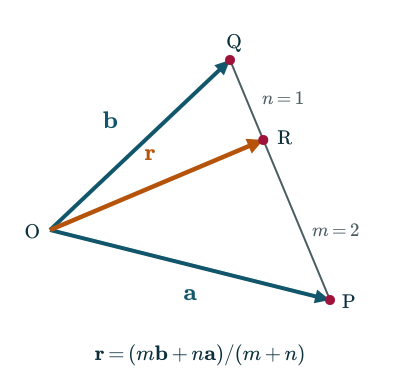
In coordinates this is the section formula in three dimensions, which JEE Main 2027 lists in Unit 11 but the Class 11 book does not teach. The internal formula comes from m(b − r) = n(r − a), that is, m RQ = n PR (page 352). NCERT Example 11 (page 353): with OP = 3a − 2b and OQ = a + b, the point dividing PQ in the ratio 2 : 1 is 5a/3 internally and 4b − a externally.
Solved examples
Example 1: A unit vector (NCERT Example 6, page 350)
Find the unit vector in the direction of a = 2î + 3ĵ + k̂.
|a| = √(4 + 9 + 1) = √14.
Answer: â = (2î + 3ĵ + k̂)/√14.
Example 2: A given magnitude (NCERT Example 7, page 350)
Find a vector of magnitude 7 in the direction of a = î − 2ĵ.
â = (î − 2ĵ)/√5, and the required vector is 7â.
Answer: (7/√5)î − (14/√5)ĵ.
Example 3: Direction cosines of a joining vector (NCERT Exercise 10.2, Q13, page 354)
Find the direction cosines of the vector from A(1, 2, −3) to B(−1, −2, 1).
AB = −2î − 4ĵ + 4k̂, and |AB| = √(4 + 16 + 16) = 6.
Answer: −1/3, −2/3, 2/3.
Example 4: Collinear vectors (NCERT Exercise 10.2, Q11, page 354)
Show that 2î − 3ĵ + 4k̂ and −4î + 6ĵ − 8k̂ are collinear.
The ratios of the components are −4/2 = 6/(−3) = −8/4 = −2, so the second vector is −2 times the first.
Answer: collinear, pointing in opposite directions, the second twice as long.
Example 5: Dividing a segment (NCERT Exercise 10.2, Q15, page 354)
P and Q have position vectors î + 2ĵ − k̂ and −î + ĵ + k̂. Find R dividing PQ in the ratio 2 : 1 (i) internally; (ii) externally.
(i) Internally, r = (2OQ + OP)/3, and 2OQ + OP = −î + 4ĵ + k̂. (ii) Externally, r = (2OQ − OP)/(2 − 1), and 2OQ − OP = −3î + 3k̂.
Answer: (i) −(1/3)î + (4/3)ĵ + (1/3)k̂; (ii) −3î + 3k̂.
Example 6: Three points in a line (NCERT Miscellaneous Exercise on Chapter 10, Q8, page 372)
Show that A(1, −2, −8), B(5, 0, −2) and C(11, 3, 7) are collinear, and find the ratio in which B divides AC.
AB = 4î + 2ĵ + 6k̂ and BC = 6î + 3ĵ + 9k̂ = (3/2)AB. So AB and BC are collinear and share the point B, and A, B, C lie on one line. AB : BC = 1 : 3/2.
Answer: collinear; B divides AC in the ratio 2 : 3.
Example 7: Choose the incorrect statements (NCERT Exercise 10.2, Q19, page 355)
If a and b are two collinear vectors, which of the following are incorrect? (A) b = λa for some scalar λ; (B) a = ±b; (C) the respective components of a and b are not proportional; (D) both the vectors a and b have the same direction, but different magnitudes.
(A) is the condition for collinearity. (B) needs equal lengths, which collinear vectors need not have. (C) contradicts proportional components. (D) is too narrow: collinear vectors may point opposite ways or have equal lengths.
Answer: (B), (C) and (D). Beyond the NCERT text: this assumes nonzero vectors; if a = 0 but b ≠ 0, (A) also fails, even though the zero vector, which NCERT (page 341) says may be regarded as having any direction, is collinear with every vector (our reasoning).
Common mistakes to avoid
Common mistake
Forgetting to divide by the magnitude
The unit vector along 2î + 3ĵ + k̂ is not (2î + 3ĵ + k̂)/6: divide by √14, the magnitude, not by the sum of the components.
Common mistake
Subtracting the wrong way round
PQ = OQ − OP: terminal point minus initial point. From P(2, 3, 0) to Q(−1, −2, −4) it is −3î − 5ĵ − 4k̂, not 3î + 5ĵ + 4k̂.
Common mistake
Pairing m with the wrong end
In r = (m b + n a)/(m + n), with PR : RQ = m : n, the weight m goes on b, the position vector of Q, the end away from P. Swapping them gives the point dividing PQ in the ratio n : m.
Quick revision summary
- λa is collinear with a, |λa| = |λ| |a|, and it is reversed when λ < 0. The unit vector is â = a/|a|.
- In components, r = xî + yĵ + zk̂ with |r| = √(x + y + z); add, subtract and scale component by component.
- Collinear: b = λa, or proportional components. Joining vector: PP = OP − OP.
- Section formula, for R with PR : RQ = m : n: (m b + n a)/(m + n) internally, (m b − n a)/(m − n) externally, (a + b)/2 at the midpoint.
Formula sheet
- |λa| = |λ| |a|; â = a/|a| for a ≠ 0
- r = xî + yĵ + zk̂, |r| = √(x + y + z)
- PP = (x − x)î + (y − y)ĵ + (z − z)k̂
- r = (mb + na)/(m + n), m,n > 0; external (mb − na)/(m − n), m ≠ n
Questions students ask
What is the unit vector in the direction of 3î + 4ĵ?
The unit vector in the direction of 3î + 4ĵ is (3/5)î + (4/5)ĵ: its magnitude is √(9 + 16) = 5, and dividing a non-zero vector by its magnitude, â = a/|a|, keeps the direction and makes the length 1. Its components 3/5 and 4/5 are the cosines of the angles it makes with the x- and y-axes, so it makes cos−1 (3/5) ≈ 53.1° with the x-axis. In the same way 4î − 3ĵ, also of magnitude 5, has the unit vector (4/5)î − (3/5)ĵ, which is perpendicular to the first.
How do you prove that three points are collinear using vectors?
To prove with vectors that three distinct points A, B and C are collinear, show that AB and BC are collinear vectors, one a scalar multiple of the other; since they share the point B, all three points lie on one line. For A(−1, 2, 4), B(1, 0, 5) and C(7, −6, 8), AB = 2î − 2ĵ + k̂ and BC = 6î − 6ĵ + 3k̂, which is 3AB, so the points are collinear. Two other tests agree: equality in the triangle inequality, as |AB| = 3 and |BC| = 9 add up to |AC| = 12, and a zero cross product, AB × BC = 0.
What is the external section formula in vectors, and why must m ≠ n?
The point R dividing PQ externally in the ratio m : n of positive numbers, so that PR : QR = m : n with R on the line PQ outside the segment, has position vector (m b − n a)/(m − n), where a and b are the position vectors of P and Q (NCERT page 353). As in the coordinate form, R lies beyond Q when m > n and beyond P when m < n, and m = n gives a zero denominator, as no point outside the segment is equally far from P and Q. For P(1, 0, 2) and Q(3, 4, 1) in the ratio 3 : 1, R has position vector (3b − a)/2, which is 4î + 6ĵ + (1/2)k̂, a point beyond Q.
Practice questions
Try each question first, then open the answer to check your working.
-
Q1. Find the magnitudes of a = î + ĵ + k̂, b = 2î − 7ĵ − 3k̂ and c = (î + ĵ − k̂)/√3 (NCERT Exercise 10.2, Q1, page 354).
Show answerHide answer
|a| = √3, |b| = √(4 + 49 + 9) = √62, and |c| = √(1/3 + 1/3 + 1/3) = 1. (NCERT prints a = î + ĵ + k, without the hat; it is k̂.)
-
Q2. For a = 2î − ĵ + 2k̂ and b = −î + ĵ − k̂, find the unit vector along a + b (NCERT Exercise 10.2, Q9, page 354).
Show answerHide answer
a + b = î + k̂, of magnitude √2, so the unit vector is (1/√2)î + (1/√2)k̂.
-
Q3. Find the position vector of the midpoint of the vector joining P(2, 3, 4) and Q(4, 1, −2) (NCERT Exercise 10.2, Q16, page 355).
Show answerHide answer
(OP + OQ)/2 = (6î + 4ĵ + 2k̂)/2 = 3î + 2ĵ + k̂.
-
Q4. Find x and y if 2î + 3ĵ and xî + yĵ are equal (NCERT Exercise 10.2, Q4, page 354).
Show answerHide answer
Equal vectors have equal components: x = 2 and y = 3.