Vectors: basic concepts, position vector and direction cosines
NCERT Class 12 Mathematics Chapter 10 Sections 10.1–10.2
Quick answer
A vector is a quantity with magnitude and direction, drawn as a directed line segment; a scalar has a real value and no spatial direction. The position vector of P(x, y, z) is r = OP, with |r| = √(x + y + z). For r ≠ 0, its direction cosines are l = x/r, m = y/r and n = z/r, and l + m + n = 1, while direction ratios are a nonzero proportional triple, with the common sign chosen for the vector’s orientation.
With your textbook
NCERT Mathematics Part II (Class 12), Chapter 10 “Vector Algebra”, Sections 10.1–10.2 “Introduction” and “Some Basic Concepts”, pages 338–341.
Open the official NCERT chapter (PDF, 5.0 MB, ncert.nic.in) (opens in a new tab)
Checked against the 2026-27 reprint on .
What is a vector?
Vector
A quantity that has magnitude as well as direction is called a vector.
NCERT Mathematics Part II (Class 12), Section 10.2, page 339
- A scalar is described by a real value without spatial direction; the value may be negative, as for work or temperature: length, mass, time, distance, speed, area, volume, temperature, work and density are scalars (NCERT Section 10.1, page 338).
- Displacement, velocity, acceleration, force, weight and momentum are vectors (page 338).
In plain words: “1.6 metres” answers “how tall?”, but “how should the ball be kicked?” needs a strength and a direction. Physics uses the same idea for scalars and vectors.
Notation. NCERT writes a vector with an arrow over it, as in AB⃗ or a⃗. On this site a vector is printed in bold, AB or a, as many books do, and its magnitude as |a| or simply a.
Directed line segments
A line with one of its two directions chosen is a directed line. Its piece from A to B, with that direction, is a directed line segment, and it has both a magnitude and a direction, so it is a vector, AB (NCERT page 339, Fig 10.1).
- A is the initial point and B the terminal point.
- The magnitude (or length) |AB| is the distance between A and B.
- A length is never negative, so |a| < 0 has no meaning (NCERT’s Note, page 339).
Position vector
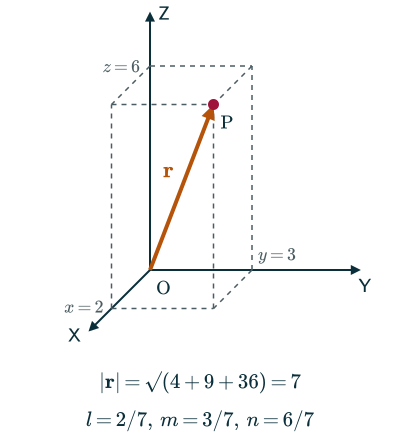
For a point P(x, y, z), the vector OP from the origin O(0, 0, 0) to P is the position vector of P, often written r (page 339). By the Class 11 distance formula,
Magnitude of a position vector
|r| = |OP| = √(x + y + z)
The position vectors of points A, B, C are usually written a, b, c (page 339, with NCERT Fig 10.2 on page 340).
Direction cosines and direction ratios
For r ≠ 0, the angles α, β, γ that r makes with the positive x-, y- and z-axes are its direction angles. Their cosines, l = cos α, m = cos β and n = cos γ, are its direction cosines (NCERT page 340). In the right-angled triangle OAP of NCERT Fig 10.3, cos α = x/r, where r = |r|; in the same way cos β = y/r and cos γ = z/r.
Direction cosines of <b>r</b> = <b>OP</b>, for P(x, y, z)
l = x/r, m = y/r, n = z/r, r > 0
l + m + n = 1
The last line holds because (x2 + y2 + z2)/r2 = 1. So P is (lr, mr, nr). NCERT calls lr, mr, nr (that is, x, y, z) the direction ratios a, b, c of r (page 340); a nonzero proportional triple serves as direction ratios for its line. Positive scaling keeps the vector’s orientation; negative scaling reverses it. The zero triple cannot specify a direction. Unlike the cosines, a2 + b2 + c2 ≠ 1 in general (NCERT’s Note, page 341). To get the cosines back from ratios, divide each by √(a2 + b2 + c2), as NCERT Example 9 does (page 351), choosing the common sign to match the specified vector. If only unoriented line ratios are known, both opposite cosine triples are possible. The zero vector has no direction cosines.
Solved examples
Example 1: Scalar or vector? (NCERT Example 2, pages 341–342)
Classify as scalars or vectors: (i) 5 seconds; (ii) 1000 cm3; (iii) 10 newton; (iv) 30 km/h; (v) 10 g/cm3; (vi) 20 m/s towards north.
Time, volume, speed and density have no direction. Force and velocity do: a force of 10 newton always acts in some direction, even if the question gives only its size.
Answer: (i) time, scalar; (ii) volume, scalar; (iii) force, vector; (iv) speed, scalar; (v) density, scalar; (vi) velocity, vector.
Example 2: Magnitude and direction cosines
Find the magnitude and the direction cosines of the position vector of P(1, −2, 2).
r = √(1 + 4 + 4) = 3, so l = 1/3, m = −2/3 and n = 2/3. Check: 1/9 + 4/9 + 4/9 = 1. The negative m means the angle with the y-axis is obtuse: β = cos−1 (−2/3) ≈ 131.8°.
Answer: magnitude 3; direction cosines 1/3, −2/3, 2/3; direction ratios 1, −2, 2 (or a nonzero multiple as line ratios, such as 2, −4, 4; use positive scaling to preserve this vector’s direction).
Example 3: Can these be direction angles?
Can a vector make angles 30°, 45° and 60° with the x-, y- and z-axes?
The squares of the cosines are 3/4, 1/2 and 1/4, which add up to 3/2, not 1.
Answer: no; for any nonzero vector, cos2 α + cos2 β + cos2 γ = 1.
Example 4: The third angle
A vector makes 60° with the x-axis and 60° with the y-axis. Find the angle it makes with the z-axis.
cos2 γ = 1 − cos2 60° − cos2 60° = 1 − 1/4 − 1/4 = 1/2, so cos γ = ±1/√2.
Answer: γ = 45° or 135°: two directions fit, one above and one below the xy-plane.
Common mistakes to avoid
Common mistake
Treating direction ratios as direction cosines
Direction ratios such as 1, −2, 2 are only proportional to the cosines. Divide by √(1 + 4 + 4) = 3 first; only then do the squares add up to 1.
Common mistake
A negative magnitude
A coordinate or a direction cosine may be negative, but a magnitude never is: |r| = √(x2 + y2 + z2) ≥ 0.
Common mistake
Distance and speed as vectors
Distance and speed are scalars; displacement and velocity are the vectors. “30 km/h” is a speed, but “20 m/s towards north” is a velocity (Example 1).
Quick revision summary
- A vector has magnitude and direction; a scalar has magnitude only. A directed line segment AB runs from its initial point A to its terminal point B, and |AB| = AB ≥ 0.
- The position vector of P(x, y, z) is r = OP, with |r| = √(x + y + z).
- Direction cosines: l = x/r, m = y/r, n = z/r, and l + m + n = 1. Direction ratios are any numbers proportional to l, m, n.
Formula sheet
- |r| = √(x + y + z) for r = OP, P(x, y, z)
- l = x/r, m = y/r, n = z/r, r > 0
- l + m + n = 1
Questions students ask
What is vector algebra in Class 12 maths?
Vector algebra is the part of mathematics that adds, subtracts and multiplies vectors, quantities with both magnitude and direction, by rules of its own; in NCERT Class 12 it is Chapter 10 of Mathematics Part II (pages 338–376). The chapter covers position vectors, types of vectors, addition, scalar multiples, components, the section formula and the scalar and vector products; Chapter 11 then uses vectors to write lines in space. NCERT’s Historical Note (page 375) discusses the term’s Latin origin and its use for a directed line segment in Hamilton’s quaternions.
What is the difference between vector algebra and vector calculus?
Vector algebra combines vectors by addition, scalar multiples and the dot and cross products, while vector calculus, which goes beyond the NCERT Class 12 book, differentiates and integrates vectors that vary, such as the position of a moving particle or a field that gives a vector at every point. Vector algebra comes first, since the derivative of a vector is a limit of differences of vectors divided by a scalar: Class 11 physics already uses one, the velocity v = dr/dt. The gradient, divergence and curl of a first university course belong to vector calculus (beyond NCERT).
What is the difference between a position vector and the coordinates of a point?
The coordinates (x, y, z) of a point P are three numbers that fix its place, while its position vector OP is the arrow from the origin O to P, whose components are those same numbers: P(5, −2, 4) has position vector 5î − 2ĵ + 4k̂. The vector, unlike the point, can be added, multiplied by a scalar and given a length, here |OP| = 3√5, since 25 + 4 + 16 = 45, the distance of P from O. Both depend on where the origin is, but the vector AB = OB − OA joining two points does not, because moving the origin changes OA and OB by the same vector.
What is the difference between a position vector and a unit vector?
A position vector r = OP locates a point P from the origin O, and its length |r| is the distance OP, which can be any non-negative number, while a unit vector has length exactly 1 and shows only a direction. Dividing a non-zero position vector by its length gives the unit vector along it, whose components are the direction cosines l, m, n: for P(−8, 9, 12), |r| = 17, since 64 + 81 + 144 = 289, so the unit vector along OP is (−8î + 9ĵ + 12k̂)/17 and the direction cosines are −8/17, 9/17 and 12/17. The position vector of O itself is the zero vector, which has no unit vector along it.
Practice questions
Try each question first, then open the answer to check your working.
-
Q1. Classify as scalars or vectors: (i) 10 kg; (ii) 2 metres north-west; (iii) 40°; (iv) 40 watt; (v) 10−19 coulomb; (vi) 20 m/s2 (NCERT Exercise 10.1, Q2, page 342).
Show answerHide answer
(i) scalar; (ii) vector; (iii) scalar; (iv) scalar; (v) scalar; (vi) vector, since an acceleration has a direction.
-
Q2. Classify as scalar or vector quantities: (i) time period; (ii) distance; (iii) force; (iv) velocity; (v) work done (NCERT Exercise 10.1, Q3, page 342).
Show answerHide answer
(i) scalar; (ii) scalar; (iii) vector; (iv) vector; (v) scalar.
-
Q3. Find the magnitude and direction cosines of the position vector of P(−3, 4, 12).
Show answerHide answer
r = √(9 + 16 + 144) = 13, so the direction cosines are −3/13, 4/13 and 12/13.
-
Q4. A vector has direction ratios 2, −1, 2. Find its direction cosines.
Show answerHide answer
√(4 + 1 + 4) = 3, so the direction cosines are 2/3, −1/3, 2/3 (or all three with the opposite sign, for the opposite direction).