Addition of vectors: triangle and parallelogram laws
NCERT Class 12 Mathematics Chapter 10 Section 10.4
Quick answer
By the triangle law, AB + BC = AC: place the second vector’s tail on the first vector’s head, and the sum joins the free ends. By the parallelogram law, the sum of two adjacent sides is the diagonal through their common point, and the two laws are equivalent. Subtraction is a − b = a + (−b), and vector addition is commutative and associative, with a + 0 = a.
With your textbook
NCERT Mathematics Part II (Class 12), Chapter 10 “Vector Algebra”, Section 10.4 “Addition of Vectors”, pages 343–346.
Open the official NCERT chapter (PDF, 5.0 MB, ncert.nic.in) (opens in a new tab)
Checked against the 2026-27 reprint on .
What is the triangle law?
Triangle law of vector addition
- To add a and b, place the initial point of b at the terminal point of a; then a + b runs from the initial point of a to the terminal point of b (NCERT Section 10.4, page 343). So AB + BC = AC, and since AC = −CA, AB + BC + CA = 0.
This means that when the sides of a triangle are taken in order, it leads to zero resultant as the initial and terminal points get coincided (Fig 10.8(iii)).
NCERT Mathematics Part II (Class 12), Section 10.4, page 343
In plain words: a vector can be represented as a displacement. If a girl walks from A to B and then from B to C, her net displacement is from A to C, so AC = AB + BC. This is the triangle law of vector addition (NCERT Section 10.4, page 343, Fig 10.7), the same law physics uses for adding displacements and forces.
For any two vectors, move b without changing its magnitude or direction until it starts where a ends; a + b is then the third side of the triangle (page 343, Fig 10.8). Going round the whole triangle brings you back to the start, as NCERT says above:
Triangle law
AB + BC = AC
AB + BC + CA = 0
Subtracting a vector
a − b means a + (−b): add the vector of the same magnitude as b and the opposite direction (page 344, with NCERT Fig 10.8(iii) on page 343). For example, AB − AC = AB + CA, which is CA + AB = CB. A useful form: AB = OB − OA for any point O, since OA + AB = OB.
The parallelogram law
NCERT’s motivating example (page 344) is a boat crossing a river: the engine’s velocity and the river’s velocity act together, and the boat moves with their sum.
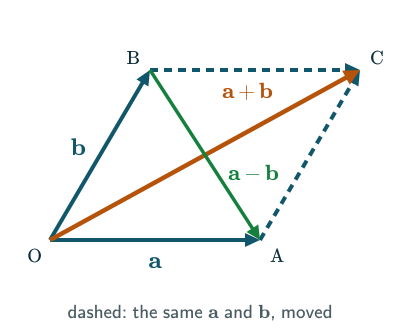
NCERT’s parallelogram law (Section 10.4, page 344): if two vectors a and b are represented in magnitude and direction by two adjacent sides of a parallelogram (NCERT Fig 10.9), their sum a + b is represented in magnitude and direction by the diagonal through their common point.
The two laws say the same thing: in the parallelogram OACB, AC = OB = b, so the triangle law in OAC gives OC = a + b (NCERT’s Note, page 344). The other diagonal, from B to A, is a − b.
Properties of vector addition
Properties (NCERT pages 344–346)
a + b = b + a (commutative)
(a + b) + c = a + (b + c) (associative)
a + 0 = a; a + (−a) = 0
- Commutative (Property 1): in the parallelogram ABCD of NCERT Fig 10.10, the triangle law in ABC and in ADC gives the same diagonal AC both ways (page 345).
- Associative (Property 2): both bracketings give the vector from the start of a to the end of c (page 345, Fig 10.11). So a sum of three or more vectors can be written without brackets (Remark, page 346).
- The zero vector is the additive identity, and −a is the additive inverse of a (page 346).
Solved examples
Example 1: Which is not true? (NCERT Exercise 10.2, Q18, page 355)
In triangle ABC, which of the following is not true? (A) AB + BC + CA = 0; (B) AB + BC − AC = 0; (C) AB + BC − CA = 0; (D) AB − CB + CA = 0.
(A) is the triangle law taken in order. (B): AB + BC = AC, so (B) is true. (D): −CB = BC, so (D) is (A) again. (C): AB + BC = AC and −CA = AC, so (C) gives 2AC, not 0.
Answer: (C).
NCERT slip (page 355): in the 2026–27 book options (B) and (C) are printed identically, as AB + BC − AC = 0, which is true; as printed, no option is false. The key (page 452) gives (C), which matches (C) read as AB + BC − CA = 0, the form used above. In an exam, check each option with the triangle law and choose the one that does not give 0.
Example 2: The diagonals of a parallelogram
ABCD is a parallelogram. Express AC and BD in terms of AB and AD.
BC = AD, so AC = AB + BC = AB + AD. Also BD = BA + AD = −AB + AD.
Answer: AC = AB + AD and BD = AD − AB.
Example 3: A boat crossing a river
A boat heads straight across a river at 4 km/h relative to the water while the water flows at 3 km/h relative to the bank. Find the boat’s actual speed and direction.
The two velocities are perpendicular sides of a rectangle, and the resultant is its diagonal: √(42 + 32) = 5. The angle θ with the straight-across direction has tan θ = 3/4.
Answer: 5 km/h, at about 36.9° downstream from straight across.
Example 4: Is the magnitude of a sum the sum of magnitudes? (NCERT Miscellaneous Exercise on Chapter 10, Q4, page 372)
If a = b + c, is it true that |a| = |b| + |c|?
Take b, c and a as the sides of a triangle, b and c in order. Then |a| is one side and |b| + |c| the sum of the other two, which is larger: in a triangle with sides 3 and 4 at right angles, the third side is 5, not 7.
Answer: no; |b + c| ≤ |b| + |c|, with equality only when b and c have the same direction or one of them is 0.
Example 5: Adding round a hexagon
Beyond the NCERT text (JEE): ABCDEF is a regular hexagon. Show that AB + AC + AD + AE + AF = 3AD.
In a regular hexagon AF = CD and AB = ED, so AC + AF = AC + CD = AD, and AE + AB = AE + ED = AD. With AD itself, the sum is 3AD.
Answer: the sum is 3AD.
Common mistakes to avoid
Common mistake
Adding magnitudes
|a + b| is not |a| + |b| unless the two vectors point the same way or one of them is 0. A 4 km/h boat in a 3 km/h current moves at 5 km/h, not 7 km/h (Example 3).
Common mistake
Joining the wrong ends
For the triangle law, the second vector must start where the first ends. Placing the two tails together is the parallelogram law, and then the sum is the diagonal from the common tail, not the side.
Common mistake
Reading a − b the wrong way round
In the parallelogram on a and b, a − b runs from the tip of b to the tip of a. The diagonal the other way is b − a = −(a − b).
Quick revision summary
- Triangle law: AB + BC = AC; the sides of a triangle taken in order add to 0.
- Parallelogram law: the sum of two adjacent sides is the diagonal through their common point; the two laws are equivalent.
- a − b = a + (−b), and AB = OB − OA for any origin O.
- Addition is commutative and associative; 0 is the identity and −a the inverse.
Formula sheet
- AB + BC = AC; AB + BC + CA = 0
- a + b = b + a; (a + b) + c = a + (b + c)
- a + 0 = a; a + (−a) = 0
Questions students ask
Is subtraction of vectors commutative or associative?
No, subtraction of vectors is neither commutative nor associative, unlike addition. In components, for a = 4î − ĵ, b = î + 5ĵ and c = 2ĵ, a − b = 3î − 6ĵ but b − a = −3î + 6ĵ, and (a − b) − c is 3î − 8ĵ but a − (b − c) is 3î − 4ĵ; the first pair agree only when a = b, the second only when c = 0. Writing each difference as a sum, a − b = a + (−b), turns it back into addition, where the order and the brackets do not matter.
Can you add a vector and a scalar?
No, a vector and a scalar cannot be added: the sum is defined, by the triangle law, only when both are vectors, and a number has no direction to place head to tail, so an expression such as a + 5 has no meaning. A scalar acts on a vector by multiplication instead, as in 5a, a vector along the line of a, and even a + 0 = a adds the zero vector, not the number 0. The two kinds meet again in the dot product, which turns two vectors into a scalar.
Can the triangle law of vector addition be proved?
The triangle law of vector addition is not proved in NCERT Class 12: it is the definition of the sum a + b (page 343), chosen because displacements combine that way. What is proved from it are the parallelogram law, which NCERT shows says the same thing (page 344), and the commutative and associative properties (pages 344–346). Books that add vectors by components can check the law directly: the components of AB and BC add up to those of AC. A physics “derivation of the triangle law” usually means the resultant’s magnitude from the law of cosines, as on adding vectors by components.
Practice questions
Try each question first, then open the answer to check your working.
-
Q1. Simplify AB + BC + CD, and show that AB + BC + CD + DA = 0 for any four points.
Show answerHide answer
AB + BC = AC, and AC + CD = AD. Adding DA = −AD gives 0: the sides of a closed polygon taken in order add to zero.
-
Q2. |a| = 8 and |b| = 15, and a is perpendicular to b. Find |a + b| and |a − b|.
Show answerHide answer
Both are diagonals of an 8 by 15 rectangle, so both are √(64 + 225) = 17.
-
Q3. Express BC in terms of the position vectors b and c of B and C.
Show answerHide answer
OB + BC = OC, so BC = c − b.
-
Q4. If a + b = 0, what is b? What does this mean geometrically?
Show answerHide answer
b = −a: the same magnitude and the opposite direction. Placed head to tail, the two arrows return to the starting point.