Types of vectors: zero, unit, collinear, equal and negative
NCERT Class 12 Mathematics Chapter 10 Section 10.3
Quick answer
The zero vector has magnitude 0 and any direction, and a unit vector has magnitude 1. Coinitial vectors share an initial point, collinear vectors are parallel to one line whatever their lengths and senses, and equal vectors have the same magnitude and direction wherever they start. The negative of a vector has the same magnitude and the opposite direction, so BA = −AB.
With your textbook
NCERT Mathematics Part II (Class 12), Chapter 10 “Vector Algebra”, Section 10.3 “Types of Vectors”, pages 341–342.
Open the official NCERT chapter (PDF, 5.0 MB, ncert.nic.in) (opens in a new tab)
Checked against the 2026-27 reprint on .
The types of vectors
Types of vectors (NCERT Section 10.3, page 341)
- Zero vector (null vector), 0: its initial and terminal points coincide, as in AA. It has zero magnitude, so it has no definite direction, or it may be regarded as having any direction.
- Unit vector: a vector of magnitude 1. For a ≠ 0, the unit vector in its direction is written â.
- Coinitial vectors: two or more vectors with the same initial point.
- Collinear vectors: vectors parallel to the same line, whatever their magnitudes and directions.
- Equal vectors: the same magnitude and the same direction, wherever their initial points are; written a = b.
- Negative of a vector: the same magnitude as a but the opposite direction, written −a; for example, BA = −AB.
Two or more vectors are said to be collinear if they are parallel to the same line, irrespective of their magnitudes and directions.
NCERT Mathematics Part II (Class 12), Section 10.3, page 341
So equal vectors are collinear, and a vector and its negative are collinear, but collinear vectors need not be equal: they may differ in length, in sense (pointing one way or the other), or both.
Free vectors
A vector may be moved parallel to itself without changing its magnitude or direction. Such vectors are called free vectors, and the whole of NCERT Chapter 10 deals with free vectors only (Remark, page 341). That is why two arrows in different places can be the same vector: equality looks only at length and direction, not at position, exactly as for equal vectors in physics.
In plain words: a free vector is a “move”, such as 40 km to the north-east, and the same move can start anywhere.
Drawing a vector to scale
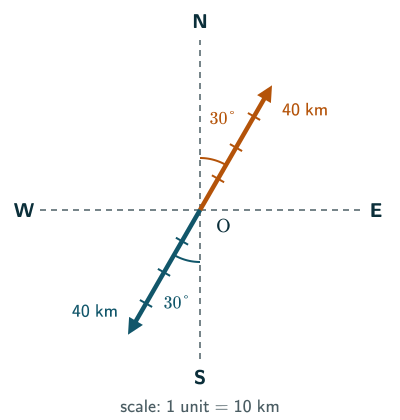
To represent a displacement graphically, choose a scale, draw the compass directions and lay off the direction and the length. NCERT Example 1 (page 341) draws 40 km, 30° west of south: from O, turn 30° from south towards west and draw 4 units at 1 unit = 10 km.
Solved examples
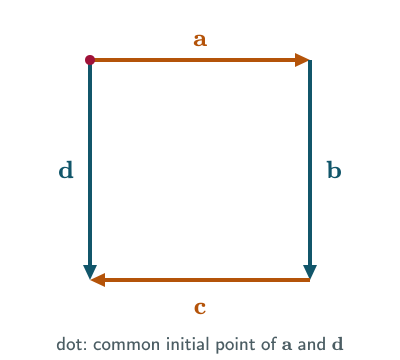
Example 1: Vectors on a square (NCERT Exercise 10.1, Q4, page 342)
In the square above, a runs along the top to the right, b down the right side, c along the bottom to the left and d down the left side. Identify vectors that are (i) coinitial; (ii) equal; (iii) collinear but not equal.
(i) a and d both start at the top left corner. (ii) b and d have the same length and both point down. (iii) a and c are parallel and equally long but point opposite ways, so c = −a.
Answer: (i) a and d; (ii) b and d; (iii) a and c.
NCERT slip (answers, page 451): the key to Exercise 10.1, Q4 (i) says “Vectors a and b are coinitial”. In Fig 10.6, b starts where a ends, at the top right corner; the vectors that share an initial point are a and d. In an exam, read the arrowheads and answer a and d.
Example 2: True or false (NCERT Exercise 10.1, Q5, page 342)
(i) a and −a are collinear. (ii) Two collinear vectors are always equal in magnitude. (iii) Two vectors having the same magnitude are collinear. (iv) Two collinear vectors having the same magnitude are equal.
(i) They lie along parallel lines. (ii) Collinear vectors may have any lengths. (iii) Equal lengths say nothing about direction. (iv) They may point in opposite directions, like a and −a.
Answer: (i) true; (ii) false; (iii) false; (iv) false.
Example 3: A regular hexagon
ABCDEF is a regular hexagon with centre O. Which of the vectors OC, FO, ED, DE are equal to AB?
In a regular hexagon each side is parallel to the opposite side and to one of the radii, and all of them have the same length. OC, FO and ED point the same way as AB; DE points the opposite way.
Answer: OC, FO and ED equal AB; DE = −AB.
Common mistakes to avoid
Common mistake
Collinear means equal
Collinear vectors only lie along parallel lines. For a ≠ 0, a and 3a are collinear but not equal, and so are a and −a.
Common mistake
Equal vectors must start at the same point
Equality ignores position: in the square, b and d are equal though they lie on opposite sides.
Common mistake
Giving the zero vector a nonzero magnitude or a fixed direction
0 has magnitude 0, so it is not a unit vector, and NCERT allows it any direction (page 341).
Quick revision summary
- Zero vector: magnitude 0, any direction. Unit vector: magnitude 1; â is the unit vector along a.
- Coinitial: same initial point. Collinear: parallel to the same line, any lengths and senses.
- Equal: same magnitude and same direction, anywhere. Negative: same magnitude, opposite direction, so BA = −AB.
- NCERT’s vectors are free vectors: moving one parallel to itself does not change it.
Formula sheet
- |0| = 0; |â| = 1
- BA = −AB
- equal vectors: same magnitude and same direction
Questions students ask
How many types of vectors are there in Class 12 maths?
NCERT Class 12 names six types of vectors in Section 10.3 (page 341): the zero (or null) vector, unit vectors, coinitial vectors, collinear vectors, equal vectors and the negative of a vector, and its Remark adds that all of them are free vectors, which may be moved parallel to themselves. The types overlap rather than sort vectors into separate boxes: one vector can be a unit vector, coinitial with a second vector and collinear with a third. Beyond this chapter, other books add names such as like and unlike vectors and coplanar vectors, and physics speaks of localised vectors, whose point of application matters.
What is the difference between collinear and coplanar vectors?
Collinear vectors are parallel to one line, while, beyond NCERT’s Chapter 10, coplanar vectors are vectors parallel to one plane, so collinear vectors are always coplanar but coplanar vectors need not be collinear. Any two vectors are coplanar, because two arrows drawn from one point always lie in a plane, so the idea matters only for three or more: î, ĵ and 2î − 3ĵ are coplanar, all parallel to the XY-plane, while î, ĵ and k̂ are not. Three vectors, two of them non-collinear, are coplanar exactly when the third is a sum of multiples of those two, as 2î − 3ĵ is of î and ĵ.
Are collinear vectors the same as parallel vectors?
Yes, in NCERT’s sense collinear vectors are parallel vectors: vectors are collinear when they are parallel to the same line, whatever their magnitudes and directions (page 341), so unlike collinear points they need not lie on one line. Two non-zero vectors a and b are collinear exactly when b = λa for some scalar λ, the test in components; beyond the NCERT text, they are called like vectors if λ > 0, as 2a and 5a are, and unlike vectors if λ < 0. NCERT’s Class 12 physics book keeps “parallel” for the same direction and says “antiparallel” for opposite ones (Physics Part I, page 27).
What is the difference between the zero vector, the null vector and the number 0?
The zero vector and the null vector are two names for one vector, 0, whose initial and terminal points coincide, as in AA or BB (NCERT page 341), while the number 0 is a scalar. There is only one zero vector, since every vector of magnitude 0 is 0, and printing it in bold keeps it apart from the number: a + (−a) = 0 is a vector, while its magnitude |0| = 0 and the dot product a · 0 = 0 are numbers. So a vector equation such as a − a = 0 keeps the bold zero on its right side.
Practice questions
Try each question first, then open the answer to check your working.
-
Q1. Represent graphically a displacement of 40 km, 30° east of north (NCERT Exercise 10.1, Q1, page 342).
Show answerHide answer
Draw N, E, S, W from a point O and choose 1 unit = 10 km. Turn 30° from north towards east and draw an arrow 4 units long, as in the figure above.
-
Q2. In the square of Example 1, a vector e runs along the diagonal from the top left corner to the bottom right corner. Which of a, b, c, d are coinitial with e? Is e collinear with any of them?
Show answerHide answer
a and d, which also start at the top left corner. No: the diagonal is parallel to no side (and |e| is √2 times a side), so e is neither collinear with nor equal to any of them.
-
Q3. True or false: (i) equal vectors are collinear; (ii) coinitial vectors are always collinear; (iii) if a = b, then |a| = |b|.
Show answerHide answer
(i) True: they are parallel to the same line. (ii) False: two vectors from one point may point anywhere. (iii) True: equal vectors have the same magnitude (and the same direction).
-
Q4. ABCD is a parallelogram. Name a vector equal to AB, a vector equal to AD, and the negative of AB.
Show answerHide answer
DC = AB and BC = AD, because opposite sides are parallel and equal. The negative of AB is BA, which also equals CD.