Matrices and their order
NCERT Class 12 Mathematics Chapter 3 Sections 3.1–3.2
Quick answer
A matrix is an ordered rectangular array of numbers or functions, written in square brackets and named by a capital letter. A matrix with m rows and n columns has order m × n and mn elements, and its element in row i and column j is written a, the row number first. The possible orders of a matrix with N elements are the factor pairs of N, taken both ways round.
With your textbook
NCERT Mathematics Part I (Class 12), Chapter 3 “Matrices”, Sections 3.1–3.2 “Introduction” and “Matrix”, pages 34–38.
Open the official NCERT chapter (PDF, 3.4 MB, ncert.nic.in) (opens in a new tab)
Checked against the 2026-27 reprint on .
What is a matrix?
Matrix
A matrix is an ordered rectangular array of numbers or functions. The numbers or functions are called the elements or the entries of the matrix.
NCERT Mathematics Part I (Class 12), Section 3.2, page 36
- Matrices are named by capital letters: A, B, C, …
- The elements are written inside square brackets, in rows and columns.
In plain words: a matrix is a table of numbers with the labels taken off. NCERT’s opening example (page 35): Radha has 15 notebooks and 6 pens, Fauzia 10 notebooks and 2 pens, and Simran 13 notebooks and 5 pens. With one row per friend and one column for notebooks and one for pens, the information becomes
The position of each number carries its meaning: the 2 in the second row and second column is Fauzia’s pens. NCERT also writes the same data the other way round, with one row for notebooks and one for pens. Matrices began as a compact way to handle the coefficients of systems of linear equations, and are now used in spreadsheets, in describing magnification, rotation and reflection, and in cryptography (NCERT Section 3.1, page 34).
Rows, columns and elements
In the above examples, the horizontal lines of elements are said to constitute, rows of the matrix and the vertical lines of elements are said to constitute, columns of the matrix.
NCERT Mathematics Part I (Class 12), Section 3.2, page 36
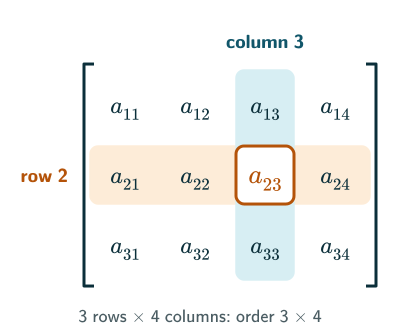
Rows are counted from the top and columns from the left. The element in row i and column j is written aij, read “a i j”, and called the (i, j)th element. The row number always comes first. In
the second row is 2, 9, −3, 5, the third column is 0, −3, 8, and a23 = −3, while a32 = 1.
Order of a matrix
A matrix having m rows and n columns is called a matrix of order m × n or simply m × n matrix (read as an m by n matrix).
NCERT Mathematics Part I (Class 12), Section 3.2.1, page 36
The matrix A above has order 3 × 4: rows first, then columns. An m × n matrix has mn elements, so A has 12. A general m × n matrix is written compactly as
A = [aij]m × n, 1 ≤ i ≤ m, 1 ≤ j ≤ n.
The ith row is ai1, ai2, …, ain and the jth column is a1j, a2j, …, amj (NCERT page 36). In this chapter all elements are real numbers or real-valued functions (NCERT page 37).
Possible orders. A matrix with N elements can have order m × n exactly when mn = N, so the possible orders come from the factor pairs of N, in both orders. NCERT Example 2 (page 38): 8 elements allow 1 × 8, 8 × 1, 2 × 4 and 4 × 2.
Points as matrices. A point in the plane (x, y) can be written as a column with entries x and y, or as the row [x y]. So the corners of a figure can be stored together. NCERT page 37 writes the quadrilateral with vertices A(1, 0), B(3, 2), C(1, 3), D(−1, 2) as the 2 × 4 matrix
with one column per vertex, or as a 4 × 2 matrix with one row per vertex.
Constructing a matrix from a formula
When a rule for aij is given, work out each element from its row number i and column number j. NCERT Example 3 (page 38) builds the 3 × 2 matrix with aij = ½|i − 3j|:
- row 1: a11 = ½|1 − 3| = 1, a12 = ½|1 − 6| = 5/2;
- row 2: a21 = ½|2 − 3| = 1/2, a22 = ½|2 − 6| = 2;
- row 3: a31 = ½|3 − 3| = 0, a32 = ½|3 − 6| = 3/2.
Work row by row and keep i and j in their places: here a12 = 5/2 but a21 = 1/2.
Solved examples
Example 1: Workers in three factories (NCERT Example 1, pages 37–38)
Factory I has 30 men and 25 women workers, factory II has 25 men and 31 women, and factory III has 27 men and 26 women. Write this as a 3 × 2 matrix. What does the entry in the third row and second column represent?
Use one row per factory and the columns men, women.
Answer: the matrix above; a32 = 26 is the number of women workers in factory III.
Example 2: Order and elements (NCERT Exercise 3.1, Q1, page 42)
For the matrix below, write (i) its order; (ii) the number of elements; (iii) the elements a13, a21, a33, a24 and a23.
There are 3 rows and 4 columns. Read each element as (row, column).
Answer: (i) 3 × 4; (ii) 12; (iii) a13 = 19, a21 = 35, a33 = −5, a24 = 12, a23 = 5/2.
Example 3: Possible orders (NCERT Exercise 3.1, Q2, page 42)
If a matrix has 24 elements, what are its possible orders? What if it has 13 elements?
24 = 1 × 24 = 2 × 12 = 3 × 8 = 4 × 6, and each pair can be taken either way round. 13 is prime, so its only factor pair is 1 × 13.
Answer: 1 × 24, 24 × 1, 2 × 12, 12 × 2, 3 × 8, 8 × 3, 4 × 6, 6 × 4 (eight orders); for 13 elements, 1 × 13 and 13 × 1.
Example 4: Three 2 × 2 matrices from formulas (NCERT Exercise 3.1, Q4, page 42)
Construct the 2 × 2 matrix A = [aij] when (i) aij = (i + j)2/2; (ii) aij = i/j; (iii) aij = (i + 2j)2/2.
(i) a11 = 4/2 = 2, a12 = a21 = 9/2, a22 = 16/2 = 8. (ii) a11 = 1, a12 = 1/2, a21 = 2, a22 = 1. (iii) a11 = 9/2, a12 = 25/2, a21 = 16/2 = 8, a22 = 36/2 = 18.
Answer:
(i)
(ii)
(iii)
Example 5: A 3 × 4 matrix (NCERT Exercise 3.1, Q5 (ii), page 42)
Construct the 3 × 4 matrix with aij = 2i − j.
Row i starts at 2i − 1 and each step to the right subtracts 1: row 1 is 1, 0, −1, −2; row 2 is 3, 2, 1, 0; row 3 is 5, 4, 3, 2.
Answer:
Common mistakes to avoid
Common mistake
Giving the order as columns × rows
A matrix with 2 rows and 3 columns has order 2 × 3, never 3 × 2. Rows come first in the order, just as the row number comes first in aij.
Common mistake
Swapping the subscripts
a23 is in row 2, column 3; a32 is in row 3, column 2. In NCERT Exercise 3.1, Q1, a23 = 5/2 but a32 = 1.
Common mistake
Listing only one order for each factor pair
A matrix with 6 elements can be 2 × 3 or 3 × 2; these are different orders. Count both, along with 1 × 6 and 6 × 1: four orders in all.
Quick revision summary
- A matrix is a rectangular array of numbers or functions, named by a capital letter.
- aij is the element in row i and column j; the row comes first.
- An m × n matrix has m rows, n columns and mn elements; the possible orders of a matrix with N elements come from the factor pairs of N, taken both ways.
- To construct a matrix from a rule for aij, work through each row, putting in i and j.
Formula sheet
- A = [aij] of order m × n: m rows, n columns
- aij = element in row i and column j
- number of elements = mn
Questions students ask
What is the difference between a matrix and a determinant?
A matrix is an arrangement of numbers (or functions) in rows and columns with no single value of its own, while a determinant is one number worked out from a square matrix A and written |A| or det A. A matrix can have any order m × n, but only a square matrix has a determinant, so a 2 × 3 matrix has none (NCERT Mathematics Part I (Class 12), Section 4.2, page 76). A matrix sits in square brackets and a determinant between straight bars, and different matrices can share a determinant: those with rows 1, 0 and 0, 1 and with rows 3, 2 and 4, 3 both have determinant 1. NCERT Section 4.2 (pages 76–81) defines |A| and shows how to find it.
Is the order of a matrix the same as its size or its rank?
The order of a matrix is the same thing as its size or dimensions, m × n for m rows and n columns, but it is not its rank, a term beyond the NCERT text. The rank is the largest number of rows that can be chosen so that none of them is a sum of multiples of the others (linearly independent rows), and it is never more than the smaller of m and n. For example, the matrix with rows 2, 1, −3, 5; 4, 2, −6, 10 and 0, 3, 1, 1 has order 3 × 4 but rank 2, because its second row is twice its first, while the first and third rows are independent. NCERT’s Chapters 3 and 4 do not use rank, and the JEE Main syllabus, Unit 3, does not name it.
How many possible orders can a matrix with N elements have?
A matrix with N elements has exactly as many possible orders as N has divisors, because each divisor m of N gives one order, m × (N/m). If N = paqb… for different primes p, q, …, the number of divisors, and so of orders, is (a + 1)(b + 1)…: 100 = 22 × 52 has 3 × 3 = 9 orders, running from 1 × 100, 2 × 50 and 4 × 25 up to 100 × 1. The count is odd exactly when N is a perfect square, and only then can the matrix be square, here 10 × 10.
Why is a matrix called an ordered rectangular array?
A matrix is called rectangular because its elements fill m complete rows of the same length n, a rectangle with no gaps, and ordered because each element has a fixed place, row i and column j, that is part of its meaning (NCERT Definition 1, page 36). So 1, 2, 3 in one row with only 4, 5 under it is not a matrix, and swapping two unequal elements gives a different matrix. Beyond the NCERT text, Sylvester named the matrix in 1850, after the Latin for womb, as the array from which smaller determinants, now called minors, are formed (MacTutor; Wikipedia, “Matrix (mathematics)”).
How are matrices used in real life?
Matrices are used wherever data comes in rows and columns, as in spreadsheets and cryptography, and to describe magnification, rotation and reflection (NCERT page 34). Beyond the NCERT text, a digital photo is a matrix of brightness values, one per pixel: a full-HD greyscale picture 1920 pixels wide and 1080 high is a 1080 × 1920 matrix with 2 073 600 elements, and a common RGB colour representation uses three such matrices, for red, green and blue. Google’s original PageRank ranked web pages using a matrix of the links between them. In Class 12 they solve linear equations written as one matrix equation AX = B.
Are matrices in the JEE Main 2027 syllabus?
Yes, matrices are in the JEE Main 2027 syllabus: Unit 3, Matrices and Determinants, lists “Matrices, algebra of matrices, type of matrices, determinants and matrices of order two and three, evaluation of determinants, area of triangles using determinants; Adjoint and inverse of a square matrix; Test of consistency and solution of simultaneous linear equations in two or three variables using matrices.” The matrix part is taught in NCERT Mathematics Part I (Class 12), Chapter 3, Sections 3.1–3.7, and the rest of the unit, from determinants to the solution of equations, in Chapter 4, Determinants.
Practice questions
Try each question first, then open the answer to check your working.
-
Q1. If a matrix has 18 elements, what are its possible orders? What if it has 5 elements? (NCERT Exercise 3.1, Q3, page 42)
Show answerHide answer
18 = 1 × 18 = 2 × 9 = 3 × 6, so: 1 × 18, 18 × 1, 2 × 9, 9 × 2, 3 × 6, 6 × 3. For 5 elements: 1 × 5 and 5 × 1.
-
Q2. Construct the 3 × 4 matrix with aij = ½|−3i + j| (NCERT Exercise 3.1, Q5 (i), page 42).
Show answerHide answer
Each element is half of |j − 3i|. Row 1 (i = 1): halves of 2, 1, 0, 1, that is 1, 1/2, 0, 1/2. Row 2: halves of 5, 4, 3, 2, that is 5/2, 2, 3/2, 1. Row 3: halves of 8, 7, 6, 5, that is 4, 7/2, 3, 5/2.
-
Q3. Construct the 2 × 3 matrix with aij = i + 2j, and find a13 + a21.
Show answerHide answer
Row 1: 3, 5, 7; row 2: 4, 6, 8. So a13 + a21 = 7 + 4 = 11.
-
Q4. How many matrices of order 3 × 3 have each entry 0 or 1? (A) 27; (B) 18; (C) 81; (D) 512 (NCERT Exercise 3.1, Q10, page 43)
Show answerHide answer
There are 9 entries, each with 2 choices, so by the multiplication principle there are 29 = 512 matrices: (D).