Operations on matrices
NCERT Class 12 Mathematics Chapter 3 Section 3.4
Quick answer
The operations on matrices are addition, subtraction, multiplication by a number (a scalar) and matrix multiplication; the first three work position by position, adding and subtracting only matrices of the same order, and obey the usual laws of numbers. The product AB is defined when A is m × n and B is n × p; it is an m × p matrix whose element in row i and column k is row i of A times column k of B, element by element, added up. Matrix multiplication is associative and distributive, but in general AB ≠ BA, and AB can be the zero matrix even when neither A nor B is.
With your textbook
NCERT Mathematics Part I (Class 12), Chapter 3 “Matrices”, Section 3.4 “Operations on Matrices”, pages 43–61.
Open the official NCERT chapter (PDF, 3.4 MB, ncert.nic.in) (opens in a new tab)
Checked against the 2026-27 reprint on .
What are the operations on matrices?
Sum, scalar multiple and product
We observe that the sum of two matrices is a matrix obtained by adding the corresponding elements of the given matrices. Furthermore, the two matrices have to be of the same order.
NCERT Mathematics Part I (Class 12), Section 3.4.1, page 44
- Scalar multiple: kA multiplies every element of A by the number k.
- Product: AB is defined when the number of columns of A equals the number of rows of B; its (i, k)th element is row i of A times column k of B, element by element, added up.
In plain words: adding, subtracting and scaling matrices work position by position, just like adding the entries of two tables with the same layout. Multiplying two matrices is different: each element of AB comes from a whole row of A and a whole column of B, so the shapes must fit and the order of the factors matters.
Addition
NCERT’s example (pages 43–44): Fatima’s two factories, at places A and B, make sports shoes for boys and girls in three price categories. Each factory’s output is a 3 × 2 matrix, and the total output is their sum, found position by position:
In general, if A = [aij] and B = [bij] have the same order m × n, then A + B = C = [cij] with cij = aij + bij (NCERT page 44). If the orders differ, A + B is not defined: a 2 × 2 matrix cannot be added to a 2 × 3 matrix.
Scalar multiple, negative and difference
If A = [aij] and k is a number (a scalar), then kA = [kaij]: every element is multiplied by k (NCERT page 45). When Fatima doubles the output of the factory at A in every category (NCERT pages 44–45), the first matrix above is multiplied by 2, giving the elements 160, 120; 150, 130; 180, 170.
The negative of A is −A = (−1)A, and the difference of two matrices of the same order is A − B = A + (−1)B, found by subtracting position by position (NCERT pages 45–46). NCERT Example 7 (page 46): with A of rows 1, 2, 3 and 2, 3, 1 and B of rows 3, −1, 3 and −1, 0, 2,
Properties of addition and scalar multiplication
For matrices A, B, C of the same order and scalars k, l (NCERT pages 46–47):
Laws for + and scalar multiples
A + B = B + A
(A + B) + C = A + (B + C)
A + O = O + A = A
A + (−A) = (−A) + A = O
k(A + B) = kA + kB
(k + l)A = kA + lA
Each law holds because it holds for every pair of corresponding numbers. So matrix equations of this kind are solved just like number equations. NCERT Example 8 (page 47) solves 2A + 3X = 5B as X = (1/3)(5B − 2A).
NCERT slip (page 47): in Section 3.4.4 the two properties are listed as (i) and (ii), but their proofs are labelled (ii) and (iii), and in the second proof the step after [(k + l) aij] is printed with a “+” where an “=” belongs. Element by element it should read (k + l)aij = kaij + laij. The property itself is right.
Multiplication of matrices
NCERT’s shop example (pages 50–51): Meera buys 2 pens and 5 story books, and Nadeem 8 pens and 10 books. At shop 1 a pen costs ₹5 and a book ₹50; at shop 2, ₹4 and ₹40. Put the purchases in the rows of one matrix and each shop’s prices in a column of another. Then each person’s bill at each shop is a row times a column:
For example, Meera at shop 1 pays 2 × 5 + 5 × 50 = ₹260.
The product of two matrices A and B is defined if the number of columns of A is equal to the number of rows of B.
NCERT Mathematics Part I (Class 12), Section 3.4.5, page 51
If A = [aij] is m × n and B = [bjk] is n × p, then AB = C = [cik] is m × p, with
Element of a product
c = ab + ab + … + ab
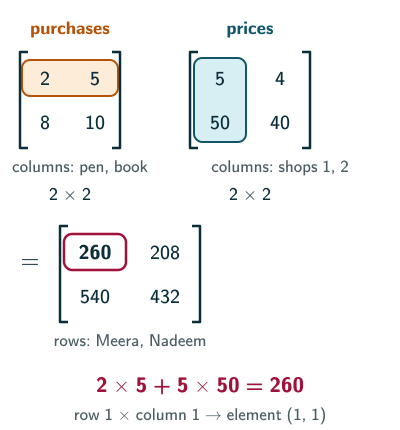
A quick check before multiplying: write the orders side by side, m × n and n × p. The inner numbers must be equal, and the outer numbers give the order m × p of the product.
Multiplication is not commutative
If AB is defined, then BA need not be defined.
NCERT Mathematics Part I (Class 12), Section 3.4.5, page 53
If A is m × n and B is k × l, both AB and BA are defined only when n = k and l = m (NCERT page 53). Even then they may differ. In NCERT Example 13 (page 53), A is 2 × 3 and B is 3 × 2, so AB is 2 × 2 but BA is 3 × 3. Equal orders do not help either; NCERT Example 14 (page 53):
So in general AB ≠ BA, and the order of the factors must be kept. Some pairs do commute: any two diagonal matrices of the same order, and any square matrix A with I, since A I = I A = A (NCERT page 54).
A zero product from non-zero matrices
For numbers, ab = 0 forces a = 0 or b = 0. For matrices it does not (NCERT Example 15, page 54):
Neither factor is O, yet the product is O. So AB = O does not let you conclude A = O or B = O, and AB = AC does not let you cancel A.
Properties of multiplication
NCERT states these without proof (page 54), whenever both sides are defined:
Laws for products
(AB)C = A(BC)
A(B + C) = AB + AC
(A + B)C = AC + BC
I A = A I = A, for a square A
NCERT Examples 16 and 17 (pages 54–56) check the associative and distributive laws with matrices of different shapes: in Example 16, A is 3 × 3, B is 3 × 2 and C is 2 × 4; in Example 17, A and B are 3 × 3 and C is a 3 × 1 column. Because products of the same square matrix can be taken in any grouping, powers make sense: A2 = AA and A3 = A A2. But (A + B)2 = A2 + AB + BA + B2, which matches the binomial theorem only when AB = BA. NCERT Example 18 (page 56) shows that the matrix A with rows 1, 2, 3; 3, −2, 1; 4, 2, 1 satisfies A3 − 23A − 40I = O, a matrix polynomial equation.
Solved examples
Example 1: Two unknown matrices (NCERT Example 9, page 48)
Find X and Y if X + Y and X − Y are the matrices below.
Adding the two equations gives 2X with rows 8, 8 and 0, 8. Subtracting the second from the first gives 2Y with rows 2, −4 and 0, 10.
Answer: X has rows 4, 4 and 0, 4; Y has rows 1, −2 and 0, 5.
Example 2: Unknowns from a matrix equation (NCERT Example 10, pages 48–49)
Find x and y from the equation below.
The left side has rows 2x + 3, 6 and 15, 2y − 4. Comparing elements: 2x + 3 = 7 and 2y − 4 = 14.
Answer: x = 2 and y = 9.
Example 3: Sums and products (NCERT Exercise 3.2, Q1)
For the matrices below, find A + B, A − B, 3A − C, AB and BA.
A + B and A − B go position by position. 3A − C = (6 + 2, 12 − 5; 9 − 3, 6 − 4). For AB, row 1 of A times the columns of B gives 2 − 8 = −6 and 6 + 20 = 26; row 2 gives 3 − 4 = −1 and 9 + 10 = 19. For BA, row 1 of B gives 2 + 9 = 11 and 4 + 6 = 10; row 2 gives −4 + 15 = 11 and −8 + 10 = 2.
Answer: A + B has rows 3, 7 and 1, 7; A − B has rows 1, 1 and 5, −3; 3A − C has rows 8, 7 and 6, 2; AB has rows −6, 26 and −1, 19; BA has rows 11, 10 and 11, 2. AB ≠ BA.
Example 4: A matrix polynomial (NCERT Exercise 3.2, Q17)
For A below, find k so that A2 = kA − 2I.
A2 = AA has rows 9 − 8, −6 + 4 and 12 − 8, −8 + 4, that is 1, −2 and 4, −4. kA − 2I has rows 3k − 2, −2k and 4k, −2k − 2. The (1, 2) elements give −2k = −2, so k = 1, and the other three then agree: 1, 4 and −4.
Answer: k = 1.
Example 5: Splitting an investment (NCERT Exercise 3.2, Q19)
₹30 000 is split between bonds paying 5% and 7% a year. How should it be split to earn (a) ₹1800; (b) ₹2000 a year?
With ₹x at 5% and ₹(30 000 − x) at 7%, the interest is the product of the row [x, 30 000 − x] and the column with entries 0.05 and 0.07: 0.05x + 0.07(30 000 − x) = 2100 − 0.02x.
Answer: (a) 2100 − 0.02x = 1800 gives x = 15 000: ₹15 000 in each bond. (b) 2100 − 0.02x = 2000 gives x = 5000: ₹5000 at 5% and ₹25 000 at 7%.
Example 6: Which orders work? (NCERT Exercise 3.2, Q21 and Q22)
X, Y, Z, W and P have orders 2 × n, 3 × k, 2 × p, n × 3 and p × k. (i) What restrictions on n, k and p make PY + WY defined? (ii) If n = p, what is the order of 7X − 5Z?
(i) PY needs the columns of P (k) to equal the rows of Y (3), so k = 3; WY is then n × k and PY is p × k, and adding them needs p = n. (ii) X and Z are both 2 × n, so 7X − 5Z is 2 × n.
Answer: (i) k = 3 and p = n, option (A); (ii) 2 × n, option (B).
Common mistakes to avoid
Common mistake
Multiplying element by element
AB is not found by multiplying matching positions. Each element of AB is a row of A times a column of B, added up.
Common mistake
Reordering a product
(A + B)2 = A2 + AB + BA + B2, not A2 + 2AB + B2, because AB and BA are usually different. The familiar formula holds only when AB = BA. Likewise (A + B)(A − B) = A2 − AB + BA − B2, not A2 − B2. And A2 = O does not force A = O: the matrix with rows 0, 1 and 0, 0 squares to O.
Common mistake
Cancelling or dividing by a matrix
AB = O does not mean A = O or B = O (NCERT Example 15), so AB = AC does not give B = C. There is no division by a matrix; the inverse matrix of the last topic of this chapter takes its place when it exists.
Common mistake
Adding matrices of different orders
A + B needs equal orders, and AB needs the columns of A to equal the rows of B. Check the orders before computing anything.
Quick revision summary
- Same order: A + B, A − B and kA are found position by position, and obey the usual laws of numbers.
- AB is defined when A is m × n and B is n × p; it is m × p, and its (i, k)th element is row i of A times column k of B.
- Matrix multiplication is associative and distributive with I as identity, but not commutative, and a product can be O with neither factor O.
Formula sheet
- A + B = [aij + bij]; kA = [kaij]; A − B = A + (−1)B
- AB: (m × n)(n × p) gives m × p
- cik = ai1b1k + ai2b2k + … + ainbnk
- (AB)C = A(BC); A(B + C) = AB + AC; I A = A I = A
- in general AB ≠ BA
Questions students ask
Why is matrix multiplication done row by column?
Matrix multiplication is done row by column because a matrix can stand for a set of linear expressions, and the product has to give what you get by substituting one set into another. If p = 4u − v, where u = 2x + 7y and v = 3x − y, then substituting gives p = 5x + 29y, and 5 and 29 are exactly the row [4, −1] times the two columns of the matrix with rows 2, 7 and 3, −1. Beyond the NCERT text, Arthur Cayley’s 1858 memoir on matrices set out the product this way, so that multiplying two matrices matches doing one such substitution after another; that is also why the number of columns of the first must equal the number of rows of the second.
What is the difference between matrix multiplication and the dot product?
The dot product of two vectors gives a single number, while matrix multiplication gives a whole matrix, each element of which is the dot product of a row of the first matrix with a column of the second. For a = 3î + 2ĵ + 5k̂ and b = 8î + 5ĵ + 8k̂, a · b = 74, the sum of 24, 10 and 40, and the same number comes out, as the 1 × 1 matrix [74], when the row [3, 2, 5] multiplies the column with entries 8, 5, 8. A 2 × 3 matrix times a 3 × 4 matrix therefore takes 2 × 4 = 8 dot products, one for each element of the product; the dot product itself is taught on the products of vectors page.
Why is matrix multiplication associative?
Matrix multiplication is associative, (AB)C = A(BC) whenever both sides are defined, because both sides have the same element in each position: in row i and column l, the sum of all the products aijbjkckl over every j and k, added in a different order. As substitutions, doing C, then B, then A gives one result however the steps are grouped, just as composition of functions is associative. Grouping changes only the work: for A of order 3 × 4, B 4 × 5 and C 5 × 1, (AB)C needs 60 + 15 = 75 multiplications of numbers and A(BC) only 20 + 12 = 32.
Why does the order matter in matrix multiplication, and when does AB = BA?
The order of the factors matters because AB combines the rows of A with the columns of B, while BA combines the rows of B with the columns of A, so the two products are built from different sums and usually differ, when both exist at all. Seen as moves of the plane, AB means doing B first and then A, and a sideways stretch followed by a quarter turn does not put a shape where a quarter turn followed by the same stretch does. AB = BA does hold when one factor is I or a scalar matrix kI, and, beyond the NCERT text, whenever B is a sum of multiples of powers of A and of I, such as A2 or 3A + 2I, since every power of A commutes with A.
Are elementary operations on matrices in NCERT Class 12 and the JEE Main 2027 syllabus?
No, elementary operations on matrices are no longer in NCERT Class 12 Mathematics: the current rationalised chapter omits the former section on elementary operations and finding an inverse by those operations. The JEE Main 2027 syllabus, Unit 3, does not name them either; it lists “algebra of matrices” and “Adjoint and inverse of a square matrix”, the inverse found from the adjoint in Chapter 4. Beyond the NCERT text, the three elementary row operations are swapping two rows, multiplying a row by a non-zero number and adding a multiple of one row to another, still used to solve equations by elimination.
Can you add a number to a matrix, as in A + 2?
No, a number cannot be added to a matrix, because addition is defined only between two matrices of the same order; in matrix algebra the number 2 is replaced by 2I, the scalar matrix with 2 down the diagonal. So the polynomial x2 + 3x − 10 becomes A2 + 3A − 10I for a square matrix A, its constant term becoming a multiple of I. For the 2 × 2 matrix A with rows 4, −3 and 1, 6, A + 2I has rows 6, −3 and 1, 8: only the diagonal changes, not every element.
Practice questions
Try each question first, then open the answer to check your working.
-
Q1. Find X and Y if X + Y has rows 7, 0 and 2, 5, and X − Y has rows 3, 0 and 0, 3 (NCERT Exercise 3.2, Q7 (i)).
Show answerHide answer
2X has rows 10, 0 and 2, 8, so X has rows 5, 0 and 1, 4. 2Y has rows 4, 0 and 2, 2, so Y has rows 2, 0 and 1, 1.
-
Q2. Find x, y, z and w from the equation below (NCERT Exercise 3.2, Q12).
Show answerHide answer
3x = x + 4 gives x = 2. 3y = 6 + x + y gives 2y = 8, so y = 4. 3w = 2w + 3 gives w = 3. 3z = −1 + z + w gives 2z = 2, so z = 1.
-
Q3. Find A2 − 5A + 6I for the matrix A below (NCERT Exercise 3.2, Q15).
Show answerHide answer
A2 has rows 5, −1, 2; 9, −2, 5; 0, −1, −2. Subtracting 5A and adding 6I gives the matrix with rows 1, −1, −3; −1, −1, −10; −5, 4, 4.
-
Q4. A school bookshop has 10 dozen chemistry books at ₹80 each, 8 dozen physics books at ₹60 each and 10 dozen economics books at ₹40 each. Use a row and a column matrix to find what it receives by selling them all (NCERT Exercise 3.2, Q20).
Show answerHide answer
The row [120, 96, 120] of numbers of books times the column of prices 80, 60, 40 gives 120 × 80 + 96 × 60 + 120 × 40 = 9600 + 5760 + 4800 = ₹20 160.