Transpose of a matrix
NCERT Class 12 Mathematics Chapter 3 Section 3.5
Quick answer
The transpose A′ of a matrix A is the matrix whose rows are the columns of A, so an m × n matrix has an n × m transpose and the element in row i and column j of A′ is the element in row j and column i of A. Transposing twice gives A back, and (kA)′ = kA′ and (A + B)′ = A′ + B′. For a product the order reverses: (AB)′ = B′A′.
With your textbook
NCERT Mathematics Part I (Class 12), Chapter 3 “Matrices”, Section 3.5 “Transpose of a Matrix”, pages 61–63.
Open the official NCERT chapter (PDF, 3.4 MB, ncert.nic.in) (opens in a new tab)
Checked against the 2026-27 reprint on .
What is the transpose of a matrix?
Transpose
If A = [a] be an m × n matrix, then the matrix obtained by interchanging the rows and columns of A is called the transpose of A.
NCERT Mathematics Part I (Class 12), Section 3.5, page 61
- The transpose of A is written A′ or A.
- If A = [aij] has order m × n, then A′ = [aji] has order n × m: the (i, j)th element of A′ is the (j, i)th element of A.
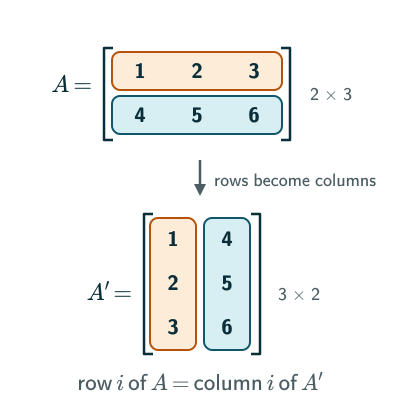
In plain words: the first row of A becomes the first column of A′, the second row becomes the second column, and so on. A 3 × 2 matrix turns into a 2 × 3 matrix. NCERT’s example (page 61):
For a square matrix the transpose is a reflection in the diagonal: the diagonal stays where it is, and each element above it swaps places with its mirror image below. A column matrix, such as a point (x, y) of the plane written as a column (NCERT page 37), transposes into a row matrix.
Properties of the transpose
We now state the following properties of transpose of matrices without proof.
NCERT Mathematics Part I (Class 12), Section 3.5.1, page 61
For matrices A and B of suitable orders and any number k (NCERT page 61):
Properties of the transpose
(A′)′ = A
(kA)′ = kA′
(A + B)′ = A′ + B′
(AB)′ = B′A′
The first three hold position by position: transposing twice puts every element back, and scaling or adding commutes with moving elements around. The fourth reverses the order. Reason, beyond what NCERT shows: the (i, k)th element of (AB)′ is the (k, i)th element of AB, which is row k of A times column i of B. That is the same as row i of B′ times column k of A′, the (i, k)th element of B′A′. Note also that A′B′ need not even be defined: if A is 2 × 3 and B is 3 × 4, then A′B′ would multiply a 3 × 2 matrix by a 4 × 3 one.
Beyond the NCERT text (reasoned from (AB)′ = B′A′; see Q9 below), the rule extends to longer products: (ABC)′ = C′B′A′.
Solved examples
Example 1: Three transposes (NCERT Exercise 3.3, Q1, page 66)
Find the transpose of each matrix.
Write each row as a column. (i) The column becomes the row [5, ½, −1]. (ii) The rows 1, −1 and 2, 3 become the columns, so A′ has rows 1, 2 and −1, 3.
Answer: (i) [5, ½, −1]; (ii) rows 1, 2 and −1, 3; (iii) rows −1, √3, 2; 5, 5, 3; 6, 6, −1.
Example 2: Transpose of a product (NCERT Example 21, page 63)
For the column A with entries −2, 4, 5 and the row B = [1, 3, −6], verify that (AB)′ = B′A′.
AB is 3 × 1 times 1 × 3, a 3 × 3 matrix: its rows are −2 × (1, 3, −6) = (−2, −6, 12), then (4, 12, −24) and (5, 15, −30). B′ is the column 1, 3, −6 and A′ is the row [−2, 4, 5], so B′A′ is the 3 × 3 matrix with rows (−2, 4, 5), (−6, 12, 15) and (12, −24, −30).
Answer: B′A′ has the columns of AB as its rows, so (AB)′ = B′A′.
Example 3: Using the rules (NCERT Exercise 3.3, Q4, page 67)
A′ and B are given below. Find (A + 2B)′.
(A + 2B)′ = A′ + 2B′. B′ has rows −1, 1 and 0, 2, so 2B′ has rows −2, 2 and 0, 4. Adding A′ gives rows −2 − 2, 3 + 2 and 1 + 0, 2 + 4.
Answer: (A + 2B)′ has rows −4, 5 and 1, 6.
Example 4: A′A = I (NCERT Exercise 3.3, Q6 (i), page 67)
For the matrix A below, verify that A′A = I.
A′ has rows cos α, −sin α and sin α, cos α. The (1, 1) element of A′A is cos2 α + sin2 α = 1, the (1, 2) element is cos α sin α − sin α cos α = 0, the (2, 1) element is likewise 0, and the (2, 2) element is sin2 α + cos2 α = 1.
Answer: A′A = I, for every α.
Example 5: Orders of AA′ and A′A
A is a 2 × 3 matrix. What are the orders of AA′ and A′A? Find both when A has rows 1, 0, 2 and 3, −1, 1.
A′ is 3 × 2, so AA′ is (2 × 3)(3 × 2) = 2 × 2 and A′A is (3 × 2)(2 × 3) = 3 × 3. AA′: row 1 times row 1 gives 1 + 0 + 4 = 5, row 1 times row 2 gives 3 + 0 + 2 = 5, row 2 times row 2 gives 9 + 1 + 1 = 11.
Answer: AA′ is 2 × 2, with rows 5, 5 and 5, 11. A′A is 3 × 3, with rows 10, −3, 5; −3, 1, −1; 5, −1, 5. Both are equal to their own transposes.
Common mistakes to avoid
Common mistake
Writing (AB)′ = A′B′
The order reverses: (AB)′ = B′A′. With A of order 2 × 3 and B of order 3 × 4, A′B′ is not even defined.
Common mistake
Keeping the order the same
The transpose of an m × n matrix is n × m. Only a square matrix keeps its order when transposed.
Common mistake
Moving the diagonal
Transposing a square matrix leaves a11, a22, … in place; only the elements off the diagonal swap with their mirror images.
Quick revision summary
- The transpose A′ (or A) is made by writing the rows of A as columns: A = [aij] of order m × n gives A′ = [aji] of order n × m.
- (A′)′ = A, (kA)′ = kA′ and (A + B)′ = A′ + B′, while (AB)′ = B′A′ reverses the order.
Formula sheet
- A = [aij] of order m × n ⇒ A′ = [aji] of order n × m
- (A′)′ = A; (kA)′ = kA′
- (A + B)′ = A′ + B′
- (AB)′ = B′A′
Questions students ask
What is the difference between the transpose and the inverse of a matrix?
The transpose of a matrix only rearranges its elements, rows into columns, so every matrix has one, while the inverse A is a new matrix with AA = AA = I that only some square matrices have. For example, the matrix with rows 1, 3 and 0, 1 has the transpose with rows 1, 0 and 3, 1 but the inverse with rows 1, −3 and 0, 1. Both reverse the order of a product: (AB)′ = B′A′ and, for invertible A and B, (AB) = BA; beyond the NCERT text, (A′) = (A)′ for an invertible A. They are equal only when AA′ = A′A = I, as for the matrix of NCERT Miscellaneous Exercise on Chapter 3, Q3 (page 72).
What is the product of a matrix and its transpose?
The product of a matrix A and its transpose is always defined, and beyond the NCERT text it is always a symmetric square matrix (Wikipedia, “Transpose”): for A of order m × n, AA′ is m × m and A′A is n × n (Example 5), and (AA′)′ = (A′)′A′ = AA′ by the rule (AB)′ = B′A′. Each diagonal element of AA′ is a row of A times itself, the sum of the squares of that row’s elements, so for real entries it is never negative and AA′ = O only when A = O; in A′A the columns of A play this part. For the row matrix A = [4, −3], AA′ = [25], since 4 + (−3) = 25, while A′A is the 2 × 2 matrix with rows 16, −12 and −12, 9.
How is the transpose of a matrix denoted, and who introduced it?
The transpose of a matrix A is denoted A′ or A (NCERT Definition 3, page 61), and NCERT mostly writes A′; neither A′ nor A is a derivative or a power. Beyond the NCERT text, other books also write A or A, and the idea goes back to Arthur Cayley, who defined it in his 1858 memoir on the theory of matrices (Wikipedia, “Transpose”).
What is the difference between the transpose of a matrix and a symmetric matrix?
The transpose is an operation that can be applied to any matrix, while a symmetric matrix is a square matrix that this operation leaves unchanged, A′ = A, as defined in NCERT Section 3.6 (page 63). The matrix with rows 4, −2 and −2, 7 is symmetric, but the one with rows 4, −2 and 2, 7 is not, because its transpose has rows 4, 2 and −2, 7. Every diagonal matrix, I included, is symmetric, and a non-square matrix never is, since transposing changes its order from m × n to n × m.
Is the transpose of a matrix in the JEE Main 2027 syllabus?
The transpose of a matrix is not named in the JEE Main 2027 syllabus, but the syllabus needs it: Unit 3, Matrices and Determinants, begins “Matrices, algebra of matrices, type of matrices” and lists the “Adjoint and inverse of a square matrix”, and NCERT defines the adjoint as the transpose of the matrix of cofactors (NCERT Mathematics Part I (Class 12), Section 4.5.1, page 87). So finding an adjoint uses it. The transpose itself is taught in NCERT Section 3.5, and the symmetric and skew symmetric matrices built on it in Section 3.6.
Practice questions
Try each question first, then open the answer to check your working.
-
Q1. For A and B below, verify that (A + B)′ = A′ + B′ and (A − B)′ = A′ − B′ (NCERT Exercise 3.3, Q2, page 66).
Show answerHide answer
A + B has rows −5, 3, −2; 6, 9, 9; −1, 4, 2, so (A + B)′ has rows −5, 6, −1; 3, 9, 4; −2, 9, 2, which is A′ + B′. A − B has rows 3, 1, 8; 4, 5, 9; −3, −2, 0, so (A − B)′ has rows 3, 4, −3; 1, 5, −2; 8, 9, 0, which is A′ − B′.
-
Q2. A′ has rows 3, 4; −1, 2; 0, 1 and B has rows −1, 2, 1 and 1, 2, 3. Verify that (A + B)′ = A′ + B′ and (A − B)′ = A′ − B′ (NCERT Exercise 3.3, Q3, page 66).
Show answerHide answer
A = (A′)′ has rows 3, −1, 0 and 4, 2, 1. A + B has rows 2, 1, 1 and 5, 4, 4, so (A + B)′ has rows 2, 5; 1, 4; 1, 4. B′ has rows −1, 1; 2, 2; 1, 3, and A′ + B′ has rows 2, 5; 1, 4; 1, 4. They agree. A − B has rows 4, −3, −1 and 3, 0, −2, so (A − B)′ has rows 4, 3; −3, 0; −1, −2, which is A′ − B′.
-
Q3. Verify (AB)′ = B′A′ for the column A with entries 0, 1, 2 and the row B = [1, 5, 7] (NCERT Exercise 3.3, Q5 (ii), page 67).
Show answerHide answer
AB has rows 0, 0, 0; 1, 5, 7; 2, 10, 14, so (AB)′ has rows 0, 1, 2; 0, 5, 10; 0, 7, 14. B′A′ is the column 1, 5, 7 times the row [0, 1, 2], with rows 0, 1, 2; 0, 5, 10; 0, 7, 14. They agree.
-
Q4. A has rows 2, −1 and 0, 4. Find (−3A)′ in two ways.
Show answerHide answer
−3A has rows −6, 3 and 0, −12, so (−3A)′ has rows −6, 0 and 3, −12. Also A′ has rows 2, 0 and −1, 4, and −3A′ has rows −6, 0 and 3, −12, the same.