Symmetric and skew symmetric matrices
NCERT Class 12 Mathematics Chapter 3 Section 3.6
Quick answer
A square matrix A is symmetric if A′ = A, so each element equals its mirror image across the diagonal, and skew symmetric if A′ = −A, so each element is the negative of its mirror image and every diagonal element is 0. For any square matrix A, A + A′ is symmetric and A − A′ is skew symmetric. So every square matrix splits as A = ½(A + A′) + ½(A − A′), the sum of a symmetric and a skew symmetric matrix.
With your textbook
NCERT Mathematics Part I (Class 12), Chapter 3 “Matrices”, Section 3.6 “Symmetric and Skew Symmetric Matrices”, pages 63–68.
Open the official NCERT chapter (PDF, 3.4 MB, ncert.nic.in) (opens in a new tab)
Checked against the 2026-27 reprint on .
What are symmetric and skew symmetric matrices?
Symmetric and skew symmetric matrices
A square matrix A = [a] is said to be symmetric if A′ = A, that is, [a] = [a] for all possible values of i and j.
NCERT Mathematics Part I (Class 12), Section 3.6, page 63
- A square matrix A is skew symmetric if A′ = −A, that is aji = −aij for all i and j (NCERT Definition 5, page 63).
In plain words: a symmetric matrix is its own mirror image in the diagonal, so it equals its transpose. In a skew symmetric matrix each element is the negative of its mirror image. The word is used as for symmetric relations: there (a, b) and (b, a) come together, and here aij and aji are equal. NCERT’s examples (pages 63–64):
A is symmetric and B is skew symmetric.
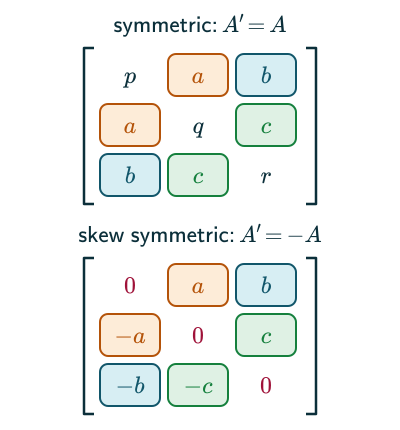
The diagonal of a skew symmetric matrix
Putting i = j in aji = −aij gives aii = −aii, so 2aii = 0 (NCERT page 63):
This means that all the diagonal elements of a skew symmetric matrix are zero.
NCERT Mathematics Part I (Class 12), Section 3.6, page 63
A matrix that is both symmetric and skew symmetric has aij = aji = −aij, so every element is 0: it is the zero matrix (NCERT Miscellaneous Exercise, Q10, page 73).
A + A′ and A − A′
NCERT Theorem 1 (page 64): for any square matrix A with real entries, A + A′ is symmetric and A − A′ is skew symmetric. The proof uses the rules for the transpose:
- (A + A′)′ = A′ + (A′)′ = A′ + A = A + A′;
- (A − A′)′ = A′ − (A′)′ = A′ − A = −(A − A′).
Halving does not change this, because (kA)′ = kA′. For A with rows 2, −3 and 4, 1, for example, A + A′ has rows 4, 1 and 1, 2, which is symmetric, and A − A′ has rows 0, −7 and 7, 0, which is skew symmetric.
Symmetric part plus skew symmetric part
Any square matrix can be expressed as the sum of a symmetric and a skew symmetric matrix.
NCERT Mathematics Part I (Class 12), Section 3.6, page 64
The proof is one line (NCERT page 64):
Splitting a square matrix
A = ½(A + A′) + ½(A − A′)
P = ½(A + A′) is symmetric
Q = ½(A − A′) is skew symmetric
Beyond what NCERT states, the split is unique: if A = P + Q with P symmetric and Q skew symmetric, then A′ = P − Q, so P = ½(A + A′) and Q = ½(A − A′) are forced.
NCERT Example 22 (pages 65–66). For B with rows 2, −2, −4; −1, 3, 4; 1, −2, −3, the transpose B′ has rows 2, −1, 1; −2, 3, −2; −4, 4, −3. Then P = ½(B + B′) and Q = ½(B − B′) are
and P + Q = B.
NCERT slip (page 66): checking that Q is skew symmetric, NCERT writes Q′ with first row 0, 1/2, 5/3. The last entry should be 5/2, the negative of Q’s (1, 3) element −5/2; with 5/3, Q′ would not equal −Q. Use 5/2.
Solved examples
Example 1: Checking the definitions (NCERT Exercise 3.3, Q7)
Show that the first matrix is symmetric and the second is skew symmetric.
In A, the mirror pairs are equal: a12 = a21 = −1, a13 = a31 = 5, a23 = a32 = 1. In B the diagonal is 0 and b21 = −1 = −b12, b31 = 1 = −b13, b32 = −1 = −b23.
Answer: A′ = A, so A is symmetric; B′ = −B, so B is skew symmetric.
Example 2: A 2 × 2 split (NCERT Exercise 3.3, Q10 (i))
Write A with rows 3, 5 and 1, −1 as the sum of a symmetric and a skew symmetric matrix.
A′ has rows 3, 1 and 5, −1. A + A′ has rows 6, 6 and 6, −2, so P = ½(A + A′) has rows 3, 3 and 3, −1. A − A′ has rows 0, 4 and −4, 0, so Q = ½(A − A′) has rows 0, 2 and −2, 0.
Answer: A = P + Q with P (rows 3, 3 and 3, −1) symmetric and Q (rows 0, 2 and −2, 0) skew symmetric.
Example 3: A product of symmetric matrices (NCERT Miscellaneous Example 24, pages 70–71)
A and B are symmetric matrices of the same order. Show that AB is symmetric exactly when AB = BA.
(AB)′ = B′A′ = BA, because A′ = A and B′ = B. So (AB)′ = AB holds exactly when BA = AB.
Answer: AB is symmetric if and only if A and B commute.
Example 4: Choose the correct answer (NCERT Exercise 3.3, Q11)
If A and B are symmetric matrices of the same order, then AB − BA is (A) skew symmetric; (B) symmetric; (C) a zero matrix; (D) an identity matrix.
(AB − BA)′ = (AB)′ − (BA)′ = B′A′ − A′B′ = BA − AB = −(AB − BA).
Answer: (A), skew symmetric. (This is also NCERT Miscellaneous Exercise, Q1, page 72.)
Example 5: How many free entries? (beyond NCERT)
How many entries can be chosen freely in a symmetric matrix of order 3, and in a skew symmetric matrix of order 3?
A symmetric matrix is fixed by its diagonal and the 3 entries above it: 3 + 3 = 6 free entries. A skew symmetric matrix has a zero diagonal, so only the 3 entries above it are free.
Answer: 6 and 3. In general, n(n + 1)/2 for symmetric and n(n − 1)/2 for skew symmetric matrices of order n (beyond the NCERT text, reasoned from the definitions).
Common mistakes to avoid
Common mistake
Letting a skew symmetric matrix have a non-zero diagonal
The matrix with rows 2, 3 and −3, 2 is not skew symmetric: its transpose has rows 2, −3 and 3, 2, while its negative has rows −2, −3 and 3, −2. A skew symmetric matrix must have 0 on the diagonal.
Common mistake
Forgetting the halves
The symmetric part is ½(A + A′), not A + A′. Without the halves, the two parts add up to 2A.
Common mistake
Assuming a product of symmetric matrices is symmetric
(AB)′ = BA, so AB is symmetric only when AB = BA. The symmetric matrices with rows 1, 0; 0, 2 and 0, 1; 1, 0 have product with rows 0, 1 and 2, 0, which is not symmetric.
Quick revision summary
- Symmetric: A′ = A (aji = aij). Skew symmetric: A′ = −A (aji = −aij), so its diagonal is all zeros.
- For any square A, A + A′ is symmetric and A − A′ is skew symmetric.
- Every square matrix is uniquely the sum of a symmetric and a skew symmetric matrix: A = ½(A + A′) + ½(A − A′).
Formula sheet
- symmetric: A′ = A; skew symmetric: A′ = −A, so aii = 0
- A + A′ is symmetric; A − A′ is skew symmetric
- A = ½(A + A′) + ½(A − A′)
Questions students ask
Is a skew symmetric matrix the same as an antisymmetric or a non-symmetric matrix?
A skew symmetric matrix, a square matrix with A′ = −A, is what other books, beyond the NCERT text, call an antisymmetric matrix (Wikipedia, “Skew-symmetric matrix”), but it is not the same as a non-symmetric matrix, which only needs A′ ≠ A: every non-zero skew symmetric matrix is non-symmetric, but not conversely. The matrix with rows 1, 4 and 2, 3 is non-symmetric, since 4 ≠ 2, but not skew symmetric, since its diagonal is not 0, so it is neither symmetric nor skew symmetric. For relations, antisymmetric means something else (types of relations).
What is the determinant of a skew symmetric matrix, and can it be invertible?
The determinant of a skew symmetric matrix of odd order is always 0, so it never has an inverse: A′ = −A gives |A| = −|A|, so |A| = 0, since |A′| = |A| (beyond the NCERT text) and |−A| = −|A| for odd order. One of even order can be invertible: the one with rows 0, 5 and −5, 0 has determinant 0 − 5 × (−5) = 25. Beyond the NCERT text, the determinant of a real skew symmetric matrix of even order is the square of a polynomial in its entries, so it is never negative (Wikipedia, “Skew-symmetric matrix”), like b for rows 0, b and −b, 0.
Is the inverse of a symmetric matrix symmetric?
Yes, the inverse of an invertible symmetric matrix is symmetric: beyond the NCERT text, the inverse of a transpose is the transpose of the inverse, (A)′ = (A′), and A′ = A turns this into (A)′ = A. For example, the symmetric matrix with rows 5, 2 and 2, 1 has the inverse with rows 1, −2 and −2, 5, also symmetric: their product in either order is I. In the same way the inverse of an invertible skew symmetric matrix is skew symmetric, since (A)′ = (A′) = (−A) = −A; the matrix with rows 0, 5 and −5, 0 has the inverse with rows 0, −1/5 and 1/5, 0.
How many symmetric and skew symmetric matrices of order 3 have entries from {−1, 0, 1}?
There are 3 = 729 symmetric matrices of order 3 with entries from {−1, 0, 1}, and 3 = 27 skew symmetric ones. A symmetric one is fixed by its 3 diagonal entries and the 3 above the diagonal, each chosen in 3 ways, while a skew symmetric one has 0 on the diagonal and only the 3 entries above it free, as Example 5 counts; each of these can be −1, 0 or 1, since the set also holds its negative for the mirror entry. With entries 0 or 1 only, there is just one skew symmetric matrix, the zero matrix, since aij and −aij are both 0 or 1 only when they are 0.
Practice questions
Try each question first, then open the answer to check your working.
-
Q1. Express the matrix below as the sum of a symmetric and a skew symmetric matrix (NCERT Exercise 3.3, Q10 (iii)).
Show answerHide answer
P = ½(A + A′) has rows 3, ½, −5/2; ½, −2, −2; −5/2, −2, 2. Q = ½(A − A′) has rows 0, 5/2, 3/2; −5/2, 0, 3; −3/2, −3, 0. P is symmetric, Q is skew symmetric and P + Q = A.
-
Q2. Find ½(A + A′) and ½(A − A′) for A with rows 0, a, b; −a, 0, c; −b, −c, 0 (NCERT Exercise 3.3, Q9).
Show answerHide answer
A′ = −A, since A is skew symmetric. So ½(A + A′) is the 3 × 3 zero matrix and ½(A − A′) = A.
-
Q3. If A is skew symmetric, show that A2 is symmetric.
Show answerHide answer
(A2)′ = (AA)′ = A′A′ = (−A)(−A) = A2. So A2 is symmetric.
-
Q4. For a square matrix A, show that B′AB is symmetric if A is symmetric and skew symmetric if A is skew symmetric (NCERT Miscellaneous Exercise, Q2, page 72).
Show answerHide answer
(B′AB)′ = B′A′(B′)′ = B′A′B. If A′ = A this is B′AB, so B′AB is symmetric; if A′ = −A it is −B′AB, so B′AB is skew symmetric.