Types of matrices
NCERT Class 12 Mathematics Chapter 3 Section 3.3
Quick answer
The basic types of matrices, the seven of NCERT Section 3.3, are the row matrix (one row), the column matrix (one column), the square matrix (as many rows as columns), the diagonal, scalar and identity matrices, and the zero matrix O. A square matrix is diagonal if every element off the diagonal is 0, scalar if it is diagonal with equal diagonal elements, and the identity matrix I if those elements are all 1; a zero matrix has every element 0. Two matrices are equal only when they have the same order and equal elements in every position.
With your textbook
NCERT Mathematics Part I (Class 12), Chapter 3 “Matrices”, Section 3.3 “Types of Matrices”, pages 39–43.
Open the official NCERT chapter (PDF, 3.4 MB, ncert.nic.in) (opens in a new tab)
Checked against the 2026-27 reprint on .
What are the types of matrices?
Types of matrices
- A column matrix has only one column; a row matrix has only one row.
- A square matrix has as many rows as columns.
- A diagonal matrix is a square matrix whose elements off the diagonal are all zero; a scalar matrix is a diagonal matrix with all its diagonal elements equal; the identity matrix is the scalar matrix with 1 on the diagonal.
- A zero matrix has all its elements zero.
A matrix in which the number of rows are equal to the number of columns, is said to be a square matrix.
NCERT Mathematics Part I (Class 12), Section 3.3, page 39
In plain words: the order of a matrix and the pattern of its zeros decide its type. Row and column matrices are thin, square matrices have equal sides, and the special square matrices keep their non-zero elements on the diagonal.
Row and column matrices
NCERT page 39: a column matrix has order m × 1 and a row matrix has order 1 × n. For example
is a column matrix of order 4 × 1, and B = [−½, √5, 2, 3] is a row matrix of order 1 × 4. A point (x, y) of the plane is often written as a column matrix of order 2 × 1 (NCERT page 37).
Square matrices and the diagonal
An m × n matrix is square when m = n, and is then called a square matrix of order n (NCERT page 39). NCERT introduces the diagonal for square matrices: in a square matrix A = [aij] of order n, the elements a11, a22, …, ann form the diagonal of A (NCERT’s note, page 39). More generally, a rectangular matrix also has main-diagonal entries with equal row and column indices, up to min(m, n); the diagonal, scalar and identity matrix types below are square, following NCERT’s definitions.
The diagonal runs from the top left to the bottom right, through the elements whose row number equals their column number. In NCERT’s example
the diagonal elements are 1, 4 and 6.
Diagonal, scalar and identity matrices
A square matrix B = [bij] is a diagonal matrix if bij = 0 whenever i ≠ j (NCERT page 40). The diagonal elements themselves may be anything, zero included. NCERT’s examples are [4] and
A diagonal matrix is a scalar matrix if its diagonal elements are all equal to one constant k: NCERT’s examples (page 40) are [3], the 2 × 2 matrix with −1 down the diagonal and the 3 × 3 matrix with √3 down the diagonal.
The identity matrix of order n, written In or just I, has 1 on the diagonal and 0 elsewhere:
Observe that a scalar matrix is an identity matrix when k = 1.
NCERT Mathematics Part I (Class 12), Section 3.3, page 40
So the types sit inside one another: every identity matrix is scalar, every scalar matrix is diagonal, and every diagonal matrix is square.
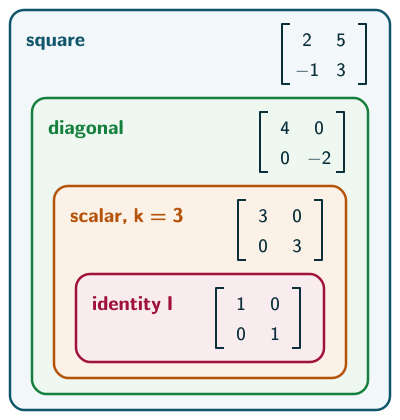
Zero matrix
A matrix is said to be zero matrix or null matrix if all its elements are zero.
NCERT Mathematics Part I (Class 12), Section 3.3, page 41
A zero matrix can have any order: [0], the 2 × 2 and 2 × 3 matrices of zeros, and the row [0 0] are all zero matrices. Each is written O, and its order is read from the context (NCERT page 41).
Equality of matrices
NCERT Definition 2 (page 41): two matrices A = [aij] and B = [bij] are equal if
- they have the same order, and
- aij = bij for every i and j.
So two matrices with the same elements in different places are not equal; NCERT’s pair with rows 3, 2; 0, 1 and 2, 3; 0, 1 differ in their first row. A 2 × 3 matrix can never equal a 3 × 2 matrix.
An equation between matrices is many ordinary equations at once, one for each position. That is how unknowns are found:
gives x = −1.5, y = 0, z = 2, a = √6, b = 3 and c = 2 (NCERT page 41).
Solved examples
Example 1: Six unknowns (NCERT Example 4, page 41)
Find a, b, c, x, y and z if
equals
Compare the elements in the same positions: x + 3 = 0, z + 4 = 6, 2y − 7 = 3y − 2, a − 1 = −3, 0 = 2c + 2 and b − 3 = 2b + 4.
Answer: a = −2, b = −7, c = −1, x = −3, y = −5, z = 2.
Example 2: Two pairs of equations (NCERT Example 5, pages 41–42)
Find a, b, c and d if
The first row gives 2a + b = 4 and a − 2b = −3; doubling the first and adding gives 5a = 5. The second row gives 5c − d = 11 and 4c + 3d = 24; three times the first plus the second gives 19c = 57.
Answer: a = 1, b = 2, c = 3, d = 4.
Example 3: A product condition (NCERT Exercise 3.1, Q6 (ii), page 42)
Find x, y and z if
5 + z = 5 gives z = 0. Also x + y = 6 and xy = 8, so x and y are the roots of t2 − 6t + 8 = 0, that is 2 and 4.
Answer: x = 4, y = 2, z = 0, or x = 2, y = 4, z = 0.
Example 4: Equations that clash (NCERT Exercise 3.1, Q9, page 43)
Which values of x and y make these matrices equal? (A) x = −1/3, y = 7; (B) not possible to find; (C) y = 7, x = −2/3; (D) x = −1/3, y = −2/3.
The (1, 1) elements need 3x + 7 = 0, so x = −7/3, but the (2, 2) elements need 2 − 3x = 4, so x = −2/3. Also y − 2 = 5 gives y = 7 while y + 1 = 8 gives y = 7.
Answer: (B): no single x works, so the matrices are never equal.
Common mistakes to avoid
Common mistake
Thinking a diagonal matrix needs non-zero diagonal elements
Only the elements off the diagonal must be zero. The 2 × 2 matrix with diagonal 5, 0 is a diagonal matrix, and so is the zero square matrix.
Common mistake
Calling a non-square matrix diagonal or scalar
Diagonal, scalar and identity matrices are square by definition. A 2 × 3 matrix whose only non-zero elements are a11 and a22 is not called a diagonal matrix.
Common mistake
Equating matrices of different orders
Equal matrices must have the same order first. If a question equates a 2 × 2 matrix with a 2 × 3 one, there is no solution, whatever the elements.
Quick revision summary
- Column matrix: order m × 1; row matrix: order 1 × n; square matrix: order n × n.
- The diagonal of a square matrix is a11, a22, …, ann.
- Diagonal: aij = 0 for i ≠ j. Scalar: diagonal with all diagonal elements equal to k. Identity I: scalar with k = 1. Zero matrix O: every element 0.
- A = B when the orders match and aij = bij for every i and j; one matrix equation gives one ordinary equation per position.
Formula sheet
- column matrix: m × 1; row matrix: 1 × n; square matrix: m = n
- diagonal: aij = 0 for i ≠ j
- scalar: diagonal with aii = k; identity I: k = 1
- A = B ⇔ same order and aij = bij for all i, j
Questions students ask
Is a unit matrix the same as an identity matrix?
Yes, unit matrix is another widely used name, beyond the NCERT text, for the identity matrix In, the square matrix with every diagonal element 1 and every other element 0; NCERT itself uses only the name identity matrix (Section 3.3, page 40). Both names fit the part it plays in multiplication, that of the number 1: A I = I A = A for every square matrix A of the same order, one of the laws for products. A matrix with every element 1, such as the 2 × 2 matrix of four 1s, is not the identity matrix, and because a few references call that all-ones matrix the unit matrix, identity matrix is the safer name.
Why is a scalar matrix called scalar?
A scalar matrix is called scalar because it is a number k, a scalar, times the identity matrix, kI, and multiplying by it does what multiplying by that number does: (kI)A = A(kI) = kA for every square matrix A of its order. For example, the 2 × 2 scalar matrix with 4 down the diagonal turns the matrix with rows 1, 3 and 2, 5 into the one with rows 4, 12 and 8, 20, from either side. So the one matrix kI does the work of the scalar multiple kA for every matrix A it can multiply. Beyond the NCERT text, scalar matrices are the only square matrices that commute with every square matrix of the same order.
What is a triangular matrix?
A triangular matrix, a type beyond the NCERT text, is a square matrix with every element on one side of the diagonal 0: upper triangular when every element below the diagonal is 0 (aij = 0 for i > j), lower triangular when every one above it is 0 (aij = 0 for i < j). The matrix with rows 2, −1, 7; 0, 3, 5 and 0, 0, −4 is upper triangular, and its mirror image across the diagonal, with rows 2, 0, 0; −1, 3, 0 and 7, 5, −4, is lower triangular. A matrix is both exactly when it is diagonal, so every diagonal matrix, I included, is triangular. Chapter 4 inverts an upper triangular matrix.
What is the principal diagonal of a matrix, and what is its trace?
The principal diagonal of a square matrix, also called its main or leading diagonal (names beyond the NCERT text), is what NCERT calls the diagonal: a11, a22, …, ann, from the top left to the bottom right. The other diagonal, which NCERT does not name, is the secondary diagonal, the elements with i + j = n + 1, such as a13, a22 and a31 of a 3 × 3 matrix. The trace, also beyond the NCERT text, is the sum of the principal diagonal elements: the matrix with rows 19, 1, 0; 2, 25, 3 and 6, 8, 15 has trace 19 + 25 + 15 = 59, and In has trace n.
What is the square or any power of a diagonal matrix?
Every positive integer power of a diagonal matrix is again a diagonal matrix, with each diagonal element raised to that power: the 3 × 3 diagonal matrix with diagonal 2, −5, 3 has a square with diagonal 4, 25, 9 and a cube with diagonal 8, −125, 27. This works because the product of two diagonal matrices of the same order is diagonal, each diagonal element being the product of the two in that position, which is also why such matrices commute. In particular I2 = I, and indeed In = I for every natural number n, while a scalar matrix gives (kI)n = knI. The zeroth power is I. Negative integer powers exist only when every diagonal entry is non-zero; their entries are the corresponding negative powers.
Can a matrix be a row matrix and a column matrix at the same time?
Yes, but only a 1 × 1 matrix [a] is both a row matrix and a column matrix, since it alone has exactly one row and exactly one column. It is also square, diagonal and scalar, as NCERT’s examples [4] and [3] of order 1 show (page 40), and beyond the NCERT text it counts as triangular too; [1] is the identity matrix I1, and [0] is the zero matrix of order 1. Every other row matrix has at least two columns, so it is not a column matrix and not square.
Practice questions
Try each question first, then open the answer to check your working.
-
Q1. Find x, y and z in each equation (NCERT Exercise 3.1, Q6 (i) and (iii), page 42).
Show answerHide answer
(i) Matching positions: y = 4, z = 3, x = 1. (ii) Subtracting x + z = 5 from x + y + z = 9 gives y = 4; then z = 7 − 4 = 3 and x = 5 − 3 = 2.
-
Q2. Find a, b, c and d (NCERT Exercise 3.1, Q7, page 42).
Show answerHide answer
a − b = −1 and 2a − b = 0 give a = 1, b = 2. Then 2 + c = 5 gives c = 3, and 9 + d = 13 gives d = 4.
-
Q3. A = [aij]m × n is a square matrix if (A) m < n; (B) m > n; (C) m = n; (D) none of these (NCERT Exercise 3.1, Q8, page 43).
Show answerHide answer
A square matrix has as many rows as columns: (C).
-
Q4. Which of these are diagonal, scalar or identity matrices?
Show answerHide answer
(i) Diagonal and scalar (k = 7), not identity. (ii) Diagonal, not scalar (the diagonal elements 2, 0, −1 differ). (iii) None: a21 = 1 is off the diagonal.