Properties of inverse trigonometric functions
NCERT Class 12 Mathematics Chapter 2 Section 2.3
Quick answer
The properties of inverse trigonometric functions in NCERT Class 12 are cancellation rules on the principal branches: sin(sin x) = x for x in [−1, 1], but sin(sin x) = x only for x in [−π/2, π/2], so sin(sin 3π/5) is 2π/5, the angle in that range with the same sine. Expressions are simplified by substitutions such as x = sin θ, x = tan θ or x = sec θ, checking at the end that the angle lies in the principal range. For JEE, sin x + cos x = π/2 and tan x + tan y = tan((x + y)/(1 − xy)) when xy < 1.
With your textbook
NCERT Mathematics Part I (Class 12), Chapter 2 “Inverse Trigonometric Functions”, Section 2.3 “Properties of Inverse Trigonometric Functions”, pages 27–30.
Open the official NCERT chapter (PDF, 1.4 MB, ncert.nic.in) (opens in a new tab)
Checked against the 2026-27 reprint on .
What are the properties of inverse trigonometric functions?
The cancellation properties
It may be mentioned here that these results are valid within the principal value branches of the corresponding inverse trigonometric functions and wherever they are defined.
NCERT Mathematics Part I (Class 12), Section 2.3, page 27
- y = sin x exactly when x = sin y and y lies in [−π/2, π/2] (NCERT page 27).
- So sin(sin x) = x for every x in [−1, 1], and sin(sin x) = x for every x in [−π/2, π/2] (NCERT page 27).
- The other five functions behave the same way, each on its own principal range.
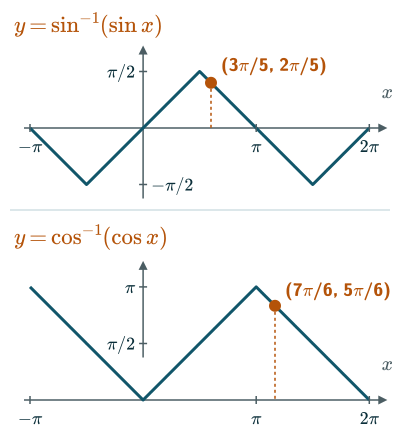
In plain words: a function and its inverse undo each other, but only inside the right sets. sin(sin x) = x holds for every input sin accepts. sin(sin x) = x holds only when x is already in the principal range [−π/2, π/2], because sin can never give back an angle outside that range. For other x, sin(sin x) is the angle in [−π/2, π/2] with the same sine.
Function of inverse, and inverse of function
Cancellation on the principal branches
sin(sin x) = x, for −1 ≤ x ≤ 1
sin(sin x) = x, for −π/2 ≤ x ≤ π/2
cos(cos x) = x, for −1 ≤ x ≤ 1
cos(cos x) = x, for 0 ≤ x ≤ π
tan(tan x) = x, for every real x
tan(tan x) = x, for −π/2 < x < π/2
For suitable values of domain similar results follow for remaining trigonometric functions.
NCERT Mathematics Part I (Class 12), Section 2.3, page 27
The ranges in the second, fourth and sixth lines are the principal ranges of the previous topic: cot(cot x) = x on (0, π), sec(sec x) = x on [0, π] − {π/2}, and cosec(cosec x) = x on [−π/2, π/2] − {0}.
Values outside the principal branch
To find sin(sin a) when a is outside [−π/2, π/2], look for the angle in [−π/2, π/2] with the same sine, using the facts about angles such as π − x from Class 11: sin(π − a) = sin a, cos(2π − a) = cos a, tan(a − π) = tan a.
NCERT Miscellaneous Example 6 (page 30): sin(sin 3π/5). Since 3π/5 > π/2, the answer is not 3π/5. But sin(3π/5) = sin(π − 3π/5) = sin(2π/5), and 2π/5 lies in [−π/2, π/2]. So sin(sin 3π/5) = 2π/5. NCERT’s solution first writes 3π/5 from the rule sin(sin x) = x and then rejects it, because the rule needs x in [−π/2, π/2]. That first line is the trap to avoid.
- NCERT slip (page 30): the line above Exercise 2.2, Q10–Q12 reads “Find the values of each of the expressions in Exercises 16 to 18.” The questions it introduces are numbered 10 to 12.
Simplifying with a trigonometric substitution
An expression in x often becomes simple after putting x = sin θ, cos θ, tan θ or sec θ, so that a square root turns into a single trigonometric function:
- √(1 − x2): put x = sin θ (or cos θ);
- √(1 + x2): put x = tan θ;
- √(x2 − 1): put x = sec θ.
Then simplify with the double angle formulas of Class 11, and before cancelling an inverse function with its function, check that the angle lies in the principal range. The restriction on x in the question is what makes this true.
NCERT Example 3 (page 28): show that sin(2x√(1 − x2)) = 2 sin x for −1/√2 ≤ x ≤ 1/√2. Put x = sin θ with θ = sin x. Then √(1 − x2) = cos θ (not negative, since θ lies in [−π/2, π/2]), and
sin(2 sin θ cos θ) = sin(sin 2θ) = 2θ = 2 sin x.
The step sin(sin 2θ) = 2θ needs 2θ in [−π/2, π/2], that is θ in [−π/4, π/4], which is exactly −1/√2 ≤ x ≤ 1/√2. NCERT’s part (ii) puts x = cos θ instead and gets 2 cos x for 1/√2 ≤ x ≤ 1. So the same expression has different simplified forms on different intervals.
NCERT Example 4 (page 28): simplify tan(cos x/(1 − sin x)) for −3π/2 < x < π/2. Write cos x and 1 − sin x with half angles:
The last equality uses the sine and cosine addition formulas directly. It avoids dividing by cos(x/2), which is zero at x = −π even though the original expression is defined there.
For −3π/2 < x < π/2, the angle π/4 + x/2 lies between −π/2 and π/2, so tan undoes tan and the answer is π/4 + x/2.
NCERT Example 5 (page 29): for x > 1, put x = sec θ with θ in (0, π/2). Then √(x2 − 1) = tan θ, so cot(1/√(x2 − 1)) = cot(cot θ) = θ = sec x.
More identities for JEE
Beyond the NCERT text: these identities are not in the 2026–27 book, and the JEE Main 2027 syllabus (Unit 14) lists inverse trigonometric functions and their properties. Each follows from the definitions, as shown.
- Negative inputs. sin(−x) = −sin x and tan(−x) = −tan x, because sine and tangent are odd and their principal ranges are symmetric about 0. cos(−x) = π − cos x and cot(−x) = π − cot x, because cos(π − θ) = −cos θ, cot(π − θ) = −cot θ, and π − θ stays in [0, π] or (0, π).
- Complementary pairs. sin x + cos x = π/2 for −1 ≤ x ≤ 1: if θ = sin x, then π/2 − θ lies in [0, π] and its cosine is sin θ = x. In the same way tan x + cot x = π/2 for every real x, and sec x + cosec x = π/2 for |x| ≥ 1.
- Sum of two tan. tan x + tan y = tan((x + y)/(1 − xy)) when xy < 1. It comes from the formula for tan(A + B), (tan A + tan B)/
(1 − tan A tan B); the condition xy < 1 keeps A + B inside (−π/2, π/2) (cos(A + B) = cos A cos B (1 − xy) is then positive). If xy > 1, add π when x > 0 and subtract π when x < 0. If xy = 1, the sum is π/2 for x > 0 and −π/2 for x < 0; the fraction is then undefined. - Twice tan. For θ = tan x, the double angle formulas give sin 2θ = 2x/(1 + x2), cos 2θ = (1 − x2)/(1 + x2) and tan 2θ = 2x/(1 − x2). So 2 tan x is sin(2x/(1 + x2)) for |x| ≤ 1, cos((1 − x2)/(1 + x2)) for x ≥ 0, and tan(2x/(1 − x2)) for |x| < 1. Each condition keeps 2θ in that function’s principal range. NCERT does not state these forms, but its Exercise 2.2, Q9 and Miscellaneous Exercise, Q8 and Q11 (extras Q8, Q13 and Q14) need them.
- Reciprocals. sec x = cos(1/x) and cosec x = sin(1/x) for |x| ≥ 1, but cot x = tan(1/x) only for x > 0; for x < 0 it is π + tan(1/x): cot(−1) = 3π/4, not −π/4. At x = 0, cot 0 = π/2 directly.
For example, sin(1/3) + cos(1/3) = π/2 exactly, and tan 2 + tan 3 is not tan((2 + 3)/(1 − 6)) = tan(−1) = −π/4: here xy = 6 > 1, and the true value is π − π/4 = 3π/4.
Solved examples
Example 1: Values outside the principal range (NCERT Exercise 2.2, Q10 and Q11)
Find (i) sin(sin 2π/3); (ii) tan(tan 3π/4).
(i) 2π/3 is not in [−π/2, π/2], but sin(2π/3) = sin(π − 2π/3) = sin(π/3), and π/3 is.
(ii) 3π/4 is not in (−π/2, π/2), but tan has period π, so tan(3π/4) = tan(3π/4 − π) = tan(−π/4), and −π/4 is in the range.
Answer: (i) π/3; (ii) −π/4.
Example 2: Choose the correct answer (NCERT Exercise 2.2, Q13)
cos(cos 7π/6) is equal to (A) 7π/6; (B) 5π/6; (C) π/3; (D) π/6.
7π/6 is not in [0, π]. cos(7π/6) = cos(2π − 7π/6) = cos(5π/6), and 5π/6 lies in [0, π].
Answer: (B).
Example 3: A triple-angle identity (NCERT Exercise 2.2, Q1)
Prove that 3 sin x = sin(3x − 4x3) for x in [−1/2, 1/2].
Put x = sin θ, θ = sin x. Then 3x − 4x3 = 3 sin θ − 4 sin3 θ = sin 3θ. For x in [−1/2, 1/2], θ lies in [−π/6, π/6], so 3θ lies in [−π/2, π/2] and sin(sin 3θ) = 3θ.
Answer: sin(3x − 4x3) = 3θ = 3 sin x.
Example 4: Simplest form with x = tan θ (NCERT Exercise 2.2, Q3)
Write tan((√(1 + x2) − 1)/x), x ≠ 0, in the simplest form.
Put x = tan θ with θ in (−π/2, π/2), θ ≠ 0. Then √(1 + x2) = sec θ (positive, since cos θ > 0), and
(sec θ − 1)/tan θ = (1 − cos θ)/sin θ = 2 sin2(θ/2)/
θ/2 lies in (−π/4, π/4), so tan(tan(θ/2)) = θ/2.
Answer: ½ tan x.
Example 5: tan of a sum (NCERT Exercise 2.2, Q12)
Find tan(A + B), where A = sin(3/5) and B = cot(3/2).
sin A = 3/5, so cos A = 4/5 and tan A = 3/4; cot B = 3/2, so tan B = 2/3. Then
tan(A + B) = (3/4 + 2/3)/
Answer: 17/6.
Example 6: Solving an equation (NCERT Miscellaneous Exercise, Q12)
Solve tan((1 − x)/(1 + x)) = ½ tan x, for x > 0.
Put x = tan θ with θ in (0, π/2). Then (1 − tan θ)/(1 + tan θ) = tan(π/4 − θ), and π/4 − θ lies in (−π/4, π/4), so the left side is π/4 − θ. The equation becomes π/4 − θ = θ/2, so θ = π/6.
Answer: x = tan(π/6) = 1/√3.
Common mistakes to avoid
Common mistake
Cancelling sin(sin x) without checking x
sin(sin 3π/5) is 2π/5, not 3π/5: the answer must lie in [−π/2, π/2]. Check the range first, then cancel.
Common mistake
Ignoring the interval in a “prove that”
sin(2x√(1 − x2)) is 2 sin x only for |x| ≤ 1/√2. At x = 0.8 the left side is sin 0.96 ≈ 1.29, but 2 sin 0.8 ≈ 1.85, outside the range of sin; in fact 1.29 = π − 1.85.
Common mistake
Using the tan sum formula when xy > 1
tan x + tan y = tan((x + y)/(1 − xy)) needs xy < 1. For x = y = √3 it gives tan(−√3) = −π/3, but the sum is 2π/3.
Common mistake
Taking the wrong sign of a square root
√(x2 − 1) is |tan θ|. With x = sec θ and x > 1, θ lies in (0, π/2) and the root is tan θ, as in NCERT Example 5. For x < −1, θ lies in (π/2, π), the root is −tan θ, and cot(1/√(x2 − 1)) = π − sec x.
Quick revision summary
- sin(sin x) = x for every x in [−1, 1], but sin(sin x) = x only for x in [−π/2, π/2]; the other functions work the same way on their principal ranges.
- Outside the principal range, replace the angle by one inside it with the same value: sin(sin 3π/5) = 2π/5.
- Substitute x = sin θ, x = tan θ or x = sec θ to clear square roots, and check that the final angle lies in the principal range.
- JEE identities (beyond NCERT): sin x + cos x = π/2, tan x + cot x = π/2, and the tan sum formula for xy < 1.
Formula sheet
- sin(sin x) = x, for x ∈ [−1, 1]
- sin(sin x) = x, for x ∈ [−π/2, π/2]
- cos(cos x) = x, for x ∈ [0, π]
- tan(tan x) = x, for x ∈ (−π/2, π/2)
- sin x + cos x = π/2 (|x| ≤ 1); tan x + cot x = π/2 (x real)
- tan x + tan y = tan((x + y)/(1 − xy)), for xy < 1
Questions students ask
What is sin(sin 10), and how do you find sin(sin x) for any real x?
sin(sin 10) = 3π − 10 ≈ −0.575, with 10 in radians, because sin(sin x) is the angle in [−π/2, π/2] that has the same sine as x, and 10 is far outside that interval. For any real x, a rule beyond the NCERT text works: take an integer n nearest to x/π (either works in a tie), so that t = x − nπ lies in [−π/2, π/2]; since sin x = sin(nπ + t) = (−1)n sin t, the answer is sin(sin x) = (−1)n(x − nπ). For x = 10, 10/π ≈ 3.18 gives n = 3 and −(10 − 3π) = 3π − 10, and for sin(sin 2), n = 1 gives π − 2 ≈ 1.14. So sin(sin x) is defined for every real x, repeats every 2π and never leaves [−π/2, π/2].
What is the formula for tan x − tan y?
Beyond the NCERT text, tan x − tan y = tan((x − y)/(1 + xy)) when xy > −1, which is the sum formula with −y in place of y, since tan(−y) = −tan y. For example, tan 5 − tan(1/3) = tan((14/3)/(8/3)) = tan(7/4) ≈ 1.052. When xy < −1 the formula is off by π: add π if x > 0 and subtract π if x < 0, so tan 5 − tan(−1/3) is not tan((16/3)/(−2/3)) = tan(−8) ≈ −1.446 but π − tan 8 ≈ 1.695. When xy = −1 the fraction is undefined and the difference is π/2 or −π/2, with the sign of x.
What is the formula for tan x + tan y + tan z?
Beyond the NCERT text, using the two-term formula twice gives, whenever the sum lies in (−π/2, π/2),
and for positive x, y and z that condition means 1 − xy − yz − zx > 0. For example, with 1/2, 1/5 and 1/8 the numerator and the denominator are equal, so tan(1/2) + tan(1/5) + tan(1/8) = π/4. For positive x, y and z, the sum is exactly π/2 when 1 − xy − yz − zx = 0, and when it is negative the sum lies between π/2 and 3π/2 and π must be added; if x + y + z = xyz, the sum is exactly π.
What is the range of sin x + cos x + tan x?
The range of sin x + cos x + tan x is [π/4, 3π/4]. The expression is defined only for −1 ≤ x ≤ 1, the common domain of sin and cos, and there, by an identity beyond the NCERT text, sin x + cos x = π/2, so the expression is π/2 + tan x. As x rises from −1 to 1, tan x rises steadily from −π/4 to π/4, so the expression takes every value from π/4 to 3π/4, with π/2 at x = 0; for |x| > 1, at x = 1.2 for instance, it is not defined at all.
Are the properties of inverse trigonometric functions deleted from NCERT, and are they in the JEE Main syllabus?
The NCERT Class 12 book has not deleted the properties of inverse trigonometric functions, but it prints only some: its 2026–27 reprint keeps Section 2.3 (pages 27–30) with the cancellation rules, such as sin(sin x) = x for x in [−π/2, π/2], NCERT Examples 3–5 and Exercise 2.2. Its Chapter 2 nowhere prints identities such as sin x + cos x = π/2 or the tan sum formula. The JEE Main 2027 syllabus, Unit 14, Trigonometry, lists “inverse trigonometrical functions their properties” without naming them, so JEE students learn these identities too.
Practice questions
Try each question first, then open the answer to check your working.
-
Q1. Write tan √u, where u = (1 − cos x)/(1 + cos x) and 0 < x < π, in the simplest form (NCERT Exercise 2.2, Q4).
Show answerHide answer
(1 − cos x)/(1 + cos x) = (2 sin2(x/2))/(2 cos2(x/2)) = tan2(x/2). For 0 < x < π, x/2 lies in (0, π/2), where tan(x/2) > 0, so the square root is tan(x/2) and the expression is x/2.
-
Q2. Find tan[2 cos(2 sin(1/2))] (NCERT Exercise 2.2, Q8).
Show answerHide answer
sin(1/2) = π/6, so 2 cos(π/3) = 2 × 1/2 = 1, and tan 1 = π/4.
-
Q3. sin(π/3 − sin(−1/2)) is equal to (A) 1/2; (B) 1/3; (C) 1/4; (D) 1 (NCERT Exercise 2.2, Q14).
Show answerHide answer
sin(−1/2) = −π/6, so the angle is π/3 + π/6 = π/2 and its sine is 1: (D).
-
Q4. tan √3 − cot(−√3) is equal to (A) π; (B) −π/2; (C) 0; (D) 2√3 (NCERT Exercise 2.2, Q15).
Show answerHide answer
tan √3 = π/3. cot(−√3) lies in (0, π): cot(5π/6) = −√3, so it is 5π/6. The value is π/3 − 5π/6 = −π/2: (B).