Inverse trigonometric functions and their principal value branches
NCERT Class 12 Mathematics Chapter 2 Sections 2.1–2.2
Quick answer
Inverse trigonometric functions such as sin x, cos x and tan x turn a value back into an angle: sin x is the angle in [−π/2, π/2] whose sine is x, for x in [−1, 1]. Each trigonometric function is first restricted to a chosen set where it is one-one and onto, which fixes the principal value branch of its inverse: sin, tan and cosec give angles between −π/2 and π/2, and cos, sec and cot angles between 0 and π, so cos(−1/2) is 2π/3, not −π/3. sin x is not (sin x), which means 1/sin x.
With your textbook
NCERT Mathematics Part I (Class 12), Chapter 2 “Inverse Trigonometric Functions”, Sections 2.1–2.2 “Introduction” and “Basic Concepts”, pages 18–27.
Open the official NCERT chapter (PDF, 1.4 MB, ncert.nic.in) (opens in a new tab)
Checked against the 2026-27 reprint on .
What are inverse trigonometric functions?
In Class XI, we studied that trigonometric functions are not one-one and onto over their natural domains and ranges and hence their inverses do not exist.
NCERT Mathematics Part I (Class 12), Section 2.1, page 18
The obstruction on the full natural domains is lack of injectivity: every function is onto its own range, but these trigonometric functions repeat values. They are therefore not one-one and onto on their natural domains, and have no inverses there.
Inverse trigonometric functions
NCERT on cosine, which is one-one and onto [−1, 1] on each of [−π, 0], [0, π], [π, 2π]:
We can, therefore, define the inverse of cosine function in each of these intervals.
NCERT Mathematics Part I (Class 12), Section 2.2, page 21
- Each trigonometric function is restricted to a suitable set where it is one-one and onto; its inverse then exists. For sine the interval is [−π/2, π/2], and sin x is the angle in [−π/2, π/2] whose sine is x, for −1 ≤ x ≤ 1 (NCERT page 19).
- The other five are made the same way, each with its own chosen range, which specifies its principal value branch. For secant and cosecant the restricted sets have a point removed and are not single intervals.
Whenever no branch of an inverse trigonometric functions is mentioned, we mean the principal value branch of that function.
NCERT Mathematics Part I (Class 12), Section 2.2, page 26
In plain words: sin x takes the value 1/2 at π/6, 5π/6, 13π/6 and infinitely many other angles, so “the angle whose sine is 1/2” has no single answer until we agree where to look. Restricting sine to [−π/2, π/2] keeps exactly one angle for each value from −1 to 1, and that angle is sin(1/2) = π/6. The inverse functions are also written arcsin x, arccos x and so on. Their values are angles in radians.
Restricting the domain
NCERT page 19: sine on all of R is not one-one, but sine restricted to [−π/2, π/2] is one-one and onto [−1, 1], and so it has an inverse. Other intervals work too: on [−3π/2, −π/2] or [π/2, 3π/2] sine is also one-one with range [−1, 1]. Each such interval gives a branch of sin; the branch with values in [−π/2, π/2] is the principal value branch.
The same idea gives the other five. Each restriction is chosen to contain the angles between 0 and π/2, where all six functions are positive (see the signs in the four quadrants from Class 11):
- cosine on [0, π] (NCERT page 20);
- tangent on (−π/2, π/2), open because tan is not defined at ±π/2 (page 24);
- cotangent on (0, π), open because cot is not defined at 0 and π (page 24);
- cosecant on [−π/2, π/2] − {0}, which leaves out 0 where sin x = 0 (page 21);
- secant on [0, π] − {π/2}, which leaves out π/2 where cos x = 0 (page 22).
NCERT slip (page 23): after showing that secant on [0, π] − {π/2} has range R − (−1, 1), NCERT says the restricted secant’s range “is R − {−1, 1}”. That would be all real numbers except −1 and 1. The range is R − (−1, 1), every real number except those strictly between −1 and 1, as NCERT itself writes in the lines before and after. Use R − (−1, 1).
Domains and ranges of the six functions
NCERT’s table on page 25, with each inverse function’s domain on the left of the arrow and the range of its principal value branch on the right:
Principal value branches
sin : [−1, 1] → [−π/2, π/2]
cos : [−1, 1] → [0, π]
cosec : R − (−1, 1) → [−π/2, π/2] − {0}
sec : R − (−1, 1) → [0, π] − {π/2}
tan : R → (−π/2, π/2)
cot : R → (0, π)
The domain of each inverse is the range of the trigonometric function, and its range is the restricted set of angles. Two patterns make the table easy to remember:
- sin, tan and cosec give angles between −π/2 and π/2: a negative input gives a negative angle in the fourth quadrant, or the boundary angle −π/2 when permitted.
- cos, cot and sec give angles between 0 and π: a negative input gives an angle above π/2 and at most π, in the second quadrant or on its boundary, never a negative angle.
Graphs as mirror images in y = x
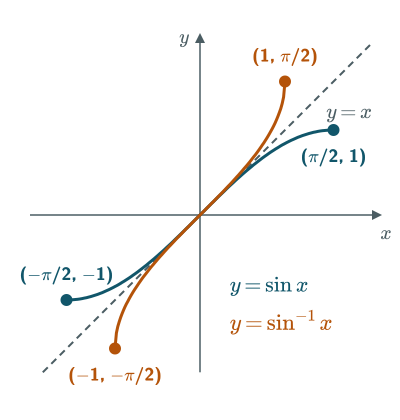
If (a, b) is on the graph of sin x with −π/2 ≤ a ≤ π/2, then (b, a) is on the graph of sin x (NCERT page 19), so the graph of the inverse is the restricted graph with the axes swapped. The graphs of sine and cosine from Class 11 are where the restricted pieces come from.
It can be shown that the graph of an inverse function can be obtained from the corresponding graph of original function as a mirror image (i.e., reflection) along the line y = x.
NCERT Mathematics Part I (Class 12), Section 2.2, page 20
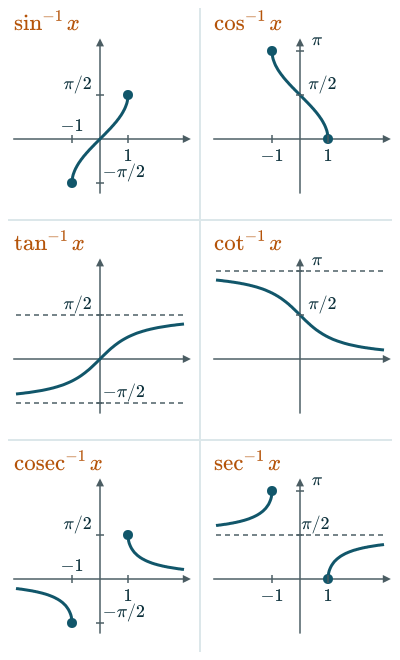
The graphs of the six principal value branches (after NCERT Figs 2.1–2.6, pages 20–25) show the domains and ranges of the table at a glance:
sin x is not (sin x)
The −1 in sin x means “inverse function”, not “reciprocal”. NCERT’s first note on page 26 warns about this: (sin x) means 1/sin x, which is cosec x, and the same goes for the other five functions. The two are very different:
- sin(1/2) = π/6, an angle;
- (sin(1/2)) = 1/sin 0.5 ≈ 1/0.479 ≈ 2.09, a ratio (0.5 here is in radians).
Positive powers keep their usual meaning: sin x is (sin x).
Principal values
The value of an inverse trigonometric functions which lies in the range of principal branch is called the principal value of that inverse trigonometric functions.
NCERT Mathematics Part I (Class 12), Section 2.2, page 26
To find a principal value, ask “which angle in the principal range has this sine (or cosine, …)?”, using the values at the standard angles from Class 11.
NCERT Example 1 (page 26): sin(1/√2). sin(π/4) = 1/√2 and π/4 lies in [−π/2, π/2], so the principal value is π/4.
- NCERT slip (page 26): Example 1’s solution gives the range of the principal value branch of sin as the open interval (−π/2, π/2). It is the closed interval [−π/2, π/2], as on NCERT pages 19 and 25: sin 1 = π/2 and sin(−1) = −π/2. The answer π/4 is not affected.
NCERT Example 2 (page 26): cot(−1/√3). Here cot y = −1/√3 = −cot(π/3) = cot(π − π/3) = cot(2π/3), and 2π/3 lies in (0, π). So the principal value is 2π/3, not −π/3, which lies outside the range of cot.
Solved examples
Example 1: Two principal values (NCERT Exercise 2.1, Q1 and Q2)
Find the principal values of (i) sin(−1/2); (ii) cos(√3/2).
(i) sin(−π/6) = −1/2, and −π/6 lies in [−π/2, π/2]. (ii) cos(π/6) = √3/2, and π/6 lies in [0, π].
Answer: (i) −π/6; (ii) π/6.
Example 2: Negative inputs (NCERT Exercise 2.1, Q4 and Q5)
Find the principal values of (i) tan(−√3); (ii) cos(−1/2).
(i) tan gives an angle in (−π/2, π/2), and tan(−π/3) = −√3.
(ii) cos gives an angle in [0, π], so the answer is in the second quadrant: cos(π − π/3) = −cos(π/3) = −1/2.
Answer: (i) −π/3; (ii) 2π/3. Not −π/3: that is outside [0, π].
Example 3: Secant and cosecant (NCERT Exercise 2.1, Q7 and Q10)
Find the principal values of (i) sec(2/√3); (ii) cosec(−√2).
(i) sec y = 2/√3 means cos y = √3/2, so y = π/6, which lies in [0, π] − {π/2}.
(ii) cosec y = −√2 means sin y = −1/√2, so y = −π/4, which lies in [−π/2, π/2] − {0}.
Answer: (i) π/6; (ii) −π/4.
Example 4: A sum of principal values (NCERT Exercise 2.1, Q11)
Find tan(1) + cos(−1/2) + sin(−1/2).
tan(1) = π/4, cos(−1/2) = 2π/3 and sin(−1/2) = −π/6. Over the common denominator 12: 3π/12 + 8π/12 − 2π/12 = 9π/12.
Answer: 3π/4.
Example 5: Choose the correct answer (NCERT Exercise 2.1, Q14)
tan √3 − sec(−2) is equal to (A) π; (B) −π/3; (C) π/3; (D) 2π/3.
tan √3 = π/3. For sec(−2), cos y = −1/2 with y in [0, π] gives y = 2π/3. So the value is π/3 − 2π/3 = −π/3.
Answer: (B).
Common mistakes to avoid
Common mistake
Giving a negative angle for cos, sec or cot
cos(−1/2) is 2π/3, not −π/3: the principal values of cos, sec and cot lie between 0 and π. Find the angle for +1/2 first, then take π minus it: π − π/3 = 2π/3.
Common mistake
Answering with any angle that works
sin(5π/6) = 1/2 too, but sin(1/2) is π/6. The principal value must lie in the principal range, and there is only one such angle.
Common mistake
Reading the −1 as a reciprocal
sin x is an angle; (sin x) = 1/sin x = cosec x is a ratio. Write 1/sin x when you mean the reciprocal.
Common mistake
Forgetting the gaps in the domains
sin 2 and cos(−3/2) do not exist: their inputs must lie in [−1, 1]. sec(1/2) and cosec 0 do not exist either: their inputs must satisfy |x| ≥ 1.
Quick revision summary
- Restrict a trigonometric function to a set where it is one-one and onto its range; the standard chosen restriction gives the principal value branch, used whenever no branch is named.
- y = sin x means sin y = x with −π/2 ≤ y ≤ π/2; the other five work the same way with the ranges below.
- sin, tan and cosec give angles in [−π/2, π/2]; cos, sec and cot give angles in [0, π].
- The graph of an inverse is the mirror image of the restricted graph in the line y = x.
- sin x is not (sin x) = 1/sin x.
Formula sheet
- sin : [−1, 1] → [−π/2, π/2]
- cos : [−1, 1] → [0, π]
- tan : R → (−π/2, π/2)
- cot : R → (0, π)
- cosec : R − (−1, 1) → [−π/2, π/2] − {0}
- sec : R − (−1, 1) → [0, π] − {π/2}
- y = sin x ⇔ sin y = x and −π/2 ≤ y ≤ π/2
Questions students ask
Why is the inverse sine called arcsin, and is arcsin x the same as sin x?
Arcsin x and sin x are two names for the same function, the inverse sine, which NCERT calls the “arc sine function” (page 19); in the same way arccos x is cos x, arctan x is tan x, and so on. The “arc” comes from the unit circle, where an angle of θ radians cuts off an arc of length θ, so arcsin x is the arc, and so the angle, whose sine is x: arccos(−1) = π, the length of the half circle from (1, 0) to (−1, 0). NCERT’s historical note (page 33) adds that the symbols sin x and cos x for arc sin x and arc cos x were suggested by the astronomer John Herschel in 1813.
Does the principal value branch mean the domain or the range of an inverse trigonometric function?
The principal value branch of an inverse trigonometric function is picked out by its range, not its domain: every branch of cos has the same domain [−1, 1], and the principal one is the branch with range [0, π]. Strictly, the branch is the whole function, cos : [−1, 1] → [0, π], but NCERT (pages 19–25) names each principal value branch by its range, and that interval is often called the principal range: [−π/2, π/2] for sin, (0, π) for cot. For example, cos 0 is π/2 on the principal branch, while the branch with range [π, 2π] gives 3π/2 for the same input, since cos(3π/2) = 0 too.
Why is the range of cos x [0, π] and not [−π/2, π/2] like that of sin x?
The range of cos x is [0, π] because [0, π] is the interval that contains the first-quadrant angles from 0 to π/2 and on which cosine is one-one and onto [−1, 1], falling steadily from cos 0 = 1 to cos π = −1. On [−π/2, π/2] cosine fails both tests: it is even, so it takes every value in [0, 1) twice there, as cos(−1) = cos 1 ≈ 0.540 (in radians) shows, and it is never negative there, so cos(−0.3) would have no angle to give. Sine rises steadily from −1 to 1 on [−π/2, π/2], which is why sin uses that interval; sec follows cosine with [0, π] − {π/2}, and cot takes (0, π) because cot is not defined at 0.
How do you find sin x on a calculator, and does it give the principal value?
A scientific calculator finds sin x with its sin key, usually the second function of the sin key, and it always returns the principal value: sin 0.3 ≈ 0.3047 in radian mode and ≈ 17.46° in degree mode, never 162.54°, the other angle between 0° and 360° with the same sine. Its cos and tan keys likewise give values in [0, π] (0° to 180°) and in (−π/2, π/2). Most calculators have no keys for cosec, sec and cot, so use the reciprocal identities, adding π to tan(1/x) when x < 0, since cot x then lies between π/2 and π. Handle x = 0 separately: cot 0 = π/2.
Are inverse trigonometric functions in the JEE Main 2027 syllabus?
Yes, inverse trigonometric functions are in the JEE Main 2027 syllabus: Unit 14, Trigonometry, lists “Trigonometrical identities and trigonometrical functions, inverse trigonometrical functions their properties.” They are taught in NCERT Mathematics Part I (Class 12), Chapter 2, Sections 2.1–2.3, and Unit 7, Limit, Continuity and Differentiability, adds their derivatives, taught in Chapter 5 of the same book. The rest of Unit 14 is the Class 11 trigonometry of NCERT Class 11, Chapter 3.
Practice questions
Try each question first, then open the answer to check your working.
-
Q1. Find the principal values of (i) cosec(2); (ii) tan(−1) (NCERT Exercise 2.1, Q3 and Q6).
Show answerHide answer
(i) sin y = 1/2 with y in [−π/2, π/2] − {0}: π/6. (ii) tan(−π/4) = −1 and −π/4 lies in (−π/2, π/2): −π/4.
-
Q2. Find the principal values of (i) cot(√3); (ii) cos(−1/√2) (NCERT Exercise 2.1, Q8 and Q9).
Show answerHide answer
(i) cot(π/6) = √3 and π/6 lies in (0, π): π/6. (ii) cos(π/4) = 1/√2, so the angle in [0, π] with cosine −1/√2 is π − π/4 = 3π/4.
-
Q3. Find the value of cos(1/2) + 2 sin(1/2) (NCERT Exercise 2.1, Q12).
Show answerHide answer
cos(1/2) = π/3 and sin(1/2) = π/6, so the value is π/3 + 2π/6 = 2π/3.
-
Q4. If sin x = y, then (A) 0 ≤ y ≤ π; (B) −π/2 ≤ y ≤ π/2; (C) 0 < y < π; (D) −π/2 < y < π/2 (NCERT Exercise 2.1, Q13).
Show answerHide answer
The principal value branch of sin has range [−π/2, π/2], end points included (sin 1 = π/2). The answer is (B).