Integration as anti differentiation
NCERT Class 12 Mathematics Chapter 7 Section 7.2
Quick answer
Integration is the inverse of differentiation: if F′(x) = f(x), then ∫f(x) dx = F(x) + C, where C is an arbitrary constant, because functions with the same derivative differ by a constant on an interval. The standard integrals come from reading derivative formulas backwards, for example ∫x dx = x/(n + 1) + C for n ≠ −1 and ∫(1/x) dx = log |x| + C, and integrals of sums and constant multiples split term by term.
With your textbook
NCERT Mathematics Part II (Class 12), Chapter 7 “Integrals”, Section 7.2 “Integration as an Inverse Process of Differentiation”, pages 226–235.
Open the official NCERT chapter (PDF, 5.7 MB, ncert.nic.in) (opens in a new tab)
Checked against the 2026-27 reprint on .
What is integration?
Anti derivative and indefinite integral
Integration is the inverse process of differentiation.
NCERT Mathematics Part II (Class 12), Section 7.2, page 226
- If F′(x) = f(x) on an interval, F is an anti derivative (or primitive) of f.
- The family of all anti derivatives is the indefinite integral, written ∫f(x) dx = F(x) + C, where C is the arbitrary constant of integration (NCERT pages 226–227).
- In ∫f(x) dx, f(x) is the integrand and x the variable of integration (NCERT Table 7.1, page 227).
In plain words: differentiation turns a function into its slope; integration runs it backwards and asks which functions have a given slope. Since sin x, x3/3 and ex have derivatives cos x, x2 and ex, they are anti derivatives of these. Adding any constant does not change a derivative, so sin x + C is an anti derivative of cos x for every real C.
Functions with same derivatives differ by a constant.
NCERT Mathematics Part II (Class 12), Section 7.2, page 227
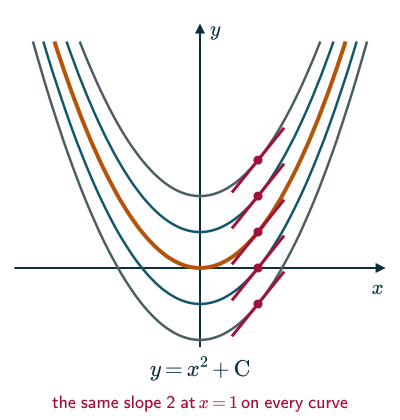
So, on an interval, the family F(x) + C contains every anti derivative of f (NCERT’s proof uses an interval I, page 227), and the graphs of the anti derivatives are vertical shifts of one another.
Standard integrals
Each derivative formula gives an integral formula read backwards (NCERT pages 228–229):
Standard integrals (each + C)
∫x dx = x/(n + 1), n ≠ −1
∫cos x dx = sin x; ∫sin x dx = −cos x
∫sec x dx = tan x; ∫cosec x dx = −cot x
∫sec x tan x dx = sec x; ∫cosec x cot x dx = −cosec x
∫dx/√(1 − x) = sin x; ∫dx/(1 + x) = tan x
∫e dx = e; ∫(1/x) dx = log |x|; ∫a dx = a/log a, a > 0, a ≠ 1
For a = 1, ∫a dx = x + C. All power formulas apply on intervals where the real powers are defined.
The log |x| needs the absolute value: for x < 0, d/dx log (−x) = (−1)/(−x) = 1/x as well (NCERT Example 1 (iii), page 232). In a particular problem, keep in mind the interval on which each formula holds (NCERT’s Note, page 229).
Properties of the indefinite integral
NCERT Section 7.2.1 (pages 229–231):
- d/dx ∫f(x) dx = f(x), and ∫f′(x) dx = f(x) + C: differentiation and integration undo each other.
- ∫[f(x) + g(x)] dx = ∫f(x) dx + ∫g(x) dx.
- ∫k f(x) dx = k ∫f(x) dx for any real k, and the same for sums of many terms. (Beyond the NCERT text: strictly k ≠ 0, since ∫0 dx = C while 0 × ∫f dx = 0.)
So a sum of standard terms is integrated term by term, with a single constant at the end. NCERT Example 2 (i) (page 232): ∫(x3 − 1)/x2 dx = ∫(x − x−2) dx = x2/2 + 1/x + C.
Integration by inspection
To find an anti derivative by inspection, guess a function whose derivative is the integrand, then adjust the constant factor (NCERT page 231). NCERT Example 1 (pages 231–232): since d/dx (sin 2x) = 2 cos 2x, an anti derivative of cos 2x is ½ sin 2x; and x3 + x4 is an anti derivative of 3x2 + 4x3.
A condition fixes C. NCERT Example 4 (pages 233–234): the anti derivatives of 4x3 − 6 are x4 − 6x + C. If F(0) = 3, then C = 3 and F(x) = x4 − 6x + 3.
Not every integral is elementary. No function built from polynomials, logarithms, exponentials, trigonometric functions and their inverses has derivative e−x2, so ∫e−x2 dx cannot be found by inspection (NCERT’s Remark (ii), page 234).
Solved examples
Example 1: Term by term (NCERT Example 3, page 233)
Find the integrals of (i) cosec x (cosec x + cot x); (ii) (1 − sin x)/cos2 x.
(i) Multiply out: ∫cosec2 x dx + ∫cosec x cot x dx. (ii) Split: ∫sec2 x dx − ∫sec x tan x dx, since sin x/cos2 x = sec x tan x.
Answer: (i) −cot x − cosec x + C; (ii) tan x − sec x + C.
Example 2: Powers of x (NCERT Exercise 7.1, Q11 and Q12, page 234)
Find (i) ∫(x3 + 5x2 − 4)/x2 dx; (ii) ∫(x3 + 3x + 4)/√x dx.
(i) Divide first: x + 5 − 4x−2. (ii) Divide first: x5/2 + 3x1/2 + 4x−1/2, then add 1 to each power and divide by the new power.
Answer: (i) x2/2 + 5x + 4/x + C; (ii) (2/7)x7/2 + 2x3/2 + 8√x + C.
Example 3: A trigonometric quotient (NCERT Exercise 7.1, Q19 and Q20, page 235)
Find (i) ∫sec2 x/cosec2 x dx; (ii) ∫(2 − 3 sin x)/cos2 x dx.
(i) sec2 x/cosec2 x = tan2 x = sec2 x − 1. (ii) Split: 2 sec2 x − 3 sec x tan x.
Answer: (i) tan x − x + C; (ii) 2 tan x − 3 sec x + C.
Example 4: Choose the correct answer (NCERT Exercise 7.1, Q22, page 235)
If d/dx f(x) = 4x3 − 3/x4 and f(2) = 0, then f(x) is (A) x4 + 1/x3 − 129/8; (B) x3 + 1/x4 + 129/8; (C) x4 + 1/x3 + 129/8; (D) x3 + 1/x4 − 129/8.
f(x) = x4 + x−3 + C, since the derivative of x−3 is −3x−4. Then f(2) = 16 + 1/8 + C = 0 gives C = −129/8 on x > 0. If the domain also includes x < 0, its constant is independent and is not fixed by f(2).
Answer: (A).
Common mistakes to avoid
Common mistake
Forgetting the constant of integration
An indefinite integral is a whole family. Writing ∫2x dx = x2 leaves out the other anti derivatives x2 + C.
Common mistake
Using the power rule for n = −1
∫xn dx = xn + 1/(n + 1) fails for n = −1 (division by 0). ∫(1/x) dx = log |x| + C instead.
Common mistake
Integrating a product or quotient factor by factor
∫f g dx is not (∫f dx)(∫g dx). Multiply out or divide first, as in Example 2, before integrating term by term.
Quick revision summary
- If F′(x) = f(x), then ∫f(x) dx = F(x) + C; on an interval, any two anti derivatives differ by a constant.
- Read the derivative table backwards for the standard integrals; ∫(1/x) dx = log |x| + C and ∫x dx = x/(n + 1) + C for n ≠ −1.
- Integrals of sums and constant multiples split term by term; a condition such as F(0) = 3 fixes C.
Formula sheet
- ∫x dx = x/(n + 1) + C, n ≠ −1
- ∫(1/x) dx = log |x| + C
- ∫e dx = e + C; ∫a dx = a/log a, a > 0, a ≠ 1 + C
Questions students ask
What is the difference between an anti derivative and an indefinite integral?
An anti derivative of f is one function F with F′(x) = f(x), while the indefinite integral ∫f(x) dx is the whole family F(x) + C of them on an interval, C being any real constant; NCERT also calls an anti derivative a primitive (page 226). So tan x and tan x + 5 are two anti derivatives of sec2 x, and ∫sec2 x dx = tan x + C names them all. NCERT’s Table 7.1 (page 227) calls any one of them “an integral of f”, so the two words are often used for each other; the + C is what marks the indefinite integral.
Why is the integral of 1/x equal to log |x| + C and not log x + C?
The integral of 1/x is log |x| + C because 1/x is defined for every x ≠ 0 but log x only for x > 0, and log |x| has derivative 1/x on both sides of 0, as the derivative of log x shows. On x > 0 alone, log x + C is right. The modulus matters whenever the expression inside can be negative: for x < 5, ∫dx/(x − 5) is log (5 − x) + C, which log |x − 5| gives and log (x − 5) cannot. A constant can hide inside too: ∫dx/(3x) is (1/3) log |x| + C or, just as well, (1/3) log |3x| + C, as log |3x| is log 3 + log |x|.
What is the difference between integration and differentiation?
Differentiation takes a function to its derivative, one answer, while integration goes back from a derivative to the functions that have it, so an indefinite integral is a family F(x) + C: d/dx (x6 + 4) = 6x5, but ∫6x5 dx = x6 + C, as the 4 is lost in differentiating. The rules differentiate any elementary function where it is differentiable, but integration has only methods that may fail, and some elementary functions, such as e−x2, have no elementary anti derivative (NCERT page 234). Geometrically, a derivative is a slope and a definite integral a signed area.
What is the integral of 0, of 1 and of a constant k?
The integral of 0 is an arbitrary constant, ∫0 dx = C, not 0, because on an interval the functions with derivative 0 are exactly the constants, such as 5 or −2. The integral of 1 is ∫dx = x + C (NCERT page 228), since dx alone means 1 dx and the derivative of x is 1. For any constant k, ∫k dx = kx + C, because d/dx (kx) = k: for example, ∫7 dx = 7x + C.
Why can ∫dx/√(1 − x2) be written both as sin x + C and as −cos x + C?
Both forms of ∫dx/√(1 − x2) are right, and NCERT’s table of standard integrals lists both (page 228), because sin x and −cos x differ only by a constant: sin x + cos x = π/2 for −1 ≤ x ≤ 1 (a JEE identity beyond the NCERT text), so −cos x is sin x − π/2. At x = ½, for example, sin x = π/6 and −cos x = −π/3, which is π/6 − π/2. In the same way, ∫dx/(1 + x2) is tan x + C or −cot x + C: the C of one form absorbs the π/2.
Is integration in the JEE Main 2027 syllabus?
Yes, integration is in the JEE Main 2027 syllabus: Unit 8 (Integral Calculus) opens with “Integral as an anti-derivative, Fundamental integrals involving algebraic, trigonometric, exponential and logarithmic functions”, then names “Integration by substitution, by parts and by partial fractions” and “Integration using trigonometric identities”. It goes on to the fundamental theorem of calculus, properties of definite integrals and areas bounded by simple curves. NCERT covers all of this in Class 12 Chapter 7 (indefinite integrals in Sections 7.2–7.6, definite ones in 7.7–7.10) and Chapter 8, Application of Integrals.
Practice questions
Try each question first, then open the answer to check your working.
-
Q1. Find an anti derivative of (i) sin 2x; (ii) e2x; (iii) (ax + b)2 by inspection (NCERT Exercise 7.1, Q1, Q3 and Q4, page 234).
Show answerHide answer
(i) −½ cos 2x; (ii) ½e2x; (iii) for a ≠ 0, (ax + b)3/(3a); for a = 0, an anti derivative is bx. In the first case, the derivative of (ax + b)3 is 3a(ax + b)2.
-
Q2. Find ∫(4e3x + 1) dx and ∫x2(1 − 1/x2) dx (NCERT Exercise 7.1, Q6 and Q7, page 234).
Show answerHide answer
(4/3)e3x + x + C, and ∫(x2 − 1) dx = x3/3 − x + C.
-
Q3. Find ∫sec x (sec x + tan x) dx (NCERT Exercise 7.1, Q18, page 235).
Show answerHide answer
∫sec2 x dx + ∫sec x tan x dx = tan x + sec x + C.
-
Q4. The anti derivative of √x + 1/√x is (A) (1/3)x1/3 + 2x1/2 + C; (B) (2/3)x2/3 + ½x2 + C; (C) (2/3)x3/2 + 2x1/2 + C; (D) (3/2)x3/2 + ½x1/2 + C (NCERT Exercise 7.1, Q21, page 235).
Show answerHide answer
∫x1/2 dx = (2/3)x3/2 and ∫x−1/2 dx = 2x1/2: (C).