Properties of definite integrals
NCERT Class 12 Mathematics Chapter 7 Section 7.10
Quick answer
When the integrals exist, definite integrals obey a few properties that save work: reversing the limits changes the sign, an interval can be split at any point, and the integral from a to b of f(x) equals that of f(a + b − x). Over [−a, a], an even function gives twice the integral over [0, a] and an odd function gives 0. Writing an integral both ways with a + b − x and adding often reduces it to a simple one, as in the integral of log sin x from 0 to π/2, which is −(π/2) log 2.
With your textbook
NCERT Mathematics Part II (Class 12), Chapter 7 “Integrals”, Section 7.10 “Some Properties of Definite Integrals”, pages 273–280.
Open the official NCERT chapter (PDF, 5.7 MB, ncert.nic.in) (opens in a new tab)
Checked against the 2026-27 reprint on .
What are the properties of definite integrals?
Properties of definite integrals
We list below some important properties of definite integrals. These will be useful in evaluating the definite integrals more easily.
NCERT Mathematics Part II (Class 12), Section 7.10, page 273
- NCERT numbers them P to P (pages 273–274) and proves each from the second fundamental theorem or a substitution (pages 274–276). They are listed below.
The properties below require the integrals to exist. Continuity on the interval is sufficient. For an improper integral, each side of every singularity must converge separately; symmetric cancellation of infinities is not ordinary integration.
Reading the interval backwards
∫ f(x) dx = ∫ f(a + b − x) dx
(both integrals from a to b)
In plain words: P says the letter used for the variable does not matter; P says reversing the limits changes the sign; P says an interval can be split at any point c. P and P say the integral is unchanged when the interval is read backwards, from right to left: this is the property that solves many integrals that are hard to find by anti derivatives. NCERT notes that P is a particular case of P.
Why P holds (NCERT pages 274–275): put t = a + b − x, so dt = −dx, and the limits a, b become b, a. The integral becomes −∫ba f(a + b − t) dt, and P and P turn this into ∫ab f(a + b − x) dx.
Integrals over [0, 2a] and [−a, a]
- P: the integral of f from 0 to 2a is twice the integral from 0 to a if f(2a − x) = f(x), and 0 if f(2a − x) = −f(x).
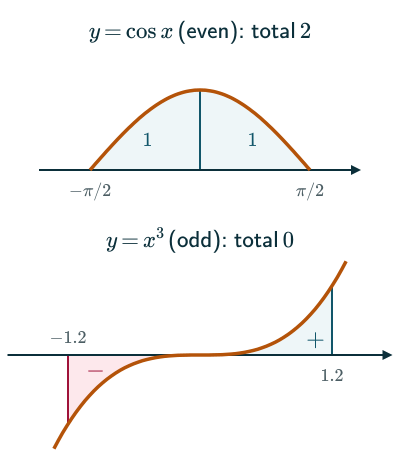
- P: the integral of f from −a to a is twice the integral from 0 to a if f is even, and 0 if f is odd.
Even and odd functions
f even: ∫ f(x) dx = 2∫ f(x) dx
f odd: ∫ f(x) dx = 0
An even function has f(−x) = f(x), so its graph is symmetric about the y-axis and the two halves of the area are equal. An odd function has f(−x) = −f(x): the part left of 0 is the part right of 0 turned upside down, so the two cancel. NCERT Example 31 (page 277): sin5 x cos4 x is odd, so its integral from −1 to 1 is 0, with no integration at all. NCERT Example 29 (pages 276–277) uses the even case: ∫−π/4π/4 sin2 x dx = 2∫0π/4 sin2 x dx = π/4 − ½.
Using P and P: add the integral to itself
When the integrand turns into a partner under x → a + b − x, write the integral both ways and add. NCERT Example 32 (page 278): with P on [0, π/2], sin4 x becomes cos4 x. So
2I = ∫0π/2 (sin4 x + cos4 x)/
and I = π/4. NCERT Example 33 (page 278) does the same with P on [π/6, π/3], where sin and cos swap: ∫dx/(1 + √tan x) from π/6 to π/3 is π/12. NCERT Example 30 (page 277) uses P to remove the x in ∫0π x sin x/(1 + cos2 x) dx, which comes to π2/4.
A standard result (NCERT Example 34, page 279): log sin x has an improper endpoint at 0, but it converges: near 0 it differs from log x by a bounded term, and x log x − x has limit 0. The matching log cos integral also converges. Thus P and P may be used:
∫0π/2 log sin x dx = −(π/2) log 2.
Splitting at the kinks of |…|. NCERT Example 28 (page 276): x3 − x is ≥ 0 on [−1, 0] and [1, 2] and ≤ 0 on [0, 1], so by P, ∫−12 |x3 − x| dx splits into three integrals without the bars, and the total is 11/4.
Solved examples
Example 1: Split at the kink (NCERT Exercise 7.10, Q5, page 280)
Evaluate ∫−55 |x + 2| dx.
|x + 2| = −(x + 2) for x < −2 and x + 2 for x ≥ −2. By P, the integral is ∫−5−2 −(x + 2) dx + ∫−25 (x + 2) dx = 9/2 + 49/2. (Each piece is a triangle: 3 × 3/2 and 7 × 7/2.)
Answer: 29.
Example 2: A log that adds to a constant (NCERT Exercise 7.10, Q8, page 280)
Evaluate ∫0π/4 log (1 + tan x) dx.
By P, x → π/4 − x, and 1 + tan (π/4 − x) = 1 + (1 − tan x)/(1 + tan x) = 2/(1 + tan x). So I is also the integral of log 2 − log (1 + tan x) over [0, π/4], which is (π/4) log 2 − I.
Answer: I = (π/8) log 2.
Example 3: Removing the x (NCERT Exercise 7.10, Q12, page 280)
Evaluate ∫0π x/(1 + sin x) dx.
By P, sin (π − x) = sin x, so I = ∫0π (π − x)/(1 + sin x) dx, and 2I = π∫0π dx/(1 + sin x). With 1/(1 + sin x) = (1 − sin x)/cos2 x, an anti derivative is tan x − sec x, which equals F(x) = −cos x/(1 + sin x) wherever cos x ≠ 0. That form is continuous on [0, π], so the integral from 0 to π is F(π) − F(0) = 1 + 1 = 2.
Answer: 2I = 2π, so I = π.
Example 4: Using a known result (NCERT Exercise 7.10, Q16, page 280)
Evaluate ∫0π log (1 + cos x) dx.
The endpoint at π is improper but has only a convergent logarithmic singularity. Since 1 + cos x = 2 cos2 (x/2), the integrand is log 2 + 2 log cos (x/2). Put x = 2t: ∫0π 2 log cos (x/2) dx = 4∫0π/2 log cos t dt, which by P and NCERT Example 34 is 4 × (−(π/2) log 2) = −2π log 2. Adding π log 2:
Answer: −π log 2.
Example 5: Check convergence before using oddness (NCERT Exercise 7.10, Q20, page 280)
The printed question asks for the integral of x3 + x cos x + tan5 x + 1 from −π/2 to π/2, with choices (A) 0; (B) 2; (C) π; (D) 1.
The polynomial and trigonometric terms are odd, but tan5 x has singular endpoints. For 0 < r < π/2,
∫0r tan5 x dx = tan4 r/4 − tan2 r/2 − log cos r.
This tends to +∞ as r → π/2; the integral on the negative half tends to −∞. The two halves do not converge separately, so P cannot be applied.
Answer: the ordinary improper integral does not exist; none of the printed choices is its value. The NCERT key gives (C), π, the value that formal odd cancellation produces. That number is the symmetric Cauchy principal value: integrating from −r to r first cancels the odd terms and gives 2r, which tends to π. A principal value is a different limiting procedure and must be explicitly requested.
NCERT slip (page 280): tan5 x is not defined at ±π/2, and NCERT’s own Remark (iv), page 268, asks for a function defined and continuous on the whole interval. The key (page 446) gives (C) all the same. In an exam, choose (C).
Common mistakes to avoid
Common mistake
Calling a function odd without checking
x cos x is odd, but x sin x is even: (−x) sin (−x) = x sin x. Check f(−x) every time, because P gives 0 only for odd functions.
Common mistake
Using P on an interval that is not symmetric
∫02 x3 dx = 4, not 0: P needs limits −a and a.
Common mistake
Dropping the bars of |…| without splitting
∫−55 |x + 2| dx is 29; ∫−55 (x + 2) dx is 20. Split at the point where the inside changes sign (P), and change the sign of the negative part.
Quick revision summary
- P: reversing the limits changes the sign; P: split an interval at any c, which is how |…| is handled.
- P and P: ∫ab f(x) dx = ∫ab f(a + b − x) dx; adding the two forms often gives 2I as something easy.
- P and P: an integral over [0, 2a] or [−a, a] is twice the half when the integrand is symmetric about the middle (f(2a − x) = f(x), or f even), and 0 when it is antisymmetric.
Formula sheet
- ∫ f(x) dx = ∫ f(a + b − x) dx, both from a to b
- For an existing integral: f even gives twice the integral from 0 to a; f odd gives 0 over [−a, a]
- ∫ log sin x dx from 0 to π/2 = −(π/2) log 2
Questions students ask
What are the King and Queen properties of definite integrals?
The King and Queen properties are JEE coaching names, beyond NCERT, for two of NCERT’s properties (pages 273–274): the King property, or King’s rule, is P, by which the integral of f(x) from a to b equals that of f(a + b − x), and the Queen property is P, which splits an integral over [0, 2a] into those of f(x) and f(2a − x) over [0, a]. King’s rule removes an x beside a function symmetric about the middle of the interval: in ∫0π x sin x cos2 x dx, x → π − x leaves sin x cos2 x unchanged, so 2I is π times ∫0π sin x cos2 x dx, that is π × 2/3, and I = π/3.
Is the integral of an odd function always 0?
The integral of an odd function is not always 0: NCERT’s P (page 274) makes it 0 only over an interval [−a, a] symmetric about 0, and only when the integral exists, which NCERT secures by requiring a continuous integrand (Remark (iv), page 268). Over [−π/2, π], sin x is odd but its integral is 1: the parts from −π/2 to π/2 cancel, leaving ∫π/2π sin x dx = 1. And x/(x2 − 1) is odd, but its anti derivative ½ log |x2 − 1| tends to −∞ on both sides of ±1, so its integral from −2 to 2 diverges and P cannot make it 0.
How many properties of definite integrals are there?
NCERT lists eight properties of definite integrals, P to P (pages 273–274), and the sum and constant-multiple rules also hold, by the second fundamental theorem (reasoned). For integrable functions, beyond the NCERT text there are more, such as the periodic property (for f of period T and a positive integer n, the integral over [0, nT] is n times that over [0, T]) and comparison: if f(x) ≤ g(x) on [a, b], with a < b, the integral of f from a to b is at most that of g. So 1 ≤ √(1 + x3) ≤ √2 on [0, 1] puts ∫01 √(1 + x3) dx between 1 and √2; it is about 1.111.
Do the properties of definite integrals also hold for indefinite integrals?
The sum and constant-multiple rules hold for both. The reflection, splitting and parity formulas here depend on the integration limits; they cannot be used to replace an indefinite integrand without the chain rule and change of variable. For example, P gives ∫02 x dx and ∫02 (2 − x) dx the same value, 2, but the indefinite integrals x2/2 + C and 2x − x2/2 + C are different families, because x2/2 and 2x − x2/2 do not differ by a constant. So use P or P only on an integral with limits, never to rewrite an anti derivative.
Practice questions
Try each question first, then open the answer to check your working.
-
Q1. Evaluate the integral from 0 to π/2 of √(sin x) divided by √(sin x) + √(cos x) (NCERT Exercise 7.10, Q2, page 280).
Show answerHide answer
By P, x → π/2 − x swaps sin and cos. Adding the two forms, 2I = ∫0π/2 1 dx = π/2, so I = π/4. NCERT Exercise 7.10, Q1, Q3 and Q4 work the same way; each is π/4.
-
Q2. Evaluate ∫28 |x − 5| dx (NCERT Exercise 7.10, Q6, page 280).
Show answerHide answer
Split at 5: ∫25 (5 − x) dx + ∫58 (x − 5) dx = 9/2 + 9/2 = 9.
-
Q3. Evaluate ∫−π/2π/2 sin2 x dx (NCERT Exercise 7.10, Q11, page 280).
Show answerHide answer
sin2 x is even, so by P the integral is 2∫0π/2 (1 − cos 2x)/2 dx = [x − ½ sin 2x] from 0 to π/2 = π/2.
-
Q4. The value of the integral from 0 to π/2 of the log of 4 + 3 sin x divided by 4 + 3 cos x is (A) 2; (B) 3/4; (C) 0; (D) −2 (NCERT Exercise 7.10, Q21, page 280).
Show answerHide answer
By P, sin and cos swap, which turns the log into its negative: I = −I, so I = 0: (C).