Definite integral
NCERT Class 12 Mathematics Chapter 7 Section 7.7
Quick answer
A definite integral, the integral of f(x) from a to b, when it exists is a single number: a is the lower limit and b the upper limit. For f continuous on [a, b], if F′ = f, its value is F(b) − F(a), and the constant of integration cancels. For a ≤ b and f(x) ≥ 0, it is the area under the curve y = f(x) from x = a to x = b; parts below the x-axis count negatively.
With your textbook
NCERT Mathematics Part II (Class 12), Chapter 7 “Integrals”, Section 7.7 “Definite Integral”, page 267.
Open the official NCERT chapter (PDF, 5.7 MB, ncert.nic.in) (opens in a new tab)
Checked against the 2026-27 reprint on .
What is a definite integral?
Definite integral
The definite integral is introduced either as the limit of a sum or if it has an anti derivative F in the interval [a, b], then its value is the difference between the values of F at the end points, i.e., F(b) – F(a).
NCERT Mathematics Part II (Class 12), Section 7.7, page 267
- It is written ∫ab f(x) dx; a is the lower limit and b the upper limit of the integral, and unlike an indefinite integral it has a unique value (NCERT page 267).
In plain words: an indefinite integral ∫f(x) dx is a whole family of functions, F(x) + C; a definite integral, when it exists, is one number. For f continuous on [a, b], you find it from any anti derivative F, a function whose derivative is f, by subtracting its value at the lower limit from its value at the upper limit. The constant C cancels in the subtraction, which is why the value is unique.
The definite integral as an area
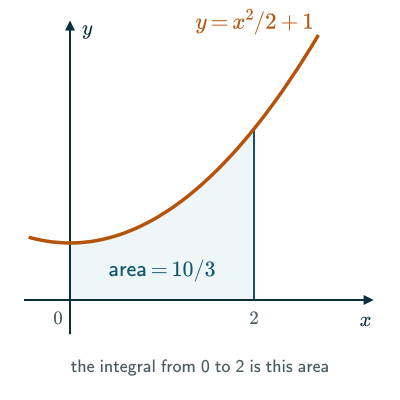
For a ≤ b, when f(x) ≥ 0 is continuous on [a, b], ∫ab f(x) dx is the area of the region bounded by the curve y = f(x), the ordinates x = a and x = b, and the x-axis (NCERT uses this meaning in Section 7.8.1, page 267, with Fig 7.1). For f(x) = x2/2 + 1 on [0, 2], an anti derivative is F(x) = x3/6 + x, so the area is
F(2) − F(0) = 8/6 + 2 = 10/3.
Below the axis the integral counts negatively. Where f(x) < 0, the region lies below the x-axis and its integral comes out negative (NCERT Chapter 8, Section 8.2, Remark, page 293). So ∫02π sin x dx = [−cos x] from 0 to 2π = −1 + 1 = 0, although the curve and the axis enclose a region of positive area, one part above the axis and an equal part below it. For an area, NCERT takes the numerical value of each part.
The limit of a sum
NCERT mentions the limit of a sum (page 267, and in Remark (ii), page 268) but the 2026–27 book does not develop it. Beyond the NCERT text, the idea is this: cut [a, b] into n strips of width h = (b − a)/n, add the areas h × f(x) of the thin rectangles, and let n grow. For ∫01 x dx with the right end of each strip, the sum is (1/n)(1/n + 2/n + … + n/n) = (n + 1)/(2n), which tends to ½, the same as F(1) − F(0) = ½ − 0 with F(x) = x2/2. The fundamental theorem of calculus, in NCERT Section 7.8, explains why the two agree.
Solved examples
Example 1: A straight line (NCERT Exercise 7.8, Q1, page 270)
Evaluate ∫−11 (x + 1) dx.
An anti derivative is F(x) = x2/2 + x. F(1) = 3/2 and F(−1) = 1/2 − 1 = −1/2.
Answer: 3/2 − (−1/2) = 2. (The region is a triangle with base 2 and height 2, area 2.)
Example 2: A polynomial (NCERT Exercise 7.8, Q3, page 270)
Evaluate ∫12 (4x3 − 5x2 + 6x + 9) dx.
F(x) = x4 − (5/3)x3 + 3x2 + 9x. F(2) = 16 − 40/3 + 12 + 18 = 98/3 and F(1) = 1 − 5/3 + 3 + 9 = 34/3.
Answer: 98/3 − 34/3 = 64/3.
Example 3: An exponential (NCERT Exercise 7.8, Q6, page 270)
Evaluate ∫45 ex dx.
F(x) = ex, so the value is e5 − e4.
Answer: e4(e − 1).
Example 4: A value of zero (NCERT Exercise 7.8, Q18, page 271)
Evaluate the integral of sin2 (x/2) − cos2 (x/2) from 0 to π.
sin2 (x/2) − cos2 (x/2) = −cos x, so the integral is [−sin x] from 0 to π = 0 − 0. The curve −cos x is below the axis on (0, π/2) and above it on (π/2, π), and the two parts cancel.
Answer: 0.
Example 5: Choose the correct answer (NCERT Exercise 7.8, Q21, page 271)
∫1√3 dx/(1 + x2) equals (A) π/3; (B) 2π/3; (C) π/6; (D) π/12.
tan √3 − tan 1 = π/3 − π/4.
Answer: π/12, (D).
Common mistakes to avoid
Common mistake
Subtracting the wrong way round
The value is F(upper limit) − F(lower limit). Swapping them changes the sign: ∫12 2x dx = 4 − 1 = 3, not 1 − 4 = −3.
Common mistake
Reading an integral of 0 as no area
∫02π sin x dx = 0, but the curve and the axis enclose a region of positive area: the part below the axis counts negatively in the integral.
Common mistake
Carrying the constant of integration
F(b) + C − (F(a) + C) = F(b) − F(a): there is no + C in the value of a definite integral.
Quick revision summary
- ∫ab f(x) dx is a number, with lower limit a and upper limit b; for any anti derivative F of f, it equals F(b) − F(a).
- For f(x) ≥ 0 it is the area under the curve y = f(x) from x = a to x = b; regions below the axis count negatively.
- It is also the limit of sums of thin rectangles, which the fundamental theorem links to F(b) − F(a).
Formula sheet
- ∫ f(x) dx from a to b = F(b) − F(a), for continuous f and F′ = f
- a: lower limit; b: upper limit
Questions students ask
What is the difference between a definite and an indefinite integral?
An indefinite integral ∫f(x) dx is a family of functions, F(x) + C, while a definite integral ∫ab f(x) dx is one number, fixed by its limits a and b. The second fundamental theorem links them: for f continuous on [a, b], that number is F(b) − F(a), and the C cancels. The number exists even when no formula for F can be found: e−x2 has no anti derivative made of elementary functions (NCERT page 234), yet ∫01 e−x2 dx is about 0.7468, found numerically.
Can a definite integral be negative?
A definite integral can be negative in two ways: more area lies below the x-axis than above it, or the limits are reversed. So ∫03 (x − 2) dx is 9/2 − 6, that is −3/2: the triangle below the axis on [0, 2] counts −2 and the one above it on [2, 3] counts +½, though the area of the region is 5/2. Reversing the limits changes the sign (NCERT’s P, page 273), so ∫10 ex dx = 1 − e, negative although ex > 0 everywhere.
What is the definite integral of 0, or of a constant k, from a to b?
The definite integral of 0 over any interval is 0, because an anti derivative of 0 is a constant and it cancels in F(b) − F(a); the indefinite integral ∫0 dx is instead an arbitrary constant C. For a constant k, kx is an anti derivative, so ∫ab k dx = k(b − a), the signed area of a rectangle of height k: ∫27 3 dx is 21 − 6 = 15, a 5 by 3 rectangle, and ∫27 (−3) dx is −15. When the two limits are equal, the integral is 0 whatever the integrand (NCERT page 273).
How do you write the limit of a sum as a definite integral?
Beyond the NCERT text, whose 2026–27 reprint does not develop the limit of a sum, the limit as n → ∞ of (1/n) times the sum of f(r/n) for r = 1 to n is ∫01 f(x) dx, for f continuous on [0, 1]: r/n becomes x, 1/n becomes dx, and the range of r becomes the interval [0, 1]. So the sum of 1/(n + r) for r = 1 to n, which is (1/n) times the sum of 1/(1 + r/n), tends to log 2, about 0.693, the integral of 1/(1 + x) from 0 to 1. For n = 1000 the sum is already 0.6929.
Is the definite integral as the limit of a sum in NCERT Class 12 and the JEE Main 2027 syllabus?
The definite integral as the limit of a sum is not developed in the 2026–27 reprint of NCERT Mathematics Part II (Class 12): Section 7.7 (page 267) only says that a definite integral can be introduced that way, and the chapter evaluates definite integrals by the fundamental theorem instead. The JEE Main 2027 syllabus, Unit 8, names “The fundamental theorem of calculus, properties of definite integrals. Evaluation of definite integrals” and does not mention the limit of a sum. This page’s section on it is labelled beyond the NCERT text and is there for the idea: why an integral is an area.
Practice questions
Try each question first, then open the answer to check your working.
-
Q1. Evaluate ∫23 dx/x (NCERT Exercise 7.8, Q2, page 270).
Show answerHide answer
log 3 − log 2 = log (3/2).
-
Q2. Evaluate ∫0π/4 sin 2x dx and ∫0π/2 cos 2x dx (NCERT Exercise 7.8, Q4 and Q5, page 270).
Show answerHide answer
[−½ cos 2x] from 0 to π/4 = −½(0 − 1) = ½. The anti derivative ½ sin 2x is 0 at both limits, so the second is 0.
-
Q3. Evaluate ∫01 dx/√(1 − x2) and ∫01 dx/(1 + x2) (NCERT Exercise 7.8, Q9 and Q10, page 270).
Show answerHide answer
The first is improper at 1. Evaluate up to r < 1, then take r → 1: sin r − sin 0 tends to π/2. The second is a proper integral: tan 1 − tan 0 = π/4.
-
Q4. ∫02/3 dx/(4 + 9x2) equals (A) π/6; (B) π/12; (C) π/24; (D) π/4 (NCERT Exercise 7.8, Q22, page 271).
Show answerHide answer
4 + 9x2 = 9(x2 + (2/3)2), so an anti derivative is (1/9) × (3/2) tan (3x/2) = (1/6) tan (3x/2). The value is (1/6)(tan 1 − 0) = π/24, (C).