Area under simple curves
NCERT Class 12 Mathematics Chapter 8 Section 8.2
Quick answer
The area between a curve y = f(x), the x-axis and the lines x = a and x = b is A = ∫ |y| dx from x = a to x = b, found by adding thin vertical strips; with horizontal strips, A = ∫ |x| dy from y = c to y = d. Parts of a curve below the x-axis give negative integrals, so split at the crossing points and add absolute values. Four first-quadrant quarters give the area πa of the circle x + y = a and πab of the ellipse x/a + y/b = 1.
With your textbook
NCERT Mathematics Part II (Class 12), Chapter 8 “Application of Integrals”, Section 8.2 “Area under Simple Curves”, pages 292–296.
Open the official NCERT chapter (PDF, 1.4 MB, ncert.nic.in) (opens in a new tab)
Checked against the 2026-27 reprint on .
How is an area found with an integral?
Area under a curve
From Fig 8.1, we can think of area under the curve as composed of large number of very thin vertical strips.
NCERT Mathematics Part II (Class 12), Section 8.2, page 292
- A strip of height y and width dx has area dA = y dx, where y = f(x) (NCERT page 292).
- Adding up the strips from x = a to x = b gives the area of the region between the curve, the x-axis and the ordinates x = a and x = b (NCERT page 293).
Area with vertical strips
A = ∫ y dx = ∫ f(x) dx, from x = a to x = b
(curve on or above the x-axis, a < b)
In plain words: the area under a curve is a definite integral. Cut the region into thin strips, find the area of one strip, and integrate it across the region. For a continuous curve that stays above the x-axis, this is exactly the integral of Chapter 7.
NCERT slip (page 292): the Introduction and Section 8.2 both say that Chapter 7 studied the definite integral “as the limit of a sum”. The 2026–27 Chapter 7 only mentions the limit of a sum (pages 267–268); it evaluates definite integrals by the fundamental theorem. In an exam, find areas with F(b) − F(a).
Horizontal strips
When the curve is easier to write as x = g(y), use horizontal strips of width dy and length x (NCERT page 293, Fig 8.2). The region between the curve, the y-axis and the lines y = c and y = d has
Area with horizontal strips
A = ∫ x dy = ∫ g(y) dy, from y = c to y = d
(curve on or to the right of the y-axis, c < d)
Example 2 below works NCERT Exercise 8.1, Q4 (page 296) this way.
Curves below the x-axis
Where f(x) < 0, the integral comes out negative, but an area cannot be negative: NCERT’s Remark (page 293) takes the absolute value of the integral. When a curve is partly below and partly above the axis, split at the points where it crosses: with A < 0 below and A > 0 above, the area is |A| + A (NCERT page 293, with its Fig 8.4 on page 294).
NCERT Example 4 (page 297): for y = cos x from 0 to 2π, the curve is below the axis between π/2 and 3π/2. The area is 1 + |−2| + 1 = 4, while the plain integral from 0 to 2π is 0. Similarly NCERT Example 3 (pages 296–297): y = 3x + 2 crosses the axis at x = −2/3, and the area between x = −1 and x = 1 is 1/6 + 25/6 = 13/3.
This is the difference between the signed value of a definite integral and an area: an integral may be 0 or negative, an area never is.
The circle and the ellipse
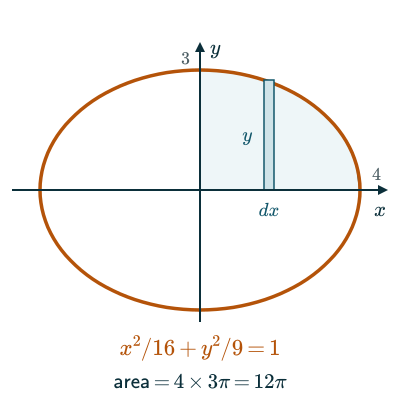
Take the radius a and semiaxes a, b to be positive. A circle x2 + y2 = a2 is symmetric about both axes, so its area is 4 times the quarter in the first quadrant, where y = √(a2 − x2) (NCERT Example 1, pages 294–295). With the square-root integral of Chapter 7:
4∫0a √(a2 − x2) dx = 4 × (a2/2)(π/2) = πa2.
For the ellipse x2/a2 + y2/b2 = 1, the quarter has y = (b/a)√(a2 − x2), and the same steps give πab (NCERT Example 2, pages 295–296). NCERT works both with horizontal strips as well, and gets the same answers.
Solved examples
Example 1: An ellipse (NCERT Exercise 8.1, Q1, page 296)
Find the area of the region bounded by the ellipse x2/16 + y2/9 = 1.
Here a = 4 and b = 3. The quarter in the first quadrant is (3/4)∫04 √(16 − x2) dx = (3/4) × (16/2)(π/2) = 3π.
Answer: 4 × 3π = 12π, which is πab.
Example 2: Horizontal strips (NCERT Exercise 8.1, Q4, page 296)
The area of the region bounded by the curve y2 = 4x, the y-axis and the line y = 3 is (A) 2; (B) 9/4; (C) 9/3; (D) 9/2.
The region lies between the y-axis and x = y2/4, for y from 0 to 3. Its area is ∫03 (y2/4) dy = 27/12.
Answer: 9/4, (B).
Example 3: Two areas under curves (NCERT Miscellaneous Exercise on Chapter 8, Q1, page 298)
Find the area under (i) y = x2 between x = 1 and x = 2; (ii) y = x4 between x = 1 and x = 5.
(i) [x3/3] from 1 to 2 = 8/3 − 1/3. (ii) [x5/5] from 1 to 5 = (3125 − 1)/5.
Answer: (i) 7/3; (ii) 3124/5 = 624.8.
Example 4: Part below the axis (NCERT Miscellaneous Exercise on Chapter 8, Q4, page 298)
The area bounded by y = x3, the x-axis and the ordinates x = −2 and x = 1 is (A) −9; (B) −15/4; (C) 15/4; (D) 17/4.
On [−2, 0] the curve is below the axis: the integral there is −16/4 = −4, so that part has area 4. On [0, 1] the area is 1/4. The plain integral from −2 to 1 would be −15/4, which is not an area.
Answer: 4 + 1/4 = 17/4, (D).
Example 5: A modulus (NCERT Miscellaneous Exercise on Chapter 8, Q2, page 298)
Sketch y = |x + 3| and evaluate its integral from −6 to 0.
The graph is a V with its corner at (−3, 0). The region from −6 to 0 is two triangles, each with base 3 and height 3.
Answer: 2 × 9/2 = 9.
Common mistakes to avoid
Common mistake
Integrating across a crossing point
For y = x − 1 from x = 0 to x = 3 the integral is 9/2 − 3 = 3/2, but the area is 1/2 + 2 = 5/2: the triangle below the axis on [0, 1] must be added, not subtracted. Split where the curve crosses the axis and add the absolute values.
Common mistake
Forgetting the symmetry factor
The integral from 0 to a gives only the quarter of a circle or ellipse in the first quadrant. Multiply by 4 for the whole area.
Common mistake
Using x-limits with horizontal strips
With strips of width dy, the limits are values of y. In Example 2 they are 0 and 3, the y-values of the region, not x-values.
Quick revision summary
- Vertical strips: A = ∫ y dx from x = a to x = b, for the region between y = f(x), the x-axis and the two ordinates.
- Horizontal strips: A = ∫ x dy from y = c to y = d, for the region between x = g(y), the y-axis and the two lines.
- Parts below the axis count with their absolute value: split at the crossing points.
- Circle x + y = a: area πa; ellipse x/a + y/b = 1: area πab, each four times a first-quadrant quarter.
Formula sheet
- A = ∫ |y| dx from x = a to x = b, a < b
- A = ∫ |x| dy from y = c to y = d, c < d
- circle x + y = a: area πa
- ellipse x/a + y/b = 1: area πab
Questions students ask
Is the area under a curve always positive?
The area under a curve is never negative: it is positive, or 0 when the region has no width or the curve lies along the x-axis, but the integral that measures it can be negative. Below the x-axis, y < 0, so each strip adds y dx < 0, and NCERT’s Remark (page 293) takes the absolute value of such a part. For y = x2 − 4 from x = 0 to x = 3, which crosses the axis at x = 2, the integral is −16/3 + 7/3 = −3, while the area, with the part below the axis counted as positive, is 16/3 + 7/3 = 23/3.
Is the area under a curve a derivative or an integral?
The area under a curve is an integral: for a continuous curve y = f(x) on or above the x-axis, the area from x = a to x = b is the definite integral of f(x) from a to b, found as F(b) − F(a) from any anti derivative F. The derivative comes in the other way round: the area from a up to a moving x has derivative f(x), the height of the curve there, which is the first fundamental theorem of calculus. For y = 4x3, the area from 0 to x (x > 0) is x4, whose derivative is 4x3 again, and the area from 0 to 2 is 24 = 16.
Does the area under a curve have units?
The area under a curve has units only when its axes do: in a pure maths question both axes carry plain numbers and the area is in square units, but on a graph of two physical quantities its unit is the product of the two axis units. So the area under a velocity–time graph is in m s × s = m, a displacement, and under a force–displacement graph in N × m = J, the work done, each with parts below the axis counted as negative. For v = t3 (in m s, t in seconds), the area from t = 0 to t = 2 is 24/4 = 4, so the displacement is 4 m.
Can you find the area under a curve without integration?
You can find some areas under curves without integration: a region bounded by lines and arcs of circles is built from triangles, trapezia, sectors and segments, so geometry gives it exactly, but most other curves need a definite integral for the exact area. A numerical rule such as the trapezium rule, beyond the NCERT text and the JEE Main syllabus, replaces each thin strip by a trapezium and gives an approximation. For y = x3 from 1 to 3 with four strips of width 0.5, the heights are 1, 3.375, 8, 15.625 and 27, and the rule (width × (sum of the middle heights + half of each end height)) gives 20.5, against the exact (34 − 1)/4 = 20; more strips bring it closer.
How many exercises are there in Application of Integrals, Class 12?
Application of Integrals, Chapter 8 of NCERT Mathematics Part II (Class 12), has two exercises in the 2026–27 reprint: Exercise 8.1, with 4 questions (page 296), and the Miscellaneous Exercise on Chapter 8, with 5 questions (page 298). Besides its introduction, the chapter has a single section, Section 8.2, Area under Simple Curves (pages 292–296), with NCERT Examples 1 and 2 (the circle and the ellipse); Miscellaneous Examples 3 and 4 follow the exercise. All nine exercise questions are worked on this page, as its solved examples and practice questions.
Practice questions
Try each question first, then open the answer to check your working.
-
Q1. Find the area of the region bounded by the ellipse x2/4 + y2/9 = 1 (NCERT Exercise 8.1, Q2, page 296).
Show answerHide answer
a = 2 and b = 3, so the area is π × 2 × 3 = 6π.
-
Q2. The area lying in the first quadrant and bounded by the circle x2 + y2 = 4 and the lines x = 0 and x = 2 is (A) π; (B) π/2; (C) π/3; (D) π/4 (NCERT Exercise 8.1, Q3, page 296).
Show answerHide answer
It is a quarter of a circle of radius 2: ¼ × π × 4 = π, (A).
-
Q3. Find the area bounded by the curve y = sin x between x = 0 and x = 2π (NCERT Miscellaneous Exercise on Chapter 8, Q3, page 298).
Show answerHide answer
On [0, π] the integral of sin x is 2; on [π, 2π] it is −2, an area of 2. The total area is 4.
-
Q4. The area bounded by the curve y = x|x|, the x-axis and the ordinates x = −1 and x = 1 is (A) 0; (B) 1/3; (C) 2/3; (D) 4/3 (NCERT Miscellaneous Exercise on Chapter 8, Q5, page 298).
Show answerHide answer
y = x2 for x > 0 and −x2 for x < 0, so each side has area 1/3. The area is 2/3, (C), although the integral is 0.