Area between two curves
Beyond NCERT In the JEE Main syllabus; the Class 12 book has no section for it.
Quick answer
The area between two curves y = f(x) on top and y = g(x) below, from x = a to x = b with a < b, is the integral of f(x) − g(x). For a region closed by the curves themselves, the limits are where they meet, found by solving f(x) = g(x), and the region must be split wherever the curves cross. For example, y = x + 2 and y = x meet at x = −1 and x = 2, and the area between them is 9/2.
What is the area between two curves?
Area between two curves
For continuous f, g on [a, b] with a < b, if f(x) ≥ g(x) throughout, the region between the two curves y = f(x), y = g(x) and the lines x = a and x = b is made of thin vertical strips of height f(x) − g(x) and width dx. Its area is the integral of that height from a to b.
Here, in this chapter, we shall study a specific application of integrals to find the area under simple curves, area between lines and arcs of circles, parabolas and ellipses (standard forms only).
NCERT Mathematics Part II (Class 12), Chapter 8, Introduction, page 292
Area between two curves
A = ∫ [f(x) − g(x)] dx, from x = a to x = b
(f(x) ≥ g(x) on the whole interval)
NCERT slip (page 292): the Introduction still promises the area between lines and arcs of circles, parabolas and ellipses, but the 2026–27 Chapter 8 has no section on it and teaches only the area under simple curves (Section 8.2). In an exam, use the method below: it is the area under a curve, applied to two curves. The JEE Main 2027 syllabus lists the areas of regions bounded by simple curves in standard forms (Unit 8), so this page gives the standard method. Apart from the NCERT lines cited, it is beyond the 2026–27 NCERT text.
In plain words: the area between two curves is the area under the upper one minus the area under the lower one. Subtracting inside the integral does this in one step, and it works even when part of the region is below the x-axis, because only the difference of heights matters.
Limits from the points of intersection
When the region is closed by the curves themselves, its ends are where they meet: solve f(x) = g(x). Then check which curve is on top between those points, for example by trying one value in each interval between consecutive intersections, where continuity prevents the ordering from changing without another intersection.
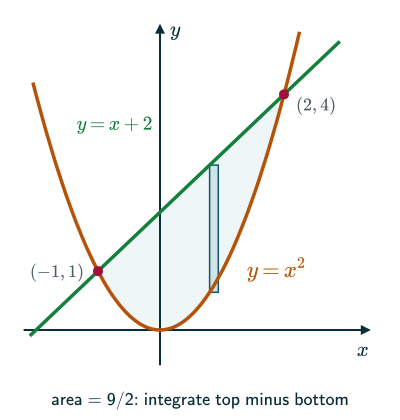
For the parabola y = x2 and the line y = x + 2: x2 = x + 2 gives x = −1 and x = 2. At x = 0 the line gives 2 and the parabola 0, so the line is on top, and
∫−12 (x + 2 − x2) dx = [x2/2 + 2x − x3/3] from −1 to 2
= 10/3 − (−7/6) = 9/2.
Horizontal strips. If the region is easier to describe from left to right, as x = p(y) on the right and x = q(y) on the left, integrate p(y) − q(y) with respect to y between the y-values where they meet. For x = y2 and the line x = 4, the region runs from y = −2 to y = 2, and its area is ∫−22 (4 − y2) dy = 32/3.
When the curves cross inside the interval, the top and bottom change places. Split at each crossing and use |f − g| on each piece; otherwise the pieces subtract from each other (in Example 2 they cancel completely).
Lines, circles, parabolas and ellipses
Many regions combine a curve with a chord. Then a known area minus a triangle is often quickest.
- Circle and chord. The circle x2 + y2 = 4 and the line x + y = 2 cut off a smaller segment in the first quadrant: the quarter circle (area π) minus the triangle with vertices (0, 0), (2, 0), (0, 2) (area 2), that is π − 2.
- Ellipse and chord. For the ellipse x2/9 + y2/4 = 1 and the line x/3 + y/2 = 1, the smaller region is the quarter ellipse 3π/2 minus the triangle 3, that is (3/2)(π − 2).
- Two parabolas. y2 = 4x and x2 = 4y meet at (0, 0) and (4, 4); between them y = 2√x is on top, and the area is ∫04 (2√x − x2/4) dx = 32/3 − 16/3 = 16/3.
Solved examples
Example 1: A line and a parabola
Find the area of the region between y = x and y = x2.
They meet where x = x2, at 0 and 1. At x = 1/2, x > x2, so the line is on top: ∫01 (x − x2) dx = 1/2 − 1/3.
Answer: 1/6.
Example 2: Curves that cross
Find the area between y = sin x and y = cos x from x = 0 to x = π/2.
They cross at π/4: cos x is on top before it and sin x after it. So the area is ∫0π/4 (cos x − sin x) dx + ∫π/4π/2 (sin x − cos x) dx, and each part is √2 − 1.
Answer: 2(√2 − 1). (Without splitting, the integral of cos x − sin x over [0, π/2] is 0.)
Example 3: A circle cut by a line
Find the area of the smaller region cut off from the circle x2 + y2 = 4 by the line x = 1.
The line meets the circle at (1, √3) and (1, −√3), and the smaller region is the part with x ≥ 1. A vertical strip runs from −√(4 − x2) up to √(4 − x2), so the area is 2∫12 √(4 − x2) dx. By the Chapter 7 formula, an anti derivative of √(4 − x2) is (x/2)√(4 − x2) + 2 sin−1 (x/2). It is π at x = 2 and √3/2 + π/3 at x = 1, so the area is 2(2π/3 − √3/2).
Answer: 4π/3 − √3, about 2.46.
Example 4: Horizontal strips
Find the area between the parabola y2 = x and the line x = y + 6.
They meet where y2 = y + 6, at y = −2 and y = 3. The line is on the right: ∫−23 (y + 6 − y2) dy = [y2/2 + 6y − y3/3] from −2 to 3 = 27/2 − (−22/3).
Answer: 125/6.
Example 5: A parabola and a circle
Find the area of the region inside the circle x2 + y2 = 8 and above the parabola x2 = 2y.
Substituting x2 = 2y: y2 + 2y − 8 = 0, so y = 2 (the other root, −4, is impossible), and x = ±2. Between x = −2 and 2 the circle’s upper half is on top. By symmetry the area is 2∫02 (√(8 − x2) − x2/2) dx, and ∫02 √(8 − x2) dx = 2 + π with the square-root integral of Chapter 7.
Answer: 2(2 + π − 4/3) = 2π + 4/3.
Common mistakes to avoid
Common mistake
Subtracting the wrong way round
The integrand is top minus bottom. Bottom minus top gives the right number with a minus sign; check with one value of x which curve is above.
Common mistake
Not splitting where the curves cross
In Example 2 the plain integral of cos x − sin x over [0, π/2] is 0, but the area is 2(√2 − 1). Split at every crossing.
Common mistake
Taking limits that are not the meeting points
The limits of a region closed by two curves are where the curves meet, found by solving f(x) = g(x), not where each curve meets the axis.
Quick revision summary
- The area between y = f(x) (top) and y = g(x) (bottom) from x = a to x = b is the integral of f(x) − g(x).
- For a region closed by the curves, solve f(x) = g(x) for the limits; split wherever the curves cross.
- With horizontal strips, integrate right curve minus left curve with respect to y.
- Curve-and-chord regions: a known area (quarter circle, quarter ellipse) minus a triangle.
- Example: y = x + 2 and y = x meet at x = −1 and x = 2, and the area between them is 9/2.
Formula sheet
- A = ∫ [f(x) − g(x)] dx from x = a to x = b, f on top
- A = ∫ [p(y) − q(y)] dy from y = c to y = d, p on the right
- limits: solve f(x) = g(x)
Questions students ask
Is the area between two curves deleted from the Class 12 syllabus?
Yes, the area between two curves was dropped from the NCERT Class 12 book in 2022 and is not in the CBSE 2026–27 Class 12 Mathematics (041) curriculum, but it is still in the JEE Main syllabus. NCERT’s 2022 list of rationalised content (page 44) removed the old Section 8.3, Area between Two Curves, so the 2026–27 reprint teaches only Section 8.2, the area under simple curves, though its introduction (page 292) still promises the “area between lines and arcs of circles, parabolas and ellipses”. The JEE Main 2027 syllabus, Unit 8, asks for “determining areas of the regions bounded by simple curves”, and a region closed off by a parabola and a line is one of them.
Is there a shortcut for the area between a parabola and a line?
Yes, beyond the 2026–27 NCERT text there is a shortcut for the area between a parabola y = ax2 + bx + c and with a ≠ 0 and a line that meets it at x = α and x = β (α < β): the area is |a|(β − α)3/6, because the gap between the two heights is |a|(x − α)(β − x). For y = 2x2 and y = x + 1, which meet at x = −1/2 and x = 1, it gives 2 × (3/2)3/6 = 9/8, the value of the integral of x + 1 − 2x2 from −1/2 to 1. It agrees with Archimedes’ result that a parabolic segment has 4/3 of the area of the largest triangle that fits in it on the same chord; use it to check an answer worked by integration.
When is it easier to find the area between two curves with respect to y?
Finding the area between two curves with respect to y (beyond the 2026–27 NCERT text) is easier when a vertical strip would change its top or bottom curve partway across the region, while a horizontal strip runs between the same two curves all the way. Between y2 = 2x and y = x − 4, which meet at (2, −2) and (8, 4), a vertical strip’s bottom is −√(2x) up to x = 2 and the line after that, so integrating in x needs two integrals. With x = y2/2 on the left and x = y + 4 on the right, one integral does it, ∫−24 (y + 4 − y2/2) dy, which is 40/3 + 14/3 = 18.
How do you find the area of a region given by inequalities, such as |x| ≤ y ≤ 2 − x2?
To find the area of a region given by inequalities, often written as a set {(x, y) : …} (beyond the 2026–27 NCERT text), read each inequality as a boundary: g(x) ≤ y ≤ f(x) means vertical strips from the curve y = g(x) up to y = f(x), and x runs between the points where the two curves meet, unless the set gives its own limits. For |x| ≤ y ≤ 2 − x2, the curves meet where |x| = 2 − x2, at x = −1 and x = 1, and the region is symmetric about the y-axis, so its area is twice ∫01 (2 − x2 − x) dx, which is 2(2 − 1/3 − 1/2) = 7/3. A quick sketch shows whether the region must be split.
Practice questions
Try each question first, then open the answer to check your working.
-
Q1. Find the area between y = x2 and y = 2x.
Show answerHide answer
They meet at x = 0 and 2; the line is on top. ∫02 (2x − x2) dx = 4 − 8/3 = 4/3.
-
Q2. Find the area of the smaller region cut off from the ellipse x2/16 + y2/9 = 1 by the line x/4 + y/3 = 1.
Show answerHide answer
The quarter ellipse has area π × 4 × 3/4 = 3π and the triangle 6, so the area is 3π − 6 = 3(π − 2).
-
Q3. Find the area between the parabolas y2 = 8x and x2 = 8y.
Show answerHide answer
They meet at (0, 0) and (8, 8); y = √(8x) is on top. ∫08 (√8 x1/2 − x2/8) dx = √8 × (2/3) × 83/2 − 512/24 = 128/3 − 64/3 = 64/3.
-
Q4. Find the area between the curve y = x3 and the line y = x.
Show answerHide answer
They meet at −1, 0 and 1. On [0, 1] the line is on top, area ¼; on [−1, 0] the cubic is on top, area ¼. The total is ½.