Maxima and minima
NCERT Class 12 Mathematics Chapter 6 Section 6.4
Quick answer
Local maxima and minima can occur only at critical points, where f′(c) = 0 or f′ does not exist. For f continuous at c, if f′ changes from positive to negative at c, f has a local maximum there, and from negative to positive a local minimum; alternatively, with f′(c) = 0, f″(c) < 0 gives a maximum and f″(c) > 0 a minimum. For a continuous function on a closed interval [a, b], the absolute maximum and minimum are the largest and smallest values of f at the critical points and the end points.
With your textbook
NCERT Mathematics Part I (Class 12), Chapter 6 “Application of Derivatives”, Section 6.4 “Maxima and Minima”, pages 159–177.
Open the official NCERT chapter (PDF, 3.3 MB, ncert.nic.in) (opens in a new tab)
Checked against the 2026-27 reprint on .
What are maximum and minimum values?
Maximum, minimum and local extrema
- f has a maximum value f(c) on an interval I if f(c) ≥ f(x) for all x in I, and a minimum value f(c) if f(c) ≤ f(x) for all x in I; either is an extreme value (NCERT Definition 3, page 160).
- An interior point c is a point of local maxima if f(c) ≥ f(x) for all x in some interval (c − h, c + h), and of local minima if f(c) ≤ f(x) there (NCERT Definition 4, page 163).
- A critical point is a point c of the domain where f′(c) = 0 or f is not differentiable (NCERT page 164).
In plain words: a maximum value is the highest value of f on the whole interval; a local maximum is a hilltop compared only with nearby points, and a local minimum a valley. f(x) = x2 has minimum value 0 at x = 0 and no maximum on R; on [−2, 1] it also has a maximum value 4, at x = −2 (NCERT Example 14, page 161). f(x) = x on the open interval (0, 1) has neither, because there is no point closest to 0 or to 1 (NCERT Example 16, page 162).
NCERT slip (page 160): Definition 3 prints the conditions as f(c) > f(x) and f(c) < f(x) “for all x ∈ I”. Since c itself is in I, these would require f(c) > f(c); the conditions are f(c) ≥ f(x) and f(c) ≤ f(x), as in Definition 4. In an exam, write ≥ and ≤ in this definition.
Where local extrema can occur
At an interior local maximum, nearby values are at most f(c). Thus the difference quotients from the left are nonnegative and those from the right are nonpositive. If the derivative exists, the two limits agree and must be 0. Otherwise the point is not differentiable. The same argument with reversed inequalities applies to a local minimum; nearby monotonicity is not required.
If f has a local maxima or a local minima at x = c, then either f′(c) = 0 or f is not differentiable at c.
NCERT Mathematics Part I (Class 12), Section 6.4, page 164
The converse is false: f(x) = x3 has f′(0) = 0, but 0 is neither a local maximum nor a local minimum (NCERT’s Remark, page 164). And f(x) = |x| has its minimum at 0, where it is not differentiable (NCERT Example 15, page 161).
The first derivative test
NCERT Theorem 3 (page 164): let f be continuous at a critical point c.
- If f′ changes from positive to negative as x increases through c, then c is a point of local maxima.
- If f′ changes from negative to positive, c is a point of local minima.
- If f′ is strictly positive on both sides, or strictly negative on both sides, c is neither a local maximum nor a local minimum. This alone does not establish a point of inflection, which requires a change of concavity.
NCERT’s Theorem 3 calls the third case a point of inflection, but that wording is too broad. For example, f(x) = x for x ≤ 0 and 2x for x > 0 is continuous and critical at 0, with positive slopes 1 and 2 on the two sides. It has neither an extremum nor a change from concave up to concave down there. A constant neighbourhood is another exceptional case: every point is both a non-strict local maximum and minimum, so the strict-sign conditions matter.
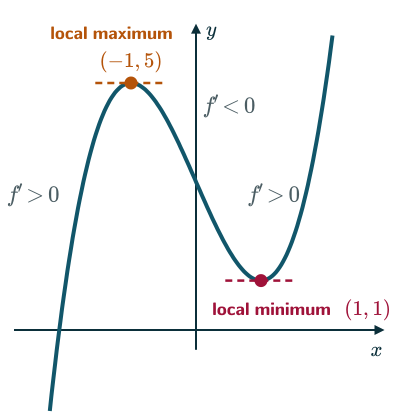
NCERT Example 17 (page 165): f(x) = x3 − 3x + 3 has f′(x) = 3(x − 1)(x + 1). At x = −1, f′ changes from + to −, so f has a local maximum f(−1) = 5; at x = 1, from − to +, so a local minimum f(1) = 1.
NCERT Example 19 (pages 166–167): f(x) = 3 + |x| has slope −1 to the left of 0 and 1 to the right, so 0 is a point of local minima with value 3, though f′(0) does not exist.
The second derivative test
NCERT Theorem 4 (page 166): if f′(c) = 0 and f is twice differentiable at c, then
Second derivative test
f″(c) < 0 ⇒ local maximum at c
f″(c) > 0 ⇒ local minimum at c
f″(c) = 0 ⇒ the test fails; use the first derivative test
NCERT Example 20 (page 167): f(x) = 3x4 + 4x3 − 12x2 + 12 has f′(x) = 12x(x − 1)(x + 2) and f″(x) = 36x2 + 24x − 24. Since f″(0) = −24 < 0, f(0) = 12 is a local maximum; since f″(1) = 36 > 0 and f″(−2) = 72 > 0, f(1) = 7 and f(−2) = −20 are local minima.
NCERT slip (page 167): the last sentence of Example 20 gives the local minimum values “at x = −1 and −2”; the points are x = 1 and x = −2, as the same sentence says just before.
NCERT Example 21 (page 167): for 2x3 − 6x2 + 6x + 5, f′ = 6(x − 1)2 and f″(1) = 0, so the test fails; f′ does not change sign at 1, so x = 1 is not an extremum. Here f″ = 12(x − 1) changes from negative to positive, establishing an inflection point (NCERT Example 18).
NCERT slips (pages 162–169): four cross-references point to example numbers 12 too high: the Note on page 162 says “Example 27” for Example 15 (|x| is not differentiable at 0), the Remark on page 166 “Example 30” for Example 18, the Remark on page 168 “Example 34” for Example 22, and the Note on page 169 “Example 35” for Example 23. Page 164 also sends the local-minimum picture to “Fig 6.14(b)”; it is Fig 6.12(b) on page 163.
Applied problems
Write the quantity to be made largest or smallest as a function of one variable, using the given conditions to remove the others; find its critical points; test them; and check that the answer makes sense (a length must be positive, and so on).
NCERT Example 22 (pages 167–168): two positive numbers add up to 15, and the sum of their squares S(x) = x2 + (15 − x)2 should be least. S′(x) = 4x − 30 = 0 at x = 15/2, and S″ = 4 > 0, so the numbers are 15/2 and 15/2.
NCERT Example 24 (page 169): poles AP = 16 m and BQ = 22 m stand 20 m apart. For R on AB with AR = x, RP2 + RQ2 = 2x2 − 40x + 1140, which is least at x = 10 m.
Absolute extrema on a closed interval
Let f be a continuous function on an interval I = [a, b]. Then f has the absolute maximum value and f attains it at least once in I.
NCERT Mathematics Part I (Class 12), Section 6.4.1, page 172
The absolute maximum (greatest value) and absolute minimum (least value) on [a, b] occur either at a critical point inside the interval or at an end point. So (NCERT’s working rule, page 172): find the critical points in the interval, add the end points, evaluate f at all of them, and pick the largest and the smallest value.
NCERT Example 27 (page 173): f(x) = 2x3 − 15x2 + 36x + 1 on [1, 5] has f′(x) = 6(x − 2)(x − 3). The values f(1) = 24, f(2) = 29, f(3) = 28 and f(5) = 56 give an absolute maximum 56 at x = 5 and an absolute minimum 24 at x = 1. The local maximum at x = 2 is not the greatest value.
Solved examples
Example 1: A critical point without a derivative (NCERT Example 28, pages 173–174)
Find the absolute maximum and minimum values of f(x) = 12x4/3 − 6x1/3 on [−1, 1].
f′(x) = 16x1/3 − 2x−2/3 = 2(8x − 1)/x2/3, which is 0 at x = 1/8 and undefined at x = 0. The values are f(−1) = 12 + 6 = 18, f(0) = 0, f(1/8) = 12(1/16) − 6(1/2) = −9/4 and f(1) = 12 − 6 = 6.
Answer: absolute maximum 18 at x = −1; absolute minimum −9/4 at x = 1/8.
Example 2: The nearest point (NCERT Example 29, page 174)
A helicopter flies along y = x2 + 7. A soldier at (3, 7) wants it at its nearest point. Find the nearest distance.
The squared distance from (x, x2 + 7) to (3, 7) is f(x) = (x − 3)2 + x4, which is least where the distance is least. f′(x) = 2(x − 3) + 4x3 = 2(x − 1)(2x2 + 2x + 3), and 2x2 + 2x + 3 has no real roots, so x = 1 is the only critical point, with f(1) = 5. Since 2x2 + 2x + 3 > 0, f′ changes from − to + at 1, so f(1) = 5 is the least value.
Answer: √5 units.
Example 3: A box from a sheet (NCERT Exercise 6.3, Q17, page 176)
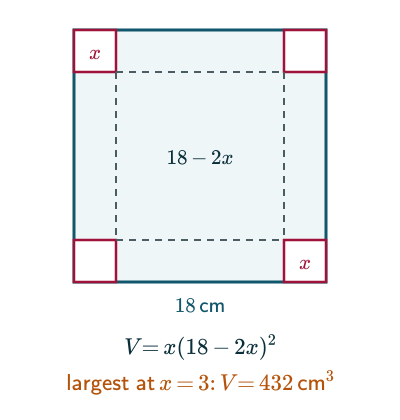
An open box is made from an 18 cm square of tin by cutting equal squares from the corners and folding up the flaps. What side of square gives the largest volume?
V(x) = x(18 − 2x)2 for 0 < x < 9. V′(x) = (18 − 2x)2 − 4x(18 − 2x) = (18 − 2x)(18 − 6x), which is 0 at x = 3 (and at x = 9, which gives no box). V″(x) = 24x − 144 is −72 < 0 at x = 3. Moreover V′ is positive on (0, 3) and negative on (3, 9), so this is the largest volume on the entire physical domain.
Answer: 3 cm, giving a volume of 3 × 122 = 432 cm3.
Example 4: Product with a fixed sum (NCERT Exercise 6.3, Q14, page 176)
Find positive x and y with x + y = 60 and xy3 as large as possible.
Put x = 60 − y: P(y) = (60 − y)y3, so P′(y) = 180y2 − 4y3 = 4y2(45 − y), zero at y = 45 for y in (0, 60). P′ changes from + to − there.
Answer: x = 15, y = 45. (NCERT’s key lists the numbers as 45, 15: y = 45, x = 15.)
Example 5: Inscribed rectangle (NCERT Exercise 6.3, Q19, page 176)
Show that of all rectangles inscribed in a fixed circle, the square has the largest area.
If the circle has radius r and the rectangle has sides a and b, the diagonal is the diameter: a2 + b2 = 4r2. Then the area A = ab has A2 = a2(4r2 − a2), and since A > 0 it is largest when A2 is; with u = a2, the quadratic u(4r2 − u) is largest at u = 2r2, so a2 = b2 = 2r2.
Answer: a = b = √2 r, a square, with area 2r2.
Common mistakes to avoid
Common mistake
Forgetting the end points
On a closed interval the greatest or least value may be at an end point, where f′ need not be 0. In NCERT Example 27 both absolute extrema are at the ends. Also drop critical points outside the interval: for 2x3 − 24x + 107 on [1, 3] (NCERT Exercise 6.3, Q10, page 175), f′ = 0 at ±2, but only 2 counts; f(1) = 85, f(2) = 75 and f(3) = 89.
Common mistake
Reading f″(c) = 0 as no extremum
x4 has f′(0) = f″(0) = 0, yet 0 is a point of local minima; −x4 has a maximum there and x3 neither. When f″(c) = 0, go back to the sign of f′ (NCERT Theorem 4 (iii), page 166).
Common mistake
Treating f′(c) = 0 as enough
f′(c) = 0 only makes c a candidate. For x3 at 0, f′ is 0 but there is no maximum or minimum; check the sign change or f″.
Common mistake
Missing points where f′ does not exist
|x| and 12x4/3 − 6x1/3 have critical points where the derivative does not exist (x = 0). Leaving them out can lose the answer.
Quick revision summary
- Local extrema occur only at critical points, where f′(c) = 0 or f′ does not exist.
- First derivative test: f′ from + to − gives a local maximum, from − to + a local minimum, the same strict sign on both sides gives neither extremum. Check concavity separately for an inflection point.
- Second derivative test: with f′(c) = 0, f″(c) < 0 gives a local maximum and f″(c) > 0 a local minimum; f″(c) = 0 decides nothing.
- For f continuous on [a, b], compare f at the critical points and the end points: the largest is the absolute maximum and the smallest the absolute minimum.
Formula sheet
- critical point: f′(c) = 0 or f′(c) does not exist
- f′(c) = 0 and f″(c) < 0 ⇒ local maximum
- f′(c) = 0 and f″(c) > 0 ⇒ local minimum
Questions students ask
What is the difference between a local maximum and an absolute maximum?
A local (or relative) maximum is a value f(c) at an interior point c that is the largest compared only with values at points near c, while the absolute (or global) maximum is the largest value of f on the whole interval or domain; NCERT uses all four names (pages 163 and 171). So f can have several local maxima but only one absolute maximum value, and an absolute maximum at an end point of [a, b] is not a local maximum, because NCERT’s Definition 4 needs an interior point. A local maximum can even be smaller than a local minimum: f(x) = x + 16/x has a local maximum −8 at x = −4 and a local minimum 8 at x = 4, and no absolute maximum or minimum at all.
When should you use the first derivative test instead of the second derivative test?
Use the first derivative test when the second derivative test cannot decide, that is when f″(c) = 0 or f is not twice differentiable at c (as at a corner, where f′(c) does not exist), and when f″ is long to work out; the second derivative test is quicker when f′(c) = 0 and f″(c) is easy to find and not 0. For f(x) = x4 − 4x3, f′(x) = 4x2(x − 3) and f″(x) = 12x(x − 2). At x = 3, f″(3) = 36 > 0 gives a local minimum f(3) = −27, but at x = 0, f″(0) = 0 decides nothing, and f′ < 0 on both sides of 0 shows that x = 0 gives neither a local maximum nor a local minimum.
Why does the second derivative test work?
The second derivative test works because it is the first derivative test in disguise: if f is twice differentiable at c with f′(c) = 0 and f″(c) < 0, then f′(x)/(x − c), the difference quotient of f′ at c, tends to f″(c), so it is negative for all x close to c. So f′(x) > 0 just to the left of c and f′(x) < 0 just to the right, the + to − change that makes c a point of local maxima; with f″(c) > 0 the signs reverse and c is a point of local minima. When f″(c) = 0 the quotient tends to 0 and fixes no sign, which is why the test fails there and the first derivative test must decide.
When is a local maximum also the absolute maximum?
Beyond NCERT’s statements, a local maximum must be the absolute maximum on an interval when it is the only critical point of f in that interval and f is continuous there: a larger value elsewhere would force f to fall from the local maximum and rise again, making a local minimum in between, a second critical point. This rule is why an applied problem can stop after one derivative test, and it works for minima too. For f(x) = 6x2 − x3 on (0, ∞), f′(x) = 3x(4 − x) is 0 only at x = 4, where it changes from + to −, so f(4) = 32 is the largest value for all x > 0; on all of R it is not, since 0 is a second critical point and f(−4) = 160.
What is the difference between a critical point, a stationary point and a point of inflection?
A critical point is a point c of the domain of f where f′(c) = 0 or f is not differentiable (NCERT page 164); beyond NCERT, a stationary point is one where f′(c) = 0, so the corner of |x| at 0 is critical, not stationary. NCERT’s Theorem 3 labels a critical point with no sign change of f′ an inflection point, but the general criterion is a switch between bending upwards and downwards (concavity), and it need not be critical: x3 + 2x bends down for x < 0 and up for x > 0, with slope 2 at 0.
Are maxima and minima of functions of two variables in the JEE Main syllabus?
No, maxima and minima of functions of two variables are not in the JEE Main syllabus: Unit 7 of the JEE Main 2027 syllabus lists “Maxima and minima of functions of one variable”, and NCERT’s Class 12 Chapter 6, Section 6.4 (pages 159–177), treats only functions of one variable. Problems that begin with two quantities, such as two positive numbers with a fixed sum, are still in scope, because the condition turns them into a function of one variable. Beyond NCERT, two-variable extrema use partial derivatives, saddle points and a second derivative test of their own, taught in university calculus.
Practice questions
Try each question first, then open the answer to check your working.
-
Q1. Find the local maxima and minima of f(x) = x3 − 6x2 + 9x + 15, and the values (NCERT Exercise 6.3, Q3 (v), page 175).
Show answerHide answer
f′(x) = 3(x − 1)(x − 3) and f″(x) = 6x − 12. f″(1) = −6 < 0: local maximum f(1) = 19. f″(3) = 6 > 0: local minimum f(3) = 15.
-
Q2. Find the absolute maximum and minimum values of f(x) = x3 on [−2, 2] (NCERT Exercise 6.3, Q5 (i), page 175).
Show answerHide answer
f′(x) = 3x2 = 0 only at 0, and f(0) = 0. With the end points: f(−2) = −8, f(2) = 8. So the absolute maximum is 8 and the absolute minimum −8.
-
Q3. Find two numbers whose sum is 24 and whose product is as large as possible (NCERT Exercise 6.3, Q13, page 176).
Show answerHide answer
P(x) = x(24 − x), P′ = 24 − 2x = 0 at x = 12, and P″ = −2 < 0. The numbers are 12 and 12.
-
Q4. The point on the curve x2 = 2y nearest to (0, 5) is (A) (2√2, 4); (B) (2√2, 0); (C) (0, 0); (D) (2, 2) (NCERT Exercise 6.3, Q27, page 177).
Show answerHide answer
For (x, x2/2), the squared distance is x2 + (x2/2 − 5)2. With u = x2, this is u + (u/2 − 5)2, whose derivative 1 + (u/2 − 5) is 0 at u = 8. So x = ±2√2, y = 4: (A).