Increasing and decreasing functions
NCERT Class 12 Mathematics Chapter 6 Section 6.3
Quick answer
A function is increasing on an interval if x < x gives f(x) ≤ f(x), and strictly increasing if it gives f(x) < f(x); decreasing is defined the same way with the inequalities reversed. If f′(x) > 0 on an interval, f is strictly increasing there, and if f′(x) < 0, strictly decreasing. To find the intervals, solve f′(x) = 0, split the domain at those points and test the sign of f′ on each piece.
With your textbook
NCERT Mathematics Part I (Class 12), Chapter 6 “Application of Derivatives”, Section 6.3 “Increasing and Decreasing Functions”, pages 152–159.
Open the official NCERT chapter (PDF, 3.3 MB, ncert.nic.in) (opens in a new tab)
Checked against the 2026-27 reprint on .
What are increasing and decreasing functions?
Increasing and decreasing on an interval
For an interval I in the domain of f, and any x < x in I (NCERT Definition 1, pages 152–153):
- f is increasing on I if f(x) ≤ f(x), and strictly increasing if f(x) < f(x);
- f is decreasing on I if f(x) ≥ f(x), and strictly decreasing if f(x) > f(x);
- f is constant on I if f(x) = c for all x in I.
In plain words: moving from left to right, the graph of an increasing function never goes down, and that of a strictly increasing function always goes up. The slope of the graph, the derivative, tells which way it is going. f(x) = x2 is strictly decreasing for x < 0 and strictly increasing for x > 0 (NCERT Fig 6.1, page 152). NCERT Example 7 (page 153): for f(x) = 7x − 3, x < x gives 7x − 3 < 7x − 3, so f is strictly increasing on R.
A function is increasing (or decreasing) at a point x if it is increasing (or decreasing) on some open interval containing x (NCERT Definition 2, page 153).
NCERT slip (page 153): in Fig 6.2, the third graph, a horizontal segment, is captioned “Neither Increasing nor Decreasing function”. By Definition 1 a constant function is both increasing and decreasing, in the “≤” and “≥” sense; what it is not is strictly increasing or strictly decreasing, and the caption should be read that way. In an exam, call a constant function neither strictly increasing nor strictly decreasing.
The first derivative test
NCERT Theorem 1 (page 153): let f be continuous on [a, b] and differentiable on (a, b). Then
The sign of f′ and monotonicity
f′(x) ≥ 0 on (a, b) ⇒ f increasing on [a, b]
f′(x) ≤ 0 on (a, b) ⇒ f decreasing on [a, b]
f′(x) = 0 on (a, b) ⇒ f constant on [a, b]
With strict signs, f′(x) > 0 on (a, b) gives a strictly increasing f, and f′(x) < 0 a strictly decreasing one. The reason is the Mean Value Theorem (not stated in the 2026–27 book; see the slip below): f(x) − f(x) = f′(c)(x − x) for some c between x and x, so f(x) − f(x) has the sign of f′(c).
NCERT slip (pages 153–154): the text says the proof “requires the Mean Value Theorem studied in Chapter 5” and cites it as “Theorem 8 in Chapter 5”. Chapter 5 of the 2026–27 book has Theorems 1 to 5 only and does not state the Mean Value Theorem. It is used here without proof. Its proof of part (a) (page 154) also takes f′(c) > 0 as “given”, though the theorem assumes only f′(x) ≥ 0; with f′(c) ≥ 0 the same lines give f(x) ≥ f(x). In an exam, quote the Mean Value Theorem as a known result.
NCERT Example 8 (page 154): f(x) = x3 − 3x2 + 4x has f′(x) = 3x2 − 6x + 4 = 3(x − 1)2 + 1 > 0, so f is increasing on R. NCERT Example 9 (pages 154–155): cos x has derivative −sin x, negative on (0, π) and positive on (π, 2π), so cos x is decreasing on (0, π) and increasing on (π, 2π).
Clearly by (a) and (b) above, f is neither increasing nor decreasing in (0, 2π).
NCERT Mathematics Part I (Class 12), Section 6.3, page 155
Finding the intervals
To find where f increases and decreases:
- Find f′(x) and the points where f′(x) = 0 (or f′ is undefined).
- These points split the domain into intervals; check the sign of f′ on each.
- f is increasing where f′ > 0 and decreasing where f′ < 0.
NCERT Example 11 (pages 155–156): f(x) = 4x3 − 6x2 − 72x + 30 has f′(x) = 12(x − 3)(x + 2), which is 0 at x = −2 and 3. On (−∞, −2) and (3, ∞) both factors have the same sign and f′ > 0; on (−2, 3), f′ < 0.
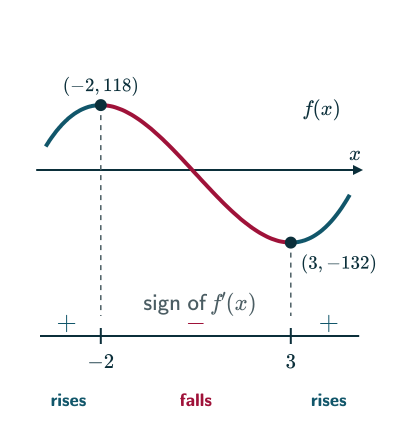
So f is increasing on (−∞, −2) and (3, ∞) and decreasing on (−2, 3) (NCERT page 156). For trigonometric functions the same method works on a bounded interval: NCERT Example 13 (pages 157–158), sin x + cos x on [0, 2π] has derivative cos x − sin x, zero at π/4 and 5π/4, so it is increasing on [0, π/4] and [5π/4, 2π] and decreasing on [π/4, 5π/4]. (NCERT’s table on page 158 prints [0, π/4), (π/4, 5π/4) and (5π/4, 2π]; by continuity the end points may be included, as NCERT does in Example 12, page 157.)
Solved examples
Example 1: A quadratic (NCERT Exercise 6.2, Q4, page 158)
Find the intervals in which f(x) = 2x2 − 3x is (a) increasing; (b) decreasing.
f′(x) = 4x − 3, which is 0 at x = 3/4, negative before and positive after.
Answer: (a) increasing on (3/4, ∞); (b) decreasing on (−∞, 3/4).
Example 2: A cubic (NCERT Exercise 6.2, Q5, page 158)
Find the intervals in which f(x) = 2x3 − 3x2 − 36x + 7 is (a) increasing; (b) decreasing.
f′(x) = 6x2 − 6x − 36 = 6(x − 3)(x + 2), zero at −2 and 3. Test points: f′(−3) = 36 > 0, f′(0) = −36 < 0, f′(4) = 36 > 0.
Answer: (a) increasing on (−∞, −2) and (3, ∞); (b) decreasing on (−2, 3).
Example 3: Show it always increases (NCERT Exercise 6.2, Q18, page 159)
Prove that f(x) = x3 − 3x2 + 3x − 100 is increasing on R.
f′(x) = 3x2 − 6x + 3 = 3(x − 1)2 ≥ 0 for all x, and it is 0 only at x = 1.
Answer: f is increasing on R. Beyond the NCERT text: it is even strictly increasing, because f′ is 0 at one point only; indeed f = (x − 1)3 − 99.
Example 4: A parameter (NCERT Exercise 6.2, Q14, page 159)
For what values of a is f(x) = x2 + ax + 1 increasing on [1, 2]?
f′(x) = 2x + a. For f′ ≥ 0 on the whole interval it is enough that its smallest value there, at x = 1, is not negative: 2 + a ≥ 0.
Answer: a ≥ −2. NCERT slip (answers, page 219): the key gives a > −2, which leaves out a = −2; there f′ = 2(x − 1) ≥ 0 on [1, 2], and f still increases. In an exam, write a ≥ −2 and check a = −2.
Example 5: Choose the correct answer (NCERT Exercise 6.2, Q19, page 159)
The interval in which y = x2e−x is increasing is (A) (−∞, ∞); (B) (−2, 0); (C) (2, ∞); (D) (0, 2).
y′ = 2xe−x − x2e−x = x(2 − x)e−x. Since e−x > 0, y′ > 0 exactly when 0 < x < 2.
Answer: (D).
Common mistakes to avoid
Common mistake
Thinking f′ = 0 always changes the direction
In Example 3, f′(1) = 0, but f′ > 0 on both sides of 1, so f keeps increasing through 1. Only a change of sign changes the direction.
Common mistake
Joining two intervals of increase
In NCERT Example 11, f is increasing on (−∞, −2) and on (3, ∞) separately, but not on the union of the two: −3 < 4, yet f(−3) = 84 is greater than f(4) = −98.
Common mistake
Ignoring the domain
log sin x is defined only where sin x > 0. On (0, π) its derivative cot x is positive on (0, π/2) and negative on (π/2, π); outside (0, π) (and its repeats) the function does not exist.
Quick revision summary
- Increasing: x < x ⇒ f(x) ≤ f(x); strictly increasing: f(x) < f(x). Decreasing likewise with ≥ and >.
- For f continuous on [a, b] and differentiable on (a, b): if f′(x) > 0 on (a, b), f is strictly increasing on [a, b]; if f′(x) < 0, strictly decreasing; if f′(x) = 0, constant. (NCERT Theorem 1, page 153, states the non-strict form: f′(x) ≥ 0 gives increasing and f′(x) ≤ 0 decreasing.)
- To find the intervals, solve f′(x) = 0, split the domain at those points and test the sign of f′ on each piece.
Formula sheet
- f continuous on [a, b], f′(x) > 0 on (a, b) ⇒ f strictly increasing on [a, b]
- f continuous on [a, b], f′(x) < 0 on (a, b) ⇒ f strictly decreasing on [a, b]
- f continuous on [a, b], f′(x) = 0 on (a, b) ⇒ f constant on [a, b]
Questions students ask
What is the difference between an increasing and a strictly increasing function?
An increasing function may stay level over a stretch, while a strictly increasing one must rise between any two points: on an interval I, x < x gives f(x) ≤ f(x) for an increasing function but f(x) < f(x) for a strictly increasing one (NCERT Definition 1, pages 152–153). So every strictly increasing function is increasing, but not the other way round: the greatest integer function [x] is increasing on R but not strictly, since [1.2] = [1.7] = 1. Beyond NCERT’s wording, many books call such functions non-decreasing and keep “increasing” for strictly increasing ones, so check which meaning a question uses.
What is a monotonic function, and is a constant function monotonic?
A monotonic function on an interval is one that is either increasing or decreasing on the whole interval (NCERT’s Note, page 162), and, in a term beyond NCERT, a strictly monotonic one is strictly increasing or strictly decreasing there; the JEE Main syllabus, Unit 7, names the topic “monotonic-Increasing and decreasing functions”. A constant function is monotonic, because it satisfies both f(x) ≤ f(x) and f(x) ≥ f(x), but it is not strictly monotonic. A function that turns inside an interval is not monotonic on it: x2 on [−1, 2] falls from 1 to 0 and then rises to 4, though it is monotonic on [−1, 0] and on [0, 2].
What is the condition for a function to be strictly increasing?
A differentiable function is strictly increasing on an interval if f′(x) > 0 at every point of it, and, going beyond NCERT’s Theorem 1, also if f′(x) ≥ 0 with f′(x) = 0 only at single points, never on a whole sub-interval. For example, f(x) = x − sin x has f′(x) = 1 − cos x, which is never negative and is 0 only at 0, ±2π, ±4π, …, so f is strictly increasing on R. The condition f′(x) > 0 is sufficient but not necessary: a strictly increasing differentiable function must have f′(x) ≥ 0 but need not have f′(x) > 0, as x3 is strictly increasing although its derivative is 0 at x = 0.
Should intervals of increase be written with open or closed brackets?
Intervals of increase can be written with open or closed brackets at an end point where f is continuous, because NCERT Theorem 1 turns the sign of f′ on an open interval (a, b) into monotonicity on the closed interval [a, b]. For example, f(x) = x3 − 12x has f′(x) = 3x2 − 12, zero at ±2, so f is strictly increasing on (−∞, −2] and [2, ∞) and strictly decreasing on [−2, 2], and the open forms are just as true; NCERT writes open intervals in Example 11 and closed ones in Example 12. An end point must stay open where f is not defined: 1/x is strictly decreasing on (−∞, 0) and on (0, ∞), and 0 belongs to neither.
Is the sum, difference or composite of two increasing functions increasing?
The sum of two increasing functions on an interval is increasing, since adding f(x) ≤ f(x) and g(x) ≤ g(x) gives the same inequality for f + g, but a difference need not be: ex and x both increase, yet ex − x decreases on (−∞, 0] and increases on [0, ∞). Beyond NCERT’s text, a composite gof is increasing when f and g both increase or both decrease, and decreasing when there is one of each (if g is monotonic on an interval holding the values of f), because an increasing function keeps the order of inputs and a decreasing one reverses it. So e−x, which is ex applied after −x, decreases on R.
Practice questions
Try each question first, then open the answer to check your working.
-
Q1. Show that f(x) = e2x is increasing on R (NCERT Exercise 6.2, Q2, page 158).
Show answerHide answer
f′(x) = 2e2x > 0 for every x, so f is (strictly) increasing on R.
-
Q2. Show that sin x is increasing on (0, π/2), decreasing on (π/2, π), and neither on (0, π) (NCERT Exercise 6.2, Q3, page 158).
Show answerHide answer
f′(x) = cos x, positive on (0, π/2) and negative on (π/2, π). On (0, π) it takes both signs, so f is neither increasing nor decreasing there (for example sin (π/6) < sin (π/2) but sin (π/2) > sin (5π/6)).
-
Q3. Find the intervals in which f(x) = x2 + 2x − 5 is strictly increasing or decreasing (NCERT Exercise 6.2, Q6 (a), page 158).
Show answerHide answer
f′(x) = 2x + 2, zero at x = −1. f is strictly decreasing on (−∞, −1) and strictly increasing on (−1, ∞).
-
Q4. Which of these is decreasing on (0, π/2)? (A) cos x; (B) cos 2x; (C) cos 3x; (D) tan x (NCERT Exercise 6.2, Q12, page 159).
Show answerHide answer
The derivatives are −sin x (negative on the whole interval), −2 sin 2x (negative, as 2x is in (0, π)), −3 sin 3x (changes sign at x = π/3) and sec2 x (positive). So (A) and (B).