Differentiability and the chain rule
NCERT Class 12 Mathematics Chapter 5 Section 5.3
Quick answer
A function is differentiable at an interior point c when its left-hand and right-hand derivatives there are finite and equal. Every differentiable function is continuous, but not conversely: |x| is continuous at 0 with one-sided derivatives −1 and 1. The chain rule gives df/dx = (dv/dt)(dt/dx) for f = v∘u with t = u(x); it also handles implicit functions and gives d/dx (sin x) = 1/√(1 − x) for −1 < x < 1.
With your textbook
NCERT Mathematics Part I (Class 12), Chapter 5 “Continuity and Differentiability”, Section 5.3 “Differentiability”, pages 118–125.
Open the official NCERT chapter (PDF, 3.2 MB, ncert.nic.in) (opens in a new tab)
Checked against the 2026-27 reprint on .
What does differentiable mean?
Differentiability at a point
- The derivative of f at c is the limit of (f(c + h) − f(c))/h as h → 0, when it exists (NCERT page 118).
- f is differentiable at c if the left-hand derivative (the limit as h → 0) and the right-hand derivative (as h → 0) are both finite and equal (NCERT page 119).
- f is differentiable on [a, b] if it is differentiable at every point, using the one-sided derivative at each end point (NCERT page 119).
In plain words: the slope of the graph must settle to one finite value whether you approach c from the left or from the right. A corner (two different one-sided slopes), a break, or a vertical tangent all stop a function from being differentiable there. The rules for sums, products and quotients, and the derivatives of x, sin x, cos x and tan x, are those of Class 11 (NCERT Table 5.3, page 119).
NCERT slip (page 119): at the end points of [a, b], NCERT calls the one-sided limits the “left hand derivative and right hand derivative of the function at a and b respectively”; at a it is the right-hand derivative and at b the left-hand one. In an exam, take each end point’s derivative from inside the interval: from the right at a, from the left at b.
Differentiable means continuous
If a function f is differentiable at a point c, then it is also continuous at that point.
NCERT Mathematics Part I (Class 12), Section 5.3, page 120
The proof (NCERT Theorem 3): for x ≠ c, f(x) − f(c) = [(f(x) − f(c))/(x − c)] × (x − c). As x → c, the bracket tends to f′(c) and the second factor to 0, so f(x) − f(c) → f′(c) × 0 = 0, that is, f(x) → f(c). So every differentiable function is continuous (NCERT Corollary 1).
The converse is false. f(x) = |x| is continuous at 0, but (|0 + h| − 0)/h = |h|/h is −1 for h < 0 and 1 for h > 0. The one-sided derivatives −1 and 1 differ, so |x| is not differentiable at 0 (NCERT page 120).
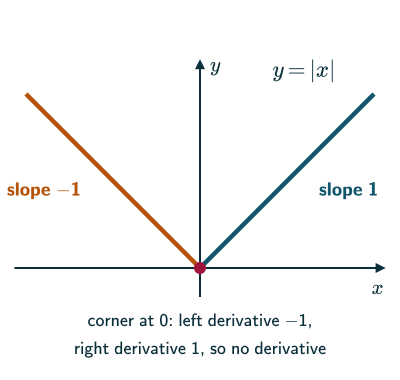
The chain rule
NCERT Theorem 4 (page 121): if f = v∘u, with t = u(x), and both dt/dx and dv/dt exist, then
Chain rule
df/dx = (dv/dt) · (dt/dx)
NCERT’s illustration (pages 120–121): f(x) = (2x + 1)3 is t3 with t = 2x + 1, so df/dx = 3t2 × 2 = 6(2x + 1)2, the same as expanding to 8x3 + 12x2 + 6x + 1 and differentiating. For three functions, f = (w∘u)∘v with t = v(x) and s = u(t), df/dx = (dw/ds)(ds/dt)(dt/dx) (NCERT page 121). NCERT Example 21: for f(x) = sin (x2), with t = x2, df/dx = cos t × 2x = 2x cos (x2).
Implicit functions
When x and y are linked by an equation that is hard to solve for y, such as x + sin xy − y = 0, differentiate both sides with respect to x, treating y as a function of x: by the chain rule, d(y2)/dx = 2y dy/dx and d(sin y)/dx = cos y dy/dx. Then solve for dy/dx (NCERT Section 5.3.2, pages 122–123). A quotient obtained this way applies only where its denominator is non-zero. If the coefficient of dy/dx is zero, inspect the original curve and its branches instead of dividing by zero.
NCERT Example 23: for y + sin y = cos x, this gives dy/dx + cos y dy/dx = −sin x, so dy/dx = −sin x/(1 + cos y), for y ≠ (2n + 1)π.
Derivatives of inverse trigonometric functions
NCERT Example 24 (page 124): let y = sin x, so x = sin y. Differentiating, 1 = cos y dy/dx. On the principal branch, y is between −π/2 and π/2, where cos y > 0, so cos y = √(1 − sin2 y) = √(1 − x2). For −1 < x < 1:
Inverse trigonometric derivatives
d/dx (sin x) = 1/√(1 − x), for −1 < x < 1
d/dx (cos x) = −1/√(1 − x), for −1 < x < 1
d/dx (tan x) = 1/(1 + x), for every real x
At x = ±1, cos y = 0 and sin x has no derivative. (The cos result follows from cos x = π/2 − sin x.)
NCERT slip (page 124): in the table of these derivatives, the middle row is labelled “f(x)” for f′(x), and the last row “Domain off” for “Domain of f′”.
Solved examples
Example 1: Chain rule (NCERT Exercise 5.2, Q1, Q2 and Q6, page 122)
Differentiate (i) sin (x2 + 5); (ii) cos (sin x); (iii) cos x3 · sin2 (x5).
(i) The outer function is sin, the inner x2 + 5. (ii) The outer is cos, the inner sin x. (iii) Use the product rule: the derivative of cos x3 is −3x2 sin x3, and of sin2 (x5) is 2 sin x5 cos x5 × 5x4.
Answer: (i) 2x cos (x2 + 5); (ii) −cos x sin (sin x); (iii) 10x4 sin x5 cos x5 cos x3 − 3x2 sin x3 sin2 x5.
Example 2: Not differentiable at a point (NCERT Exercise 5.2, Q9 and Q10, page 122)
Show that (i) f(x) = |x − 1| is not differentiable at 1; (ii) f(x) = [x], 0 < x < 3, is not differentiable at 1 and 2.
(i) (|1 + h − 1| − 0)/h = |h|/h, which is −1 for h < 0 and 1 for h > 0. (ii) At an integer c, [c + h] = c − 1 for small h < 0, so the left-hand quotient is (c − 1 − c)/h = −1/h, which grows without bound as h → 0. (In fact [x] is not even continuous at 1 and 2, and by Theorem 3 a function is not differentiable where it is not continuous.)
Answer: (i) the one-sided derivatives −1 and 1 differ; (ii) the left-hand derivative does not exist at 1 or 2.
Example 3: An implicit curve (NCERT Exercise 5.3, Q5, page 125)
Find dy/dx if x2 + xy + y2 = 100.
Differentiating, 2x + (y + x dy/dx) + 2y dy/dx = 0, using the product rule on xy. So (x + 2y) dy/dx = −(2x + y).
Answer: dy/dx = −(2x + y)/(x + 2y), where x + 2y ≠ 0. At the two points with x + 2y = 0, the other coefficient 2x + y is non-zero, giving vertical tangents rather than finite derivatives.
Example 4: A substitution (NCERT Exercise 5.3, Q10, page 125)
Find dy/dx for y = tan ((3x − x3)/(1 − 3x2)), −1/√3 < x < 1/√3.
Put x = tan θ with −π/6 < θ < π/6. Then (3x − x3)/(1 − 3x2) = tan 3θ, and 3θ lies between −π/2 and π/2, so y = 3θ = 3 tan x.
Answer: dy/dx = 3/(1 + x2).
Example 5: Watch the interval (NCERT Exercise 5.3, Q9, page 125)
Find dy/dx for y = sin (2x/(1 + x2)).
With x = tan θ, 2x/(1 + x2) = sin 2θ. If −1 < x < 1, then 2θ lies between −π/2 and π/2 and y = 2θ = 2 tan x. NCERT’s answer, 2/(1 + x2), is this case; the question does not state the interval.
Answer: dy/dx = 2/(1 + x2) for −1 < x < 1. Beyond the NCERT text (JEE; reasoned from the principal branch): for |x| > 1, 2θ falls outside the principal branch, y = π − 2 tan x (for x > 1) or −π − 2 tan x (for x < −1), and dy/dx = −2/(1 + x2); at x = ±1, y is not differentiable.
Common mistakes to avoid
Common mistake
Thinking continuous means differentiable
Differentiable ⇒ continuous, but not the other way round: |x| is continuous at 0 and not differentiable there.
Common mistake
Forgetting dy/dx when differentiating y
In implicit differentiation, the derivative of y2 with respect to x is 2y dy/dx, not 2y; y depends on x.
Common mistake
Stopping at the outer function
sin (x2) differentiates to 2x cos (x2), not cos (x2): the chain rule multiplies by the derivative of the inside.
Quick revision summary
- f is differentiable at c when its left-hand and right-hand derivatives at c are finite and equal; a differentiable function is continuous, but |x| shows the converse fails.
- Chain rule: df/dx = (dv/dt)(dt/dx) for f = v∘u with t = u(x).
- Implicit functions: differentiate both sides in x, with d(g(y))/dx = g′(y) dy/dx, then solve for dy/dx.
- d/dx (sin x) = 1/√(1 − x2), d/dx (cos x) = −1/√(1 − x2) for −1 < x < 1, and d/dx (tan x) = 1/(1 + x2).
Formula sheet
- f differentiable at c ⇒ f continuous at c
- df/dx = (dv/dt)(dt/dx), for f = v∘u and t = u(x)
- d/dx (sin x) = 1/√(1 − x); d/dx (cos x) = −1/√(1 − x), for |x| < 1
- d/dx (tan x) = 1/(1 + x)
Questions students ask
What is the difference between continuity and differentiability?
Continuity at a point means the graph has no break there (the limit of f(x) as x → c equals f(c)), while differentiability means it also has one finite slope there (the left-hand and right-hand derivatives are finite and equal), so differentiability is the stronger condition. Every function differentiable at c is continuous at c, but a continuous function can still fail to be differentiable, at a corner like that of |x| at 0 or at a vertical tangent: x1/3 is continuous at 0, but its difference quotient h1/3/h = 1/h2/3 grows without bound as h → 0. A function with a break at a point, such as a jump, is never differentiable there.
What is the difference between the chain rule and the product rule?
The product rule differentiates a product of two functions, such as x2 tan x, while the chain rule differentiates a function of a function, such as tan (x2): one adds two terms, (uv)′ = u′v + uv′, and the other multiplies the outer derivative, taken at the inside, by the inside’s derivative. So d/dx (x2 tan x) = 2x tan x + x2 sec2 x, but d/dx tan (x2) = 2x sec2 (x2). To choose, look at the last step in working out the function: a multiplication calls for the product rule, a function applied to an expression for the chain rule, and x tan (x2) needs both.
Why does implicit differentiation work, and when should you use it?
Implicit differentiation works because an equation such as x3 + y3 = 9, with y a differentiable function of x, holds for every x in an interval, so its two sides are equal functions of x and have equal derivatives; the chain rule turns the derivative of each term in y into its derivative with respect to y times dy/dx. Here 3x2 + 3y2 dy/dx = 0, so dy/dx = −x2/y2, which is −1/4 at (1, 2), the same as differentiating y = (9 − x3)1/3 directly. Use it when y is hard or impossible to isolate, as in x + sin xy − y = 0.
What are the derivatives of cot x, sec x and cosec x?
The derivatives are d/dx (cot x) = −1/(1 + x2) for every real x, d/dx (sec x) = 1/(|x|√(x2 − 1)) and d/dx (cosec x) = −1/(|x|√(x2 − 1)), both for |x| > 1. Each “co” function’s derivative is minus its partner’s, because cot x = π/2 − tan x and cosec x = π/2 − sec x on the principal branches. The |x| is there because sec x rises on both parts of its domain, so its slope is positive for x < −1 too: at x = −2 it is 1/(2√3) ≈ 0.289. NCERT’s table (page 124) lists only sin, cos and tan, while JEE Main Unit 7 names inverse trigonometric functions in general.
Are Rolle’s theorem and the mean value theorem in NCERT Class 12 and the JEE Main 2027 syllabus?
No, Rolle’s theorem and the mean value theorem are not in the 2026–27 NCERT book, whose Chapter 5 has only Theorems 1–5, nor in JEE Main 2027 Unit 7. The mean value theorem says: if f is continuous on [a, b] and differentiable on (a, b), then f′(c) = (f(b) − f(a))/(b − a) for some c in (a, b), such as c = √3 for x3 on [0, 3]; Rolle’s theorem is its special case f(a) = f(b), where f′(c) = 0. NCERT’s Chapter 6 still cites the mean value theorem as “Theorem 8 in Chapter 5” to prove its test for increasing and decreasing functions (page 154).
Practice questions
Try each question first, then open the answer to check your working.
-
Q1. Differentiate (i) sin (ax + b); (ii) sec (tan √x) (NCERT Exercise 5.2, Q3 and Q4, page 122).
Show answerHide answer
(i) a cos (ax + b). (ii) The chain has three links: sec (tan √x) tan (tan √x) × sec2 √x × 1/(2√x), for x > 0 wherever both secant factors are defined. At the domain endpoint x = 0, the quotient formula cannot be substituted directly; the right derivative is 1/2, since sec(tan √x) = 1 + x/2 + o(x).
-
Q2. Find dy/dx for (i) 2x + 3y = sin y; (ii) ax + by2 = cos y (NCERT Exercise 5.3, Q2 and Q3, page 125).
Show answerHide answer
(i) 2 + 3 dy/dx = cos y dy/dx, so dy/dx = 2/(cos y − 3). (ii) a + 2by dy/dx = −sin y dy/dx, so dy/dx = −a/(2by + sin y).
-
Q3. Find dy/dx if sin2 x + cos2 y = 1 (NCERT Exercise 5.3, Q8, page 125).
Show answerHide answer
2 sin x cos x − 2 cos y sin y dy/dx = 0, so dy/dx = sin 2x/sin 2y where sin 2y ≠ 0. When both numerator and denominator vanish, this quotient gives no conclusion; the branches sin y = sin x must be examined separately.
-
Q4. Find dy/dx for y = cos ((1 − x2)/(1 + x2)), 0 < x < 1 (NCERT Exercise 5.3, Q11, page 125).
Show answerHide answer
With x = tan θ, 0 < θ < π/4, the bracket is cos 2θ with 0 < 2θ < π/2, so y = 2θ = 2 tan x and dy/dx = 2/(1 + x2).