Derivatives of functions in parametric form
NCERT Class 12 Mathematics Chapter 5 Section 5.6
Quick answer
Parametric differentiation finds dy/dx when x = f(t) and y = g(t) are both given in terms of a parameter t: by the chain rule, dy/dx = (dy/dt)/(dx/dt), wherever dx/dt ≠ 0, and the answer may stay in terms of t. For example, on the circle x = a cos θ, y = a sin θ, dy/dx = −cot θ, and on the parabola x = at, y = 2at, dy/dx = 1/t.
With your textbook
NCERT Mathematics Part I (Class 12), Chapter 5 “Continuity and Differentiability”, Section 5.6 “Derivatives of Functions in Parametric Forms”, pages 134–137.
Open the official NCERT chapter (PDF, 3.2 MB, ncert.nic.in) (opens in a new tab)
Checked against the 2026-27 reprint on .
What is a parametric form?
Parametric form
- A relation between x and y written as x = f(t), y = g(t), through a third variable t, is in parametric form (NCERT Section 5.6, page 135).
The third variable is called the parameter.
NCERT Mathematics Part I (Class 12), Section 5.6, page 135
In plain words: instead of giving y in terms of x, both coordinates are given in terms of t, like the position of a moving point at time t. The circle x = a cos θ, y = a sin θ is one example; θ runs round the circle. The chain rule gives dy/dx without eliminating the parameter.
The rule
By the chain rule, dy/dt = (dy/dx)(dx/dt), so (NCERT page 135)
Derivative in parametric form
dy/dx = (dy/dt)/(dx/dt) = g′(t)/f′(t), provided f′(t) ≠ 0
In the geometric examples take the scale constants a, b positive. Any simplified slope formula below retains the original domain restrictions and the condition dx/dt ≠ 0; excluded parameter values require separate checks.
NCERT notes (page 136) that the answer comes out in terms of the parameter only, without directly involving x and y.
NCERT Example 31 (page 135): for x = a cos θ, y = a sin θ, dx/dθ = −a sin θ and dy/dθ = a cos θ, so dy/dx = −cot θ. The radius to that point has slope tan θ, and (−cot θ)(tan θ) = −1, where both slopes are finite. At the axis endpoints one line is horizontal and the other vertical; in all cases the two are perpendicular: the tangent to a circle is at right angles to the radius.
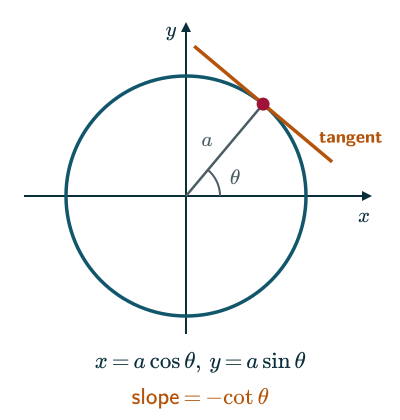
NCERT Example 32 (page 135): for the parabola x = at2, y = 2at, dx/dt = 2at and dy/dt = 2a, so dy/dx = 1/t. NCERT Example 33 (page 136): for x = a(θ + sin θ), y = a(1 − cos θ), dy/dx = a sin θ/(a(1 + cos θ)) = tan (θ/2).
Choosing a parameter
A parameter can also simplify an implicit equation. NCERT Example 34 (page 136): for x2/3 + y2/3 = a2/3, put x = a cos3 θ and y = a sin3 θ, which satisfy it because cos2 θ + sin2 θ = 1. Then dx/dθ = −3a cos2 θ sin θ and dy/dθ = 3a sin2 θ cos θ, so
dy/dx = −tan θ = −(y/x)1/3.
Solved examples
Example 1: Two quick ones (NCERT Exercise 5.6, Q1 and Q4, page 137)
Find dy/dx if (i) x = 2at2, y = at4; (ii) x = 4t, y = 4/t.
(i) dx/dt = 4at and dy/dt = 4at3. (ii) dx/dt = 4 and dy/dt = −4/t2.
Answer: (i) t2 for t ≠ 0 by the ratio rule. Eliminating t gives y = x/(4a) for x ≥ 0, whose right derivative at x = 0 is also 0. (ii) −1/t2, for t ≠ 0.
Example 2: A cycloid (NCERT Exercise 5.6, Q6, page 137)
Find dy/dx if x = a(θ − sin θ), y = a(1 + cos θ).
dx/dθ = a(1 − cos θ) and dy/dθ = −a sin θ. Using 1 − cos θ = 2 sin2 (θ/2) and sin θ = 2 sin (θ/2) cos (θ/2), the ratio −sin θ/(1 − cos θ) simplifies.
Answer: dy/dx = −cot (θ/2).
Example 3: A logarithm in the parameter (NCERT Exercise 5.6, Q8, page 137)
Find dy/dx if x = a(cos t + log tan (t/2)), y = a sin t.
The derivative of log tan (t/2) is ½ sec2 (t/2)/tan (t/2) = 1/(2 sin (t/2) cos (t/2)) = 1/sin t. So dx/dt = a(1/sin t − sin t) = a cos2 t/sin t, and dy/dt = a cos t.
Answer: dy/dx = (a cos t)(sin t)/(a cos2 t) = tan t, where tan (t/2) > 0 and cos t ≠ 0.
Example 4: An involute (NCERT Exercise 5.6, Q10, page 137)
Find dy/dx if x = a(cos θ + θ sin θ), y = a(sin θ − θ cos θ).
In dx/dθ, the terms −a sin θ and a sin θ cancel, leaving aθ cos θ. In dy/dθ, the terms a cos θ and −a cos θ cancel, leaving aθ sin θ.
Answer: dy/dx = tan θ where θ cos θ ≠ 0. At θ = 0 the ratio is 0/0; each local branch has a horizontal limiting tangent, which must be checked separately.
Example 5: Show that dy/dx = −y/x (NCERT Exercise 5.6, Q11, page 137)
x = √(asin⁻¹t) and y = √(acos⁻¹t), with a > 0 and a ≠ 1, for −1 < t < 1. Show that dy/dx = −y/x.
Multiply: the exponents add, and sin t + cos t = π/2, so xy = √(aπ/2), a constant. Differentiating xy = constant with respect to x: y + x dy/dx = 0.
Answer: dy/dx = −y/x. The restriction a ≠ 1 matters: for a = 1 the parametrisation is the single point (1, 1), so it does not define this derivative. At t = ±1, use the one-sided branch of the same hyperbola if endpoint slopes are required.
Common mistakes to avoid
Common mistake
Dividing the wrong way round
dy/dx is (dy/dt)/(dx/dt), the y-derivative on top. For x = 4t, y = 4/t, it is (−4/t2)/4, not 4/(−4/t2).
Common mistake
Forgetting where dx/dt = 0
The formula needs dx/dt ≠ 0. On the circle of NCERT Example 31, dx/dθ = 0 at θ = 0 and π, where the tangent is vertical and dy/dx does not exist.
Common mistake
Eliminating the parameter when it is not needed
The answer may stay in terms of t, as NCERT notes. Eliminating t first is often longer and can lose information, such as which branch of a curve is meant.
Quick revision summary
- In parametric form x = f(t), y = g(t), the parameter t links x and y.
- dy/dx = (dy/dt)/(dx/dt), wherever dx/dt ≠ 0; the answer may stay in terms of t.
- A good parameter can simplify an implicit curve, as x = a cos3 θ, y = a sin3 θ does for x2/3 + y2/3 = a2/3.
Formula sheet
- dy/dx = (dy/dt)/(dx/dt), for dx/dt ≠ 0
- x = a cos θ, y = a sin θ: dy/dx = −cot θ (a > 0, sin θ ≠ 0)
- x = at, y = 2at: dy/dx = 1/t (a > 0, t ≠ 0)
Questions students ask
Does a parametric curve always give y as a function of x?
No, a parametric curve x = f(t), y = g(t) need not give y as one function of x, because two values of t can give the same x: on the circle x = a cos θ, y = a sin θ of NCERT Example 31, θ and −θ give the same x but the two points (a cos θ, ±a sin θ), with slopes −cot θ and cot θ. Near a value of t where dx/dt is continuous and not 0, though, x keeps increasing or decreasing, so that piece of the curve is the graph of a function of x. So (dy/dt)/(dx/dt) gives the slope of the branch through the point with that value of t.
What is the difference between parametric and implicit differentiation?
Parametric differentiation handles a curve given through a third variable, x = f(t), y = g(t), and gives dy/dx in terms of t, while implicit differentiation handles one equation linking x and y, differentiated with respect to x, so its answer usually contains both. The same curve can often be done both ways: y2 = x3 gives 2yy′ = 3x2, so y′ = 3x2/(2y), and its parametric form x = t2, y = t3 gives 3t/2, which is the same, since 3t4/(2t3) = 3t/2 for t ≠ 0.
What happens to dy/dx when dx/dt and dy/dt are both zero?
When dx/dt and dy/dt are both 0 at some value of t, the parametric formula gives 0/0 and decides nothing: the curve may have a perfectly good slope there, or none. x = t3, y = t3 is the line y = x, with slope 1 everywhere, although both t-derivatives vanish at t = 0; but x = t3, y = t2 is y = x2/3, whose slope 2/(3t) tends to ∞ as t → 0 from the right and to −∞ from the left, so the curve has a sharp point, a cusp, at the origin and no derivative there. At such a point, find the limit of dy/dx as t approaches that value, or eliminate t and use the definition of the derivative.
How do you differentiate one function with respect to another function?
To differentiate u(x) with respect to v(x), treat x as the parameter: du/dv is (du/dx)/(dv/dx), wherever dv/dx ≠ 0, which is the parametric rule with x in place of t; NCERT uses it in Example 43 (page 144), one of its Miscellaneous Examples. For example, the derivative of log x with respect to 1/x, for x > 0, is (1/x)/(−1/x2) = −x. This checks: with v = 1/x, log x = −log v, whose derivative with respect to v is −1/v = −x.
Is parametric differentiation in the JEE Main syllabus?
Parametric differentiation is not named in the JEE Main 2027 syllabus: Unit 7 lists the differentiation of “composite and implicit functions” and “derivatives of order upto two”, but not parametric forms. The parametric rule is the chain rule for a composite, which makes dy/dt the product of dy/dx and dx/dt, solved for dy/dx, so it rests on what the unit does name. NCERT teaches it in Class 12, Section 5.6 (pages 134–137), with Exercise 5.6.
Practice questions
Try each question first, then open the answer to check your working.
-
Q1. Find dy/dx if x = a cos θ, y = b cos θ (NCERT Exercise 5.6, Q2, page 137).
Show answerHide answer
(−b sin θ)/(−a sin θ) = b/a, for sin θ ≠ 0. (The points lie on the line y = (b/a)x.)
-
Q2. Find dy/dx if x = sin t, y = cos 2t (NCERT Exercise 5.6, Q3, page 137).
Show answerHide answer
dy/dt = −2 sin 2t = −4 sin t cos t and dx/dt = cos t, so dy/dx = −4 sin t.
-
Q3. Find dy/dx if x = a sec θ, y = b tan θ (NCERT Exercise 5.6, Q9, page 137).
Show answerHide answer
dy/dθ = b sec2 θ and dx/dθ = a sec θ tan θ, so dy/dx = b sec θ/(a tan θ) = (b/a) cosec θ.
-
Q4. Find dy/dx if x = cos θ − cos 2θ, y = sin θ − sin 2θ (NCERT Exercise 5.6, Q5, page 137).
Show answerHide answer
dx/dθ = −sin θ + 2 sin 2θ and dy/dθ = cos θ − 2 cos 2θ, so dy/dx = (cos θ − 2 cos 2θ)/
(2 sin 2θ − sin θ).