Exponential and logarithmic functions
NCERT Class 12 Mathematics Chapter 5 Section 5.4
Quick answer
For a base b > 1, b is defined for all real x and takes only positive values, and its inverse, the logarithm to base b, is defined only for positive x; the two graphs are mirror images in y = x. In NCERT’s calculus chapters, log x means the natural logarithm, to base e. The two key derivatives are d/dx (e) = e and d/dx (log x) = 1/x, combined with the chain rule for composites.
With your textbook
NCERT Mathematics Part I (Class 12), Chapter 5 “Continuity and Differentiability”, Section 5.4 “Exponential and Logarithmic Functions”, pages 125–130.
Open the official NCERT chapter (PDF, 3.2 MB, ncert.nic.in) (opens in a new tab)
Checked against the 2026-27 reprint on .
What are exponential and logarithmic functions?
Exponential and logarithmic functions
- For a base b > 1, the exponential function is y = bx (NCERT Definition 3, page 126). With b = e, the number between 2 and 3 given by 1 + 1/1! + 1/2! + …, it is the natural exponential function ex (NCERT page 127).
- logb a = x means bx = a (NCERT Definition 4, page 127). For example, 23 = 8 says log2 8 = 3.
- In this chapter, log x means the natural logarithm, to base e (often written ln x); base 10 gives common logarithms (NCERT page 127).
In plain words: bx grows faster than any power of x, and logb undoes it, just as an inverse function undoes the original. NCERT’s comparison (page 126): at x = 10, x = 10, while 10 = 10.
Graphs and key facts
For a base b > 1 (NCERT pages 126–128):
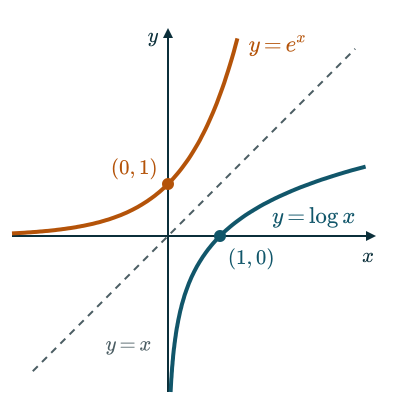
- bx has domain all real numbers and range the positive real numbers. Its graph passes through (0, 1), always rises, and approaches the x-axis on the left without meeting it.
- logb x has domain the positive real numbers (there is no real logarithm of 0 or of a negative number) and range all real numbers. Its graph passes through (1, 0), always rises, and goes down along the y-axis as x → 0.
We cannot make a meaningful definition of logarithm of non-positive numbers and hence the domain of log function is R
NCERT Mathematics Part I (Class 12), Section 5.4, page 128
The graphs of ex and log x are mirror images of each other in the line y = x (NCERT page 128), as the graphs of a function and its inverse always are.
Laws of logarithms
NCERT proves the product law and the change of base rule from the definition (page 128) and leaves the power and quotient laws to the reader (page 129). For a base b > 1 and positive p, q, x, y:
Laws of logarithms (any one base b > 1)
log (pq) = log p + log q
log (x/y) = log x − log y
log (p) = n log p
The change of base rule is loga p = logb p/logb a.
For the product law: if bβ = p and bγ = q, then pq = bβ + γ, so logb pq = β + γ. For example, 625 = 54 = 252, so log5 625 = 4 and log25 625 = 2 (NCERT page 127); by change of base, log25 625 = log5 625/log5 25 = 4/2.
NCERT slip (page 129): the two lines after the product law end “= 2 log p” and “= n log p”; with base b they should read 2 logb p and n logb p.
NCERT Example 25 (page 129): x = elog x holds only for x > 0, because log x is defined only for positive x.
Derivatives of e and log x
NCERT Theorem 5 (page 129; the chapter skips the proof and points to its supplementary material): ex is its own derivative, and log x has derivative 1/x.
Derivatives of e and log x
d/dx (e) = e
d/dx (log x) = 1/x, for x > 0
With the chain rule (NCERT Section 5.3.1) these handle composites. NCERT Example 26 (pages 129–130):
- d/dx (e−x) = e−x × (−1) = −e−x;
- d/dx sin (log x) = cos (log x) × 1/x, for x > 0;
- d/dx cos (ex) = −ex/√(1 − e2x), which needs ex < 1, that is x < 0;
- d/dx ecos x = −sin x ecos x.
Solved examples
Example 1: Three chain rules (NCERT Exercise 5.4, Q2, Q3 and Q5, page 130)
Differentiate (i) esin⁻¹ x; (ii) ex3; (iii) log (cos ex).
(i) The exponent sin x has derivative 1/√(1 − x2). (ii) The exponent x3 has derivative 3x2. (iii) The derivative of log u is 1/u times u′, with u = cos ex and u′ = −sin ex × ex.
Answer: (i) esin⁻¹ x/√(1 − x2), for −1 < x < 1; (ii) 3x2ex3; (iii) −ex tan ex, where cos ex > 0.
NCERT slip (answers, page 216): the key’s condition for (iii), ex ≠ (2n + 1)π/2, n ∈ N, allows cos ex < 0, where log (cos ex) is not defined, and misses ex = π/2. The condition is cos ex > 0; write that in an exam.
Example 2: A quotient (NCERT Exercise 5.4, Q1, page 130)
Differentiate ex/sin x.
By the quotient rule: (ex sin x − ex cos x)/sin2 x.
Answer: ex(sin x − cos x)/sin2 x, for x ≠ nπ.
Example 3: log of log (NCERT Exercise 5.4, Q8 and Q9, page 130)
Differentiate (i) log (log x), x > 1; (ii) cos x/log x, x > 0.
(i) 1/(log x) × 1/x. (ii) Quotient rule: (−sin x log x − cos x × 1/x)/
Answer: (i) 1/(x log x); (ii) −(x log x sin x + cos x)/
Example 4: Change of base
Find d/dx (log10 x) and d/dx (2x).
log10 x = log x/log 10, a constant times log x. And 2x = ex log 2, so the chain rule multiplies by log 2.
Answer: d/dx (log10 x) = 1/(x log 10); d/dx (2x) = 2x log 2. (NCERT uses this step for log7 (log x) in Miscellaneous Example 39 (ii), pages 140–141, and derives the second in Example 28, page 131.)
Common mistakes to avoid
Common mistake
Taking log of a non-positive number
log x needs x > 0. So x = elog x is false for x ≤ 0 (NCERT Example 25), and log (cos ex) is only defined where cos ex > 0.
Common mistake
Splitting the log of a sum
log (p + q) is not log p + log q; the law is log (pq) = log p + log q. For example, log2 (2 + 6) = log2 8 = 3, while log2 2 + log2 6 = log2 12, which is about 3.58.
Common mistake
Forgetting the chain factor
d/dx (e3x) = 3e3x, not e3x; for exponent x the chain factor is 1; an exponent such as 3x introduces the extra factor 3.
Quick revision summary
- bx (b > 1) has domain R, range the positive reals and passes through (0, 1); logb x has domain the positive reals, range R and passes through (1, 0). The graphs are mirror images in y = x.
- log x means log to base e; log (pq) = log p + log q, log (p/q) = log p − log q, log p = n log p, and loga p = logb p/logb a.
- d/dx (e) = e and d/dx (log x) = 1/x; use the chain rule for composites.
Formula sheet
- logb (pq) = logb p + logb q; logb (x/y) = logb x − logb y
- loga p = logb p / logb a, for p > 0, a,b > 0 and a,b ≠ 1
- d/dx (ex) = ex; d/dx (log x) = 1/x (x > 0)
Questions students ask
Why is the derivative of e equal to e?
The derivative of ex is ex by NCERT’s Theorem 5 (page 129), whose proof the chapter skips; the reason, from first principle, is that the difference quotient (ex + h − ex)/h equals ex times (eh − 1)/h, and e is the one base for which (eh − 1)/h tends to 1 as h → 0. With h = 0.001 that factor is already about 1.0005, while for base 10 the same factor, (10h − 1)/h, tends to log 10 ≈ 2.303, not 1.
Why is the derivative of log x equal to 1/x?
The derivative of log x is 1/x because log x is the inverse of ex: writing y = log x as x = ey and differentiating both sides with respect to x gives 1 = ey dy/dx, so dy/dx = 1/ey = 1/x, for x > 0. This is the method NCERT uses for sin x, and like NCERT it assumes that the derivative exists. For negative x, log (−x) has the same derivative, 1/x, so d/dx log |x| = 1/x for every x ≠ 0, which is why ∫(1/x) dx = log |x| + C.
Is log x the same as ln x in Class 12 maths?
Yes, in NCERT’s Class 12 calculus log x is the natural logarithm, to base e, which calculators and many books write as ln x; NCERT says so for this chapter on page 127. A calculator’s log key, though, is base 10: log10 100 = 2, while ln 100 ≈ 4.605, and in general ln x = ln 10 × log10 x ≈ 2.303 log10 x. So read log x in a derivative as loge x, with derivative 1/x, and handle a base-10 logarithm with the change of base rule, which brings in the factor 1/ln 10 ≈ 0.4343 (see Example 4).
What is the difference between exponential and logarithmic functions?
An exponential function bx and the logarithmic function logb x with the same base b > 1 are inverses: the exponential turns any real exponent into a positive number, and the logarithm turns that number back into the exponent, as in 43 = 64 and log4 64 = 3. So their domains and ranges swap (all real numbers and the positive reals), and they grow at different rates: ex outgrows every power of x, reaching about 22 026 at x = 10, while log x grows more slowly than every root, only about 2.303 at x = 10. Logarithms are the tool for solving exponential equations: 3x = 20 gives x = log 20/log 3 ≈ 2.727.
Can the base of a logarithm be between 0 and 1?
Yes, a logarithm can have any positive base other than 1, so a base between 0 and 1 is allowed, though NCERT’s Definitions 3 and 4 (pages 126–127) take b > 1 only. With such a base both functions fall instead of rising: (1/2)x decreases as x grows, and log1/2 8 = −3 because (1/2)−3 = 8, so an inequality turns round when such a logarithm is removed: log1/2 x > 2 means 0 < x < 1/4. The base 1 is excluded because 1x = 1 for every x, which has no inverse, and negative bases fail because, for example, (−4)1/2 is not a real number.
Practice questions
Try each question first, then open the answer to check your working.
-
Q1. Differentiate sin (tan e−x) (NCERT Exercise 5.4, Q4, page 130).
Show answerHide answer
cos (tan e−x) × 1/(1 + e−2x) × (−e−x) = −e−x cos (tan e−x)/(1 + e−2x).
-
Q2. Differentiate ex + ex2 + … + ex5 (NCERT Exercise 5.4, Q6, page 130).
Show answerHide answer
Term by term, the derivative of exk is kxk − 1exk: ex + 2xex2 + 3x2ex3 + 4x3ex4 + 5x4ex5.
-
Q3. Differentiate √(e√x), x > 0 (NCERT Exercise 5.4, Q7, page 130).
Show answerHide answer
√(e√x) = e√x/2, so the derivative is e√x/2 × 1/(4√x). (NCERT writes the same as e√x/(4√(xe√x)).)
-
Q4. Differentiate cos (log x + ex), x > 0 (NCERT Exercise 5.4, Q10, page 130).
Show answerHide answer
−sin (log x + ex) × (1/x + ex).