Continuity of a function
NCERT Class 12 Mathematics Chapter 5 Section 5.2
Quick answer
A function f is continuous at a point c of its domain when f(c) is defined and the limit of f(x) as x tends to c equals f(c), at an interior point both one-sided limits equal f(c), while an endpoint uses the inward limit. A continuous function is continuous at every point of its domain. Polynomials, rational functions, |x|, sin x and cos x are continuous; sums, products, quotients and composites of continuous functions are continuous where defined; and [x] jumps at every integer.
With your textbook
NCERT Mathematics Part I (Class 12), Chapter 5 “Continuity and Differentiability”, Section 5.2 “Continuity”, pages 104–118.
Open the official NCERT chapter (PDF, 3.2 MB, ncert.nic.in) (opens in a new tab)
Checked against the 2026-27 reprint on .
What does continuous at a point mean?
Continuity at a point
a function is continuous at x = c if the function is defined at x = c and if the value of the function at x = c equals the limit of the function at x = c.
NCERT Mathematics Part I (Class 12), Section 5.2, page 105
- In symbols (NCERT Definition 1): f is continuous at c if limx→c f(x) = f(c).
- If f is not continuous at c, then c is a point of discontinuity of f.
At an interior point of an interval in the domain, three things must hold at x = c. The function has a value f(c); the left-hand and right-hand limits exist and are equal; and that common limit equals f(c). Informally, you can draw the graph through c without lifting the pen (NCERT page 105).
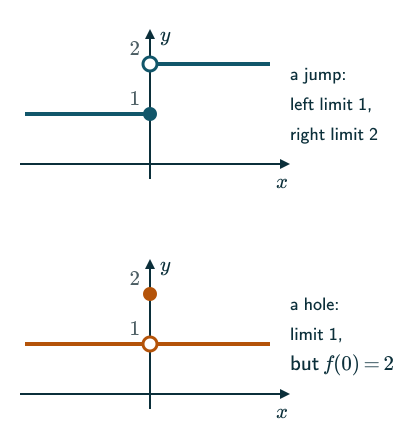
NCERT’s two opening examples (pages 104–105) fail in different ways. For f(x) = 1 when x ≤ 0 and 2 when x > 0, the left-hand limit at 0 is 1 and the right-hand limit is 2, so there is no limit at all. For f(x) = 1 when x ≠ 0 and f(0) = 2, the limit at 0 is 1 but the value is 2.
Checking continuity at a point
At an interior point, find f(c), then both one-sided limits, and compare. At an endpoint, use only the side inside the domain. NCERT Example 1: f(x) = 2x + 3 at x = 1 has f(1) = 5 and limit 2(1) + 3 = 5, so it is continuous there. NCERT Example 3: f(x) = |x| at 0 has left-hand limit lim (−x) = 0, right-hand limit lim x = 0 and f(0) = 0, so it is continuous at 0.
NCERT Example 4 (pages 106–107): f(x) = x3 + 3 for x ≠ 0 and f(0) = 1. The limit at 0 is 0 + 3 = 3, which is not f(0) = 1, so f is not continuous at 0. It is the only point of discontinuity.
Continuous functions
A real function f is said to be continuous if it is continuous at every point in the domain of f.
NCERT Mathematics Part I (Class 12), Section 5.2, page 107
Two points follow from this definition (NCERT pages 107–111):
- On a closed interval [a, b], continuity at the end points uses one side only: the right-hand limit at a must equal f(a), and the left-hand limit at b must equal f(b).
- Only points in the domain count. f(x) = 1/x is continuous, because it is continuous at every x ≠ 0 and 0 is not in its domain (NCERT Example 9), even though its graph breaks at 0. Near 0 its values grow without bound: the right-hand limit is +∞ and the left-hand limit −∞, and ±∞ are not real numbers, so these limits do not exist (NCERT page 109).
Constant functions, x, polynomials (NCERT Examples 5, 6, 8 and 14) and |x| (Example 7) are continuous at every real number.
Points of discontinuity, and [x]
For a function defined piece by piece, each piece given by a polynomial is continuous inside its own interval, so only the joins need checking. NCERT Example 10 (page 110): f(x) = x + 2 for x ≤ 1 and x − 2 for x > 1. At 1, the left-hand limit is 1 + 2 = 3 and the right-hand limit is 1 − 2 = −1, so x = 1 is the only point of discontinuity. NCERT Example 13 (pages 111–112): f(x) = x for x ≥ 0 and x2 for x < 0 is continuous at 0, since both one-sided limits are 0 = f(0).
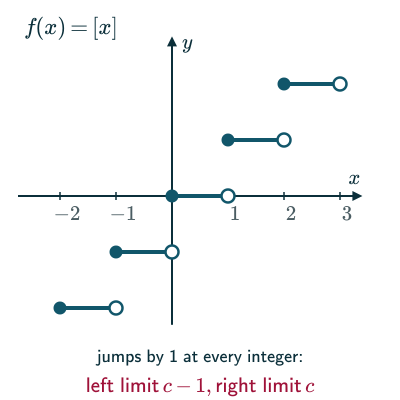
The greatest integer function f(x) = [x], the greatest integer less than or equal to x, is continuous at every non-integer c, where it is constant nearby. At an integer c, values just to the left are c − 1 and values from c onwards are c, so the one-sided limits differ: [x] is discontinuous at every integer (NCERT Example 15, pages 112–113).
Algebra of continuous functions
NCERT Theorem 1 (page 113), proved from the algebra of limits: if f and g are continuous at c, then so are
Sums, products and quotients
f + g, f − g, f · g and f/g (when g(c) ≠ 0)
So λf is continuous for any constant λ, and 1/g is continuous wherever g ≠ 0 (NCERT’s Remarks, page 114). Every rational function p/q is continuous at every point where q ≠ 0, which is its whole domain (NCERT Example 16). sin x is continuous at every real c: with x = c + h, sin (c + h) = sin c cos h + cos c sin h, which tends to sin c as h → 0 (NCERT Example 17), and cos x likewise. Then tan x = sin x/cos x is continuous wherever cos x ≠ 0, that is for x ≠ (2n + 1)π/2 (NCERT Example 18).
Continuity of composite functions
NCERT Theorem 2 (page 115, stated without proof): if g is continuous at c and f is continuous at g(c), then the composite f∘g is continuous at c.
So sin (x2) is continuous, as sin applied to x2 (NCERT Example 19), and |1 − x + |x|| is continuous, as |·| applied to the continuous function 1 − x + |x| (NCERT Example 20).
Solved examples
Example 1: Finding k (NCERT Exercise 5.1, Q27 and Q29, page 118)
Find k so that (i) f(x) = kx2 for x ≤ 2 and 3 for x > 2 is continuous at 2; (ii) f(x) = kx + 1 for x ≤ 5 and 3x − 5 for x > 5 is continuous at 5.
(i) f(2) and the left-hand limit are 4k; the right-hand limit is 3. So 4k = 3. (ii) f(5) and the left-hand limit are 5k + 1; the right-hand limit is 15 − 5 = 10. So 5k + 1 = 10.
Answer: (i) k = 3/4; (ii) k = 9/5.
Example 2: Two unknowns (NCERT Exercise 5.1, Q30, page 118)
Find a and b so that f(x) = 5 for x ≤ 2, ax + b for 2 < x < 10 and 21 for x ≥ 10 is continuous.
Each piece is continuous inside its interval, so only x = 2 and x = 10 matter. At 2: 5 = 2a + b. At 10: 10a + b = 21. Subtracting, 8a = 16.
Answer: a = 2, b = 1.
Example 3: A limit with cos x (NCERT Exercise 5.1, Q26, page 118)
Find k so that f(x) = k cos x/(π − 2x) for x ≠ π/2, and f(π/2) = 3, is continuous at π/2.
Put x = π/2 + h. Then cos x = −sin h and π − 2x = −2h, so f(x) = k sin h/(2h), which tends to k/2 as h → 0, using sin h/h → 1. Continuity needs k/2 = 3.
Answer: k = 6.
Example 4: No value works (NCERT Exercise 5.1, Q18, page 117)
For what value of λ is f(x) = λ(x2 − 2x) for x ≤ 0 and 4x + 1 for x > 0 continuous at 0? What about at 1?
At 0, f(0) and the left-hand limit are λ(0 − 0) = 0 for every λ, but the right-hand limit is 4(0) + 1 = 1. At 1, f is given by the polynomial 4x + 1 on both sides.
Answer: for no value of λ is f continuous at 0; f is continuous at 1 for every λ.
Example 5: The fractional part x − [x] (NCERT Exercise 5.1, Q19, page 117)
Show that g(x) = x − [x] is discontinuous at every integer.
At an integer c, values just to the left are x − (c − 1), which tend to 1, while from c onwards g(x) = x − c, which tends to 0 = g(c). The left-hand limit 1 is not g(c).
Answer: g jumps from 1 down to 0 at every integer, so it is discontinuous there (and continuous everywhere else).
Common mistakes to avoid
Common mistake
Calling 1/x discontinuous at 0
0 is not in the domain of 1/x, so it is neither continuous nor discontinuous there. On its domain, 1/x is continuous (NCERT Example 9).
Common mistake
Checking only that the limit exists
In NCERT Example 4, the limit at 0 exists (it is 3), but f(0) = 1, so f is not continuous at 0. The limit must equal the value.
Common mistake
Using the wrong piece at the join
At x = c, the value f(c) comes from the piece whose condition includes c (for example x ≤ 1), and each one-sided limit from the piece on that side.
Common mistake
Reading Theorem 1 backwards
[x] and −[x] are both discontinuous at every integer, but their sum, 0, is continuous. NCERT Theorem 1 works one way only: a sum of continuous functions is continuous, but a continuous sum need not be made of continuous functions.
Quick revision summary
- f is continuous at c when f(c) is defined and limx→c f(x) = f(c): both one-sided limits equal f(c) at an interior point, while an endpoint uses the inward one-sided limit.
- A continuous function is continuous at every point of its domain; at the ends of a closed interval only one side counts.
- Polynomials, rational functions, |x|, sin x, cos x and tan x are continuous on their domains; [x] is discontinuous at every integer.
- Sums, differences, products, quotients (where the denominator ≠ 0) and composites of continuous functions are continuous.
Formula sheet
- at an interior point c: f continuous ⇔ limx→c− f(x) = limx→c+ f(x) = f(c)
- f + g, f − g, fg, f/g (g(c) ≠ 0) continuous at c
- g continuous at c, f continuous at g(c) ⇒ f∘g continuous at c
Questions students ask
What are the types of discontinuity of a function?
The types of discontinuity of a function, which NCERT does not name, are removable, where the limit exists but differs from the value of the function, and non-removable, where the limit does not exist: a jump (both one-sided limits exist but differ), an infinite discontinuity or an oscillating one. NCERT’s two opening examples are a jump and a removable discontinuity at 0, and [x] + [−x], which is −1 near each integer but 0 at it (unlike [x] + (−[x]) = 0), has a removable one at every integer. NCERT counts only points of the domain, so (x3 − 8)/(x − 2), undefined at 2, has no discontinuity there in its sense, though many calculus books call x = 2 a removable one.
Can a function be continuous at only one point?
Yes, a function can be continuous at exactly one point, as an example beyond NCERT shows: f(x) = x for rational x and f(x) = −x for irrational x is continuous at 0 and nowhere else. At 0, |f(x)| = |x|, which tends to 0 = f(0); but near any a ≠ 0 there are rational numbers, where f is close to a, and irrational numbers, where f is close to −a, so f(x) has no limit at a. So continuity at a point says nothing about the points around it.
Is √x continuous at x = 0?
Yes, √x is continuous at 0: its domain is [0, ∞), so 0 is an end point, where only the right-hand limit is needed, and √x → 0 = √0 as x → 0. There is no left-hand limit, because √x is not defined for x < 0, and that does not count against it, just as NCERT checks only one side at the ends of a closed interval (page 107). So √x is a continuous function, though it is not differentiable at 0: its difference quotient √h/h = 1/√h grows without bound as h → 0, so the graph has a vertical tangent there.
Are continuity and differentiability in the JEE Main 2027 syllabus?
Yes, continuity and differentiability are in the JEE Main 2027 syllabus, Unit 7 (Limit, Continuity and Differentiability), which lists “Limits, continuity and differentiability” and the differentiation of “trigonometric, inverse trigonometric, logarithmic, exponential, composite and implicit functions”, with “derivatives of order upto two”. NCERT teaches them in Class 12 Chapter 5, building on the limits and derivatives of Class 11. The same unit goes on to rate of change, increasing and decreasing functions and maxima and minima, NCERT’s Class 12 Chapter 6.
Practice questions
Try each question first, then open the answer to check your working.
-
Q1. Is f(x) = x for x ≤ 1 and 5 for x > 1 continuous at x = 0? At x = 1? At x = 2? (NCERT Exercise 5.1, Q5, page 116)
Show answerHide answer
At 0 and at 2, f is given by one polynomial on both sides, so it is continuous. At 1, f(1) = 1 and the left-hand limit is 1, but the right-hand limit is 5. So f is continuous at 0 and 2 but not at 1.
-
Q2. Find all points of discontinuity of f(x) = 2x + 3 for x ≤ 2 and 2x − 3 for x > 2 (NCERT Exercise 5.1, Q6, page 116).
Show answerHide answer
Only x = 2 needs checking: the left-hand limit and f(2) are 7, while the right-hand limit is 1. So f is discontinuous at x = 2 only.
-
Q3. Find the relationship between a and b so that f(x) = ax + 1 for x ≤ 3 and bx + 3 for x > 3 is continuous at x = 3 (NCERT Exercise 5.1, Q17, page 117).
Show answerHide answer
3a + 1 = 3b + 3, so a = b + 2/3.
-
Q4. Find all the points of discontinuity of f(x) = |x| − |x + 1| (NCERT Exercise 5.1, Q34, page 118).
Show answerHide answer
|x| and |x + 1| are continuous everywhere (|·| composed with a polynomial), so their difference is too: there is no point of discontinuity.