Rate of change of quantities
NCERT Class 12 Mathematics Chapter 6 Section 6.2
Quick answer
If y = f(x), then dy/dx is the rate of change of y with respect to x; a positive derivative indicates increase, though an increasing function may have isolated zero derivatives. When quantities change with time, differentiate the equation linking them with respect to t by the chain rule, then substitute the values: for a circle, dA/dt = 2πr dr/dt. In economics, marginal cost is dC/dx and marginal revenue is dR/dx.
With your textbook
NCERT Mathematics Part I (Class 12), Chapter 6 “Application of Derivatives”, Section 6.2 “Rate of Change of Quantities”, pages 147–152.
Open the official NCERT chapter (PDF, 3.3 MB, ncert.nic.in) (opens in a new tab)
Checked against the 2026-27 reprint on .
What is a rate of change?
Rate of change
- If y = f(x), then dy/dx, or f′(x), is the rate of change of y with respect to x, and its value at x = x is the rate of change at that point (NCERT Section 6.2, page 147).
- If x = f(t) and y = g(t), the chain rule links the rates: dy/dx = (dy/dt)/(dx/dt), when dx/dt ≠ 0 (NCERT page 147).
Thus, the rate of change of y with respect to x can be calculated using the rate of change of y and that of x both with respect to t.
NCERT Mathematics Part I (Class 12), Section 6.2, page 148
In plain words: the derivative measures how fast one quantity changes as another changes, as ds/dt is velocity when s denotes displacement (and speed when it denotes distance travelled), in Class 11’s velocity at an instant. Its sign tells the direction: a positive derivative indicates increase and a negative derivative indicates decrease; an increasing function can still have zero derivative at an isolated point (NCERT’s Note, page 149).
The units of dy/dx are the units of y per unit of x: cm2 per cm for the area of a circle against its radius, cm2/s for the area against time.
Rate with respect to another quantity
NCERT Example 1 (page 148): the area of a circle is A = πr2, so dA/dr = 2πr, which is 10π when r = 5 cm. The area grows by about 10π cm2 for each extra centimetre of radius at that moment.
NCERT slip (page 148): Example 1 asks for the rate “per second with respect to its radius” and gives the answer in cm2/s. A rate with respect to the radius is in cm2 per cm, as NCERT’s own answers to Exercise 6.1, Q1 give it; no time is involved. The number 10π is right. In an exam, give a rate with respect to the radius in cm2 per cm.
Related rates: linking through time
When several quantities change with time, differentiate the equation linking them with respect to t, using the chain rule. NCERT Example 2 (page 148): a cube’s volume V = x3 grows at 9 cm3/s. Then 9 = 3x2 dx/dt, so dx/dt = 3/x2, and the surface area S = 6x2 changes at dS/dt = 12x × 3/x2 = 36/x, which is 3.6 cm2/s when x = 10 cm.
NCERT Example 3 (page 149): ripples spread at dr/dt = 4 cm/s, so the enclosed area changes at dA/dt = 2πr dr/dt = 2π(10)(4) = 80π cm2/s when r = 10 cm.
NCERT Example 4 (page 149): a rectangle’s length x falls at 3 cm/min (dx/dt = −3) while its width y grows at 2 cm/min. With x = 10 cm and y = 6 cm, the perimeter P = 2(x + y) changes at 2(−3 + 2) = −2 cm/min, and the area A = xy at y dx/dt + x dy/dt = −18 + 20 = 2 cm2/min.
Marginal cost and marginal revenue
In economics, the marginal cost is the rate of change of total cost with respect to the output, dC/dx, and the marginal revenue is dR/dx (NCERT Examples 5 and 6, page 150).
NCERT Example 5: C(x) = 0.005x3 − 0.02x2 + 30x + 5000 gives MC = 0.015x2 − 0.04x + 30. At x = 3, MC = 0.135 − 0.12 + 30 = 30.015, about ₹30.02. NCERT Example 6: R(x) = 3x2 + 36x + 5 gives MR = 6x + 36, which is ₹66 at x = 5.
Solved examples
Example 1: A sphere being inflated (NCERT Exercise 6.1, Q8, page 151)
A spherical balloon is inflated at 900 cm3 of gas per second. Find the rate at which its radius increases when the radius is 15 cm.
V = (4/3)πr3, so dV/dt = 4πr2 dr/dt. With dV/dt = 900 and r = 15, 900 = 4π(225) dr/dt = 900π dr/dt.
Answer: dr/dt = 1/π cm/s.
Example 2: The ladder (NCERT Exercise 6.1, Q10, page 151)
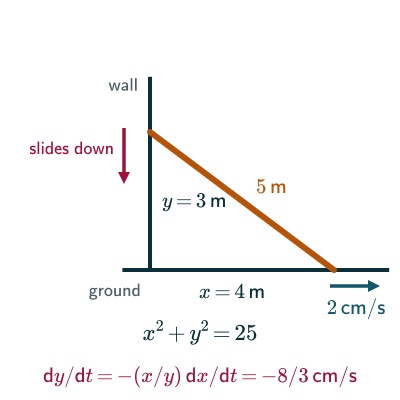
A 5 m ladder leans against a wall. Its foot is pulled away from the wall at 2 cm/s. How fast is its height on the wall decreasing when the foot is 4 m from the wall?
With the foot x m out and the top y m up, x2 + y2 = 25, so x dx/dt + y dy/dt = 0. When x = 4, y = 3. Then dy/dt = −(4/3) × 2 cm/s (the rate in cm/s can be used with lengths in metres, because only the ratio x/y enters).
Answer: the height decreases at 8/3 cm/s.
Example 3: A cone of sand (NCERT Exercise 6.1, Q14, page 151)
Sand pours at 12 cm3/s into a cone whose height is always one-sixth of its base radius. How fast is the height increasing when the height is 4 cm?
With r = 6h, V = (1/3)πr2h = 12πh3, so dV/dt = 36πh2 dh/dt. At h = 4: 12 = 36π(16) dh/dt.
Answer: dh/dt = 12/(576π) = 1/(48π) cm/s.
Example 4: Where y changes 8 times as fast (NCERT Exercise 6.1, Q11, page 151)
A particle moves along 6y = x3 + 2. Find the points where y is changing 8 times as fast as x.
Differentiating in time, 6 dy/dt = 3x2 dx/dt, so dy/dt = (x2/2) dx/dt. Assuming dx/dt ≠ 0, so that the ratio of rates is meaningful, this is 8 dx/dt when x2 = 16, that is x = ±4, with y = 66/6 = 11 or y = −62/6 = −31/3.
Answer: (4, 11) and (−4, −31/3), for a nonzero instantaneous horizontal rate. If both rates are zero, the equality 0 = 8 × 0 holds at any stationary instant and does not determine these points.
Example 5: Marginal cost (NCERT Exercise 6.1, Q15, page 151)
C(x) = 0.007x3 − 0.003x2 + 15x + 4000. Find the marginal cost when 17 units are produced.
MC = 0.021x2 − 0.006x + 15. At x = 17: 0.021 × 289 − 0.102 + 15 = 6.069 − 0.102 + 15.
Answer: ₹20.967.
Common mistakes to avoid
Common mistake
Substituting the value too early
In Example 2, putting x = 4 before differentiating would make x a constant and dx/dt = 0. Differentiate the general relation first, then substitute.
Common mistake
Losing the sign of a decreasing quantity
A quantity that decreases has a negative rate: in NCERT Example 4 the length falls at 3 cm/min, so dx/dt = −3, not 3.
Common mistake
Mixing up “with respect to r” and “with respect to t”
dA/dr = 2πr does not involve time; dA/dt = 2πr dr/dt does. Read which variable the question names.
Quick revision summary
- If y = f(x), dy/dx is the rate of change of y with respect to x; a positive derivative indicates increase, while an increasing function may also have isolated zero derivatives.
- For quantities changing with time, differentiate the linking equation with respect to t by the chain rule, then substitute the values: for a circle, dA/dt = 2πr dr/dt.
- Marginal cost is dC/dx and marginal revenue is dR/dx.
Formula sheet
- rate of change of y with respect to x = dy/dx
- dy/dx = (dy/dt)/(dx/dt), for dx/dt ≠ 0
- marginal cost = dC/dx; marginal revenue = dR/dx
Questions students ask
What is the difference between related rates and implicit differentiation?
Related rates problems use implicit differentiation with respect to time: each changing quantity is a function of t, so each term picks up a rate such as dx/dt, while implicit differentiation with respect to x gives dy/dx. For a rectangle of fixed area xy = 36 cm2, differentiating with respect to t gives y dx/dt + x dy/dt = 0, but with respect to x it gives dy/dx = −y/x. The chain rule links the two, as dy/dt is dy/dx times dx/dt: when x = 9 cm, y = 4 cm and dx/dt = 3 cm/s, dy/dt = −(4/9) × 3, that is −4/3 cm/s.
What is the difference between related rates and optimisation problems?
Related rates and optimisation use derivatives differently: related rates asks how fast a quantity changes at an instant, and the time derivative is the answer, while optimisation asks for its largest or smallest value, which can occur only where the derivative is 0 or undefined, or at an end point. If a square’s side x grows at 0.5 m/s, dA/dt = 2x dx/dt is 7 m2/s when x = 7 m. If 20 m of fencing makes three sides of a rectangle by a wall, two sides x m long, the area x(20 − 2x) has derivative 20 − 4x, zero at x = 5, and the second derivative −4 < 0 makes 50 m2 the largest area.
Why is profit greatest where marginal revenue equals marginal cost?
Profit is greatest where marginal revenue equals marginal cost because the profit P(x) = R(x) − C(x) has derivative P′(x) = MR − MC, which must be 0 at a maximum inside the range of outputs, as long as R and C are differentiable there. The condition is necessary but not sufficient, and P″(x) < 0, that is MC increasing faster than MR (C″ > R″), confirms a local maximum. A global maximum also requires comparison over the allowed outputs. With revenue 50x and cost 0.1x2 + 10x + 300 rupees, MR = 50 and MC = 0.2x + 10 are equal at x = 200, and P″ = −0.2 < 0, so 200 units give the largest profit, ₹3700. Below 200 units MR > MC, so each extra unit adds to the profit, and beyond 200 each extra unit takes some away.
What is the difference between related rates and differential equations?
In a related rates problem the equation linking the quantities is known, and differentiating it gives one rate from another at an instant, while a differential equation relates an unknown function to its derivatives, and solving it, usually by integrating, finds the function itself. If a circle’s radius grows at dr/dt = 2 cm/s, related rates gives the area’s rate dA/dt = 2πr dr/dt, here 4πr, which is 28π cm2/s when r = 7 cm. Solving the differential equation dr/dt = 2 with r = 1 cm at t = 0 instead gives the radius at every time, r = 2t + 1 (in cm, with t in seconds).
Practice questions
Try each question first, then open the answer to check your working.
-
Q1. The volume of a cube increases at 8 cm3/s. How fast is the surface area increasing when an edge is 12 cm? (NCERT Exercise 6.1, Q2, page 150)
Show answerHide answer
3x2 dx/dt = 8, so dx/dt = 8/(3x2), and dS/dt = 12x dx/dt = 32/x = 32/12 = 8/3 cm2/s.
-
Q2. A length x decreases at 5 cm/min and a width y increases at 4 cm/min. When x = 8 cm and y = 6 cm, find the rates of change of the perimeter and of the area (NCERT Exercise 6.1, Q7, page 151).
Show answerHide answer
dP/dt = 2(−5 + 4) = −2 cm/min. dA/dt = y dx/dt + x dy/dt = 6(−5) + 8(4) = 2 cm2/min.
-
Q3. The radius of an air bubble increases at ½ cm/s. At what rate is its volume increasing when the radius is 1 cm? (NCERT Exercise 6.1, Q12, page 151)
Show answerHide answer
dV/dt = 4πr2 dr/dt = 4π(1)(½) = 2π cm3/s.
-
Q4. R(x) = 3x2 + 36x + 5. The marginal revenue at x = 15 is (A) 116; (B) 96; (C) 90; (D) 126 (NCERT Exercise 6.1, Q18, page 152).
Show answerHide answer
MR = 6x + 36 = 90 + 36 = 126: (D).