Equation of a line in space: vector and Cartesian forms
NCERT Class 12 Mathematics Chapter 11 Section 11.3
Quick answer
The line through the point with position vector a, parallel to nonzero b, is r = a + λb, one point for each real λ. With A(x, y, z) and direction ratios a, b, c, its parametric form is x = x + λa, y = y + λb, z = z + λc, and its Cartesian form is (x − x)/a = (y − y)/b = (z − z)/c for nonzero denominators; a zero direction component means the corresponding coordinate is constant.
With your textbook
NCERT Mathematics Part II (Class 12), Chapter 11 “Three Dimensional Geometry”, Section 11.3 “Equation of a Line in Space”, pages 381–383.
Open the official NCERT chapter (PDF, 2.1 MB, ncert.nic.in) (opens in a new tab)
Checked against the 2026-27 reprint on .
What is the vector equation of a line?
Vector equation of a line
- A line in space is fixed by a point on it and its direction, or by two distinct points (NCERT Section 11.3, page 381).
- The line through the point with position vector a, parallel to a nonzero vector b, is r = a + λb, where λ is a real number (page 382).
Conversely, for each value of the parameter λ, this equation gives the position vector of a point P on the line.
NCERT Mathematics Part II (Class 12), Section 11.3.1, page 382
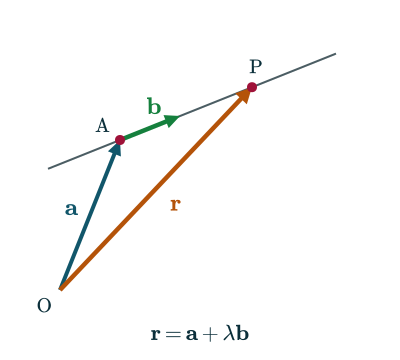
In plain words: a point and a direction fix a line in space, just as the Class 11 point-slope form fixes a line in the plane. Let A have position vector a, and let the line through A be parallel to b. A point P with position vector r is on the line exactly when AP is parallel to b, that is, AP = λb for some real λ. Since AP = r − a (page 382, Fig 11.3):
Line through a, parallel to b (NCERT page 382)
r = a + λb, λ real
NCERT slip (page 382): equation (1) prints the parameter as “»” (r = a + » b). It is λ, as in the line above it (λb = r − a) and in the Summary (page 392). In an exam, write λ.
If b = aî + bĵ + ck̂, then a, b, c are direction ratios of the line, and conversely (Remark, page 382). NCERT warns that the number b here is not |b|.
Parametric and Cartesian equations
With A(x, y, z), r = xî + yĵ + zk̂ and direction ratios a, b, c, equating components gives the parametric equations, and eliminating λ gives the Cartesian equation (page 382):
Parametric and Cartesian forms
x = x + λa, y = y + λb, z = z + λc
(x − x)/a = (y − y)/b = (z − z)/c
With direction cosines l, m, n in place of a, b, c, the same form holds (NCERT’s Note, page 382). NCERT Example 6 (pages 382–383): through (5, 2, −4) parallel to 3î + 2ĵ − 8k̂, the line is r = 5î + 2ĵ − 4k̂ + λ(3î + 2ĵ − 8k̂), or (x − 5)/3 = (y − 2)/2 = (z + 4)/(−8).
Reading a Cartesian equation. The numerators must be x − x with x alone, coefficient 1: then the point is (x, y, z) and the denominators are direction ratios. The fraction form is literal only for nonzero denominators. A printed zero denominator is shorthand for a constant-coordinate condition, never division by zero: x/1 = y/0 = z/0 is the x-axis, y = 0 and z = 0.
Two distinct points. Page 381 lists “two given points” as the second way to fix a line. The 2026–27 text does not derive the equation, but its Summary (page 392) gives the line through A(a) and B(b): r = a + λ(b − a), since b − a is a direction.
NCERT slip (page 377): the chapter’s introduction still promises “the equations of lines and planes”, angles involving planes, and the distance of a point from a plane. The 2026–27 chapter covers lines only, Sections 11.2 to 11.5; planes are no longer in the book. In an exam, answer from Sections 11.2–11.5: the chapter’s exercises use only lines.
Solved examples
Example 1: Point and direction (NCERT Exercise 11.2, Q4, page 389)
Find the equation of the line through (1, 2, 3) parallel to 3î + 2ĵ − 2k̂.
a = î + 2ĵ + 3k̂ and b = 3î + 2ĵ − 2k̂.
Answer: r = î + 2ĵ + 3k̂ + λ(3î + 2ĵ − 2k̂), or (x − 1)/3 = (y − 2)/2 = (z − 3)/(−2).
Example 2: Both forms (NCERT Exercise 11.2, Q5, page 389)
Find the line through the point with position vector 2î − ĵ + 4k̂ in the direction î + 2ĵ − k̂, in vector and Cartesian form.
The point is (2, −1, 4) and the direction ratios are 1, 2, −1. (NCERT prints the point as 2î − j + 4k̂, without the hat on j; it is ĵ.)
Answer: r = 2î − ĵ + 4k̂ + λ(î + 2ĵ − k̂), and (x − 2)/1 = (y + 1)/2 = (z − 4)/(−1).
Example 3: Parallel to a given line (NCERT Exercise 11.2, Q6, page 389)
Find the Cartesian equation of the line through (−2, 4, −5) parallel to (x + 3)/3 = (y − 4)/5 = (z + 8)/6.
Parallel lines share direction ratios, here 3, 5, 6.
Answer: (x + 2)/3 = (y − 4)/5 = (z + 5)/6.
Example 4: From Cartesian to vector (NCERT Exercise 11.2, Q7, page 389)
The Cartesian equation of a line is (x − 5)/3 = (y + 4)/7 = (z − 6)/2. Write its vector form.
The point is (5, −4, 6), and the direction ratios are 3, 7, 2.
Answer: r = 5î − 4ĵ + 6k̂ + λ(3î + 7ĵ + 2k̂).
Example 5: An axis as a line (NCERT Miscellaneous Exercise on Chapter 11, Q2, page 390)
Find the equation of the line parallel to the x-axis and passing through the origin.
The point is the origin and the direction is î, with direction ratios 1, 0, 0.
Answer: r = λî; in Cartesian form x/1 = y/0 = z/0, that is, y = 0 and z = 0.
Common mistakes to avoid
Common mistake
Reading the point with the wrong sign
In (x + 3)/3, the point has x = −3, not 3: rewrite it as (x − (−3))/3.
Common mistake
Taking denominators before making x stand alone
(1 − x)/3 is (x − 1)/(−3), so its direction ratio is −3, not 3; and (3x + 2)/6 is (x + 2/3)/2.
Common mistake
Mixing up the point and the direction
In r = a + λb, a is a point of the line and b its direction. Swapping them generally gives a different line (they can coincide in special cases, such as two nonzero collinear position vectors), through the point b.
Quick revision summary
- Vector form: r = a + λb, through the point a and parallel to b; each λ gives one point of the line.
- Parametric form: x = x + λa, y = y + λb, z = z + λc.
- Cartesian form: (x − x)/a = (y − y)/b = (z − z)/c, with a, b, c direction ratios; a zero denominator means that coordinate is constant.
Formula sheet
- r = a + λb, b ≠ 0
- x = x + λa, y = y + λb, z = z + λc
- (x − x)/a = (y − y)/b = (z − z)/c, for nonzero denominators
Questions students ask
What do the letters r and λ (or t) mean in the vector equation of a line?
In the vector equation of a line, r = a + λb, r is the position vector of a general point P(x, y, z) of the line and λ is a real number, the parameter, that picks out one point: λ = 0 gives the point A with position vector a, and positive and negative λ give points on either side of A. Since AP = λb, the distance AP is |λ| |b|, so λ counts steps of length |b|, and it is the signed distance from A only when b is a unit vector. The letter does not matter: NCERT itself uses t and s in Exercise 11.2, Q15 (page 390), and a second line needs its own letter, such as μ.
How do you find the equation of a line through two points in 3D?
To find the line through distinct points A(x, y, z) and B(x, y, z), with position vectors a and b, take A as the point and b − a, with direction ratios x − x, y − y, z − z, as the direction: r = a + λ(b − a), as in NCERT’s Summary (page 392). NCERT’s 2022 list of rationalised content (page 45) dropped Section 11.3.2, Equation of a Line Passing through Two Given Points, so the Cartesian form is no longer printed, but it follows in the same way: (x − x)/(x − x) equals the matching y and z quotients. For A(3, 1, −2) and B(0, 5, −1), the direction ratios are −3, 4, 1, and λ = 1 gives B as a check.
How do you write a line segment AB in vector form?
Beyond the NCERT text, the segment AB is the part of the line r = a + λ(b − a) with 0 ≤ λ ≤ 1: λ = 0 gives A, λ = 1 gives B, and λ < 0 or λ > 1 gives points of the line beyond A or beyond B respectively. Each λ in between gives the point dividing AB internally in the ratio λ : (1 − λ), since r = (1 − λ)a + λb is the section formula in vectors in another form, and λ = 1/2 gives the mid-point. For A(2, 0, −3) and B(−4, 6, 3), λ = 1/3 gives the point (0, 2, −1), one third of the way from A to B.
What is the difference between the equation of a line and of a plane in 3D?
Beyond the 2026–27 NCERT book, which no longer covers planes, a plane in space is given by one linear equation Ax + By + Cz = D (A, B, C not all 0), while a line needs two at once, as the line where two non-parallel planes meet. So a line’s Cartesian equation, a chain of three equal fractions, is really two equations, which is also why each coordinate axis needs two (coordinate axes and planes). In vector form a line, r = a + λb, has one parameter, and a plane, r = a + λb + μc with b and c not parallel, has two.
How do you find the direction ratios of a line written as 2x = 3y = 4z?
To read the direction ratios of a line such as 2x = 3y = 4z, first put each of x, y and z alone on top: dividing all three parts by 12 gives x/6 = y/4 = z/3, so the direction ratios are 6, 4, 3 and the line passes through the origin. Reading 2, 3, 4 is a slip: the direction ratios are proportional to the reciprocals ½, ⅓ and ¼ of the coefficients, not to the coefficients themselves. With √(36 + 16 + 9) = √61, the direction cosines are 6/√61, 4/√61 and 3/√61, or all three negated.
Practice questions
Try each question first, then open the answer to check your working.
-
Q1. Find the point of the line (x − 1)/2 = (y + 3)/(−1) = z/4 given by λ = 2.
Show answerHide answer
x = 1 + 2λ, y = −3 − λ and z = 4λ, so λ = 2 gives (5, −5, 8).
-
Q2. Is the point (7, 2, −3) on the line r = î + 4ĵ + k̂ + λ(3î − ĵ − 2k̂)?
Show answerHide answer
From x: 1 + 3λ = 7 gives λ = 2. Then y = 4 − 2 = 2 and z = 1 − 4 = −3, which match. Yes, it is on the line.
-
Q3. Write (2x − 1)/4 = (y + 3)/(−2) = (3 − z)/1 in standard form, and give a point and direction ratios.
Show answerHide answer
(x − ½)/2 = (y + 3)/(−2) = (z − 3)/(−1). A point is (½, −3, 3), and the direction ratios are 2, −2, −1.
-
Q4. Find the vector equation of the line through the origin and (2, −1, 3).
Show answerHide answer
r = λ(2î − ĵ + 3k̂).