Conditional probability: definition, properties and examples
NCERT Class 12 Mathematics Chapter 13 Section 13.2
Quick answer
The conditional probability of E given F is the chance of E once F is known to have occurred: P(E|F) = P(E ∩ F)/P(F), defined only when P(F) ≠ 0. With equally likely outcomes it is n(E ∩ F)/n(F), as if the sample space shrank to F. It behaves like a probability: P(S|F) = 1 and P(E′|F) = 1 − P(E|F).
With your textbook
NCERT Mathematics Part II (Class 12), Chapter 13 “Probability”, Section 13.2 “Conditional Probability”, pages 406–415.
Open the official NCERT chapter (PDF, 2.9 MB, ncert.nic.in) (opens in a new tab)
Checked against the 2026-27 reprint on .
What is conditional probability?
Conditional probability
This probability of the event E is called the conditional probability of E given that F has already occurred, and is denoted by P (E|F).
NCERT Mathematics Part II (Class 12), Section 13.2, page 407
- P(E|F) = P(E ∩ F)/P(F), provided P(F) ≠ 0 (NCERT Definition 1, page 408).
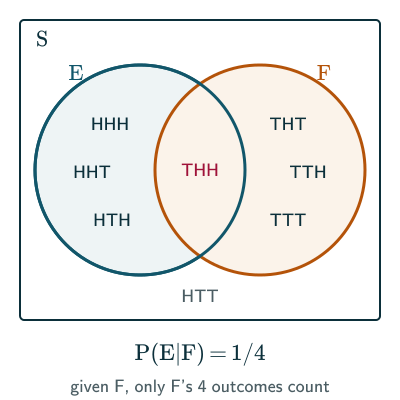
In plain words: knowing that one event has happened can change the chance of another. NCERT tosses three fair coins: E is “at least two heads” and F is “the first coin shows tail”. P(E) = 1/2, but once F is known, only F’s four outcomes THH, THT, TTH, TTT remain, and just one of them, THH, is in E (NCERT Section 13.2, pages 406–407). So P(E|F) = 1/4. For a finite sample space with equally likely outcomes, P(E|F) = n(E ∩ F)/n(F); dividing top and bottom by n(S) gives NCERT’s Definition 1 (page 408):
Conditional probability (NCERT Definition 1, page 408)
P(E|F) = P(E ∩ F) / P(F), provided P(F) ≠ 0
The definition also works when the outcomes are not equally likely, with P(E ∩ F) and P(F) found from the given probabilities. NCERT Example 7 (pages 412–413) tosses a coin, tosses it again on a head and throws a die on a tail, and asks for the chance that the die shows a number greater than 4, given at least one tail. From the tree diagram, a tail and then 5 or 6 has probability 1/12 + 1/12 = 1/6, and at least one tail has 1/4 + 1/2 = 3/4, so the answer is (1/6)/(3/4) = 2/9.
In the coin and dice examples, assume fair coins, unbiased dice and independent tosses or rolls unless stated otherwise. Card and ball draws are uniformly random from the available objects.
Properties of conditional probability
For events of a sample space S with P(F) ≠ 0 (NCERT Section 13.2.1, pages 408–409):
Properties
P(S|F) = P(F|F) = 1
P((A ∪ B)|F) = P(A|F) + P(B|F) − P((A ∩ B)|F)
P(E′|F) = 1 − P(E|F)
For disjoint A and B the middle rule loses its last term. In words: given F, P( ·|F) behaves like an ordinary probability on the smaller sample space F, which the Class 11 probability rules describe.
Solved examples
Example 1: From given probabilities (NCERT Exercise 13.1, Q1, page 413)
P(E) = 0.6, P(F) = 0.3 and P(E ∩ F) = 0.2. Find P(E|F) and P(F|E).
P(E|F) = 0.2/0.3 and P(F|E) = 0.2/0.6.
Answer: P(E|F) = 2/3 and P(F|E) = 1/3: conditioning on different events gives different answers.
Example 2: Building the union (NCERT Exercise 13.1, Q3, page 413)
P(A) = 0.8, P(B) = 0.5 and P(B|A) = 0.4. Find P(A ∩ B), P(A|B) and P(A ∪ B).
P(A ∩ B) = P(A) P(B|A) = 0.32. Then P(A|B) = 0.32/0.5 = 0.64 and P(A ∪ B) = 0.8 + 0.5 − 0.32 = 0.98.
Answer: 0.32, 0.64 and 0.98.
Example 3: Three coins (NCERT Exercise 13.1, Q6, page 413)
A coin is tossed three times. Find P(E|F) for (ii) E: at least two heads, F: at most two heads; (iii) E: at most two tails, F: at least one tail.
(ii) F is every outcome except HHH (7 outcomes), and E ∩ F is “exactly two heads” (3 outcomes): 3/7. (iii) F is every outcome except HHH, E is every outcome except TTT, and E ∩ F has 6 outcomes: 6/7.
Answer: 3/7 and 6/7. (Part (i), head on the third toss given heads on the first two, is 1/2.)
Example 4: Two dice (NCERT Exercise 13.1, Q10, page 414)
A black and a red die are rolled. Find (a) P(sum > 9 | black die shows 5); (b) P(sum = 8 | red die shows less than 4).
(a) With black 5, the sum exceeds 9 when red is 5 or 6: 2 of 6. (b) Red less than 4 leaves 18 outcomes; sum 8 needs (red, black) = (2, 6) or (3, 5): 2 of 18.
Answer: (a) 1/3; (b) 1/9.
Example 5: Different numbers (NCERT Exercise 13.1, Q14, page 414)
Given that the two numbers on two dice are different, find the probability that their sum is 4.
There are 30 outcomes with different numbers, and the sum 4 comes from (1, 3) and (3, 1).
Answer: 2/30 = 1/15.
Example 6: Choose the correct answer (NCERT Exercise 13.1, Q16, page 414)
If P(A) = 1/2 and P(B) = 0, then P(A|B) is (A) 0; (B) 1/2; (C) not defined; (D) 1.
The definition needs P(B) ≠ 0.
Answer: (C).
Common mistakes to avoid
Common mistake
Swapping the condition
P(E|F) and P(F|E) have different denominators, P(F) and P(E). In Example 1 they are 2/3 and 1/3.
Common mistake
Dividing by the whole sample space
Given F, count only the outcomes in F. In Example 5, the denominator is 30, not 36.
Common mistake
Conditioning on a zero-probability event
If P(F) = 0, P(E|F) is not defined by this quotient; assigning 0 would be incorrect (Example 6).
Quick revision summary
- P(E|F) is the probability of E when F is known to have occurred: P(E|F) = P(E ∩ F)/P(F), with P(F) ≠ 0.
- With equally likely outcomes, P(E|F) = n(E ∩ F)/n(F): the sample space shrinks to F.
- P(S|F) = 1 and P(F|F) = 1; P((A ∪ B)|F) = P(A|F) + P(B|F) − P((A ∩ B)|F); and P(E′|F) = 1 − P(E|F).
Formula sheet
- P(E|F) = P(E ∩ F) / P(F), P(F) ≠ 0
- P(S|F) = P(F|F) = 1
- P(E′|F) = 1 − P(E|F)
Questions students ask
What is the difference between conditional probability and joint probability?
Conditional probability P(E|F) is the chance of E measured within F, while joint probability, a statistics name beyond the NCERT text, is P(E ∩ F), the chance that E and F both happen, measured within the whole sample space. NCERT’s definition links them: P(E|F) is P(E ∩ F) divided by P(F), provided P(F) ≠ 0, so it is never smaller than P(E ∩ F). In a two-way table, a joint probability divides one cell by the grand total and a conditional probability divides it by its row or column total: in a class of 60 with 30 girls, of whom 12 play chess, the chance that a student chosen at random is a girl who plays chess is 12/60 = 1/5, but P(chess | girl) is 12/30 = 2/5.
How do you read P(E|F), and is it the same as P(E)/P(F)?
P(E|F) is read “the probability of E given F”: the vertical bar means “given that F has occurred”, so it is not a division, and E|F is not an event of its own; only E is being measured, with F as the condition. It equals P(E ∩ F)/P(F), which is P(E)/P(F) only when P(E ∩ F) = P(E), as when E is a subset of F. For one roll of a die with F = “an even number”, a six is always even, so P(six | F) is 1/6 divided by 1/2, that is 1/3, the same as P(six)/P(F); but for E = “less than 3”, P(E|F) is 1/3 while P(E)/P(F) is 2/3.
Can a conditional probability P(E|F) be greater than P(E)?
Yes, a conditional probability P(E|F) can be greater than, smaller than or equal to the unconditional probability P(E): it is greater when knowing F makes E more likely, smaller when it makes E less likely, and equal exactly when E and F are independent, for P(F) ≠ 0. For one card from a pack of 52, P(heart) = 1/4, while the chance of a heart is 1/2 given a red card, 0 given a black card, and 3/12 = 1/4 given a face card, since 3 of the 12 face cards are hearts.
How do you know that a question asks for a conditional probability?
A question asks for a conditional probability when it states that one event is already known and asks about another: wording such as “given that”, “if it is known that”, “it is found to be” or “of those who” marks the known event F, and the probability asked for is P(E|F). A plain “and” or “both” asks for P(E ∩ F) instead. “A card drawn is a red face card” has probability 6/52 = 3/26, but “a card drawn is red; find the probability that it is a face card” asks for P(face card | red), which is 6/26 = 3/13.
What is the conditional probability formula for three events?
There is no new formula for three events: the condition can itself be an intersection, so P(A|B ∩ C) is P(A ∩ B ∩ C) divided by P(B ∩ C), provided P(B ∩ C) ≠ 0, and the event can be a union or an intersection, as in NCERT’s Property 2 for P((A ∪ B)|F) (page 408). For one roll of a die with A = “a 5”, B = “an odd number” and C = “more than 2”, B ∩ C = {3, 5}, so P(A|B ∩ C) = 1/2, while P(A|B) = 1/3. The multiplication rule for three events uses this kind of factor, P(G|E ∩ F).
Practice questions
Try each question first, then open the answer to check your working.
-
Q1. Compute P(A|B) if P(B) = 0.5 and P(A ∩ B) = 0.32 (NCERT Exercise 13.1, Q2, page 413).
Show answerHide answer
P(A|B) = 0.32/0.5 = 0.64, that is, 16/25.
-
Q2. If P(A) = 6/11, P(B) = 5/11 and P(A ∪ B) = 7/11, find P(A ∩ B), P(A|B) and P(B|A) (NCERT Exercise 13.1, Q5, page 413).
Show answerHide answer
P(A ∩ B) = 6/11 + 5/11 − 7/11 = 4/11. Then P(A|B) = 4/5 and P(B|A) = 4/6 = 2/3.
-
Q3. A family has two children, each independently equally likely to be a boy or a girl. Find the probability that both are girls given that (i) the youngest is a girl; (ii) at least one is a girl (NCERT Exercise 13.1, Q12, page 414).
Show answerHide answer
(i) The youngest being a girl leaves {(g, g), (b, g)}: 1/2. (ii) At least one girl leaves {(g, g), (g, b), (b, g)}: 1/3.
-
Q4. A question bank has 300 easy and 200 difficult True/False questions, and 500 easy and 400 difficult multiple choice questions. Find the probability that a random question is easy given that it is multiple choice (NCERT Exercise 13.1, Q13, page 414).
Show answerHide answer
There are 900 multiple choice questions, 500 of them easy: 5/9.