Multiplication theorem on probability
NCERT Class 12 Mathematics Chapter 13 Section 13.3
Quick answer
The multiplication theorem of probability says that the chance that both E and F occur is the chance of E times the chance of F once E is known: P(E ∩ F) = P(E) P(F|E), which also equals P(F) P(E|F), provided P(E) ≠ 0 and P(F) ≠ 0. For three events with P(E ∩ F) > 0, P(E ∩ F ∩ G) = P(E) P(F|E) P(G|E ∩ F). For draws without replacement each factor uses what is left, as on a probability tree.
With your textbook
NCERT Mathematics Part II (Class 12), Chapter 13 “Probability”, Section 13.3 “Multiplication Theorem on Probability”, pages 415–417.
Open the official NCERT chapter (PDF, 2.9 MB, ncert.nic.in) (opens in a new tab)
Checked against the 2026-27 reprint on .
What is the multiplication rule?
Multiplication rule of probability
- P(E ∩ F) = P(E) P(F|E) = P(F) P(E|F), provided P(E) ≠ 0 and P(F) ≠ 0 (NCERT Section 13.3, page 415).
The above result is known as the multiplication rule of probability.
NCERT Mathematics Part II (Class 12), Section 13.3, page 415
In plain words: the event that both E and F happen is E ∩ F, also written EF (NCERT Section 13.3, page 415). Rearranging the definition of conditional probability, P(F|E) = P(E ∩ F)/P(E), gives its probability in two ways:
Multiplication rule (NCERT page 415)
P(E ∩ F) = P(E) P(F|E) = P(F) P(E|F)
provided P(E) ≠ 0 and P(F) ≠ 0
Each two-event product only needs its own conditioning event to have positive probability: P(E) > 0 for the first product, P(F) > 0 for the second. All card and ball draws below are uniformly random from the available objects; replacement includes fresh random selection.
In words: the chance that both happen is the chance of E times the chance of F once E is known. It is the natural rule for draws without replacement, where each draw changes what is left.
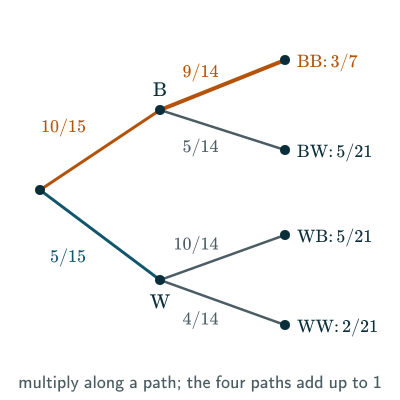
NCERT Example 8 (pages 415–416): an urn has 10 black and 5 white balls, and two are drawn without replacement. P(first black) = 10/15, and then 9 of the remaining 14 are black, so P(both black) = (10/15)(9/14) = 3/7.
Three or more events
The rule extends step by step (page 416), provided P(E ∩ F) > 0. This also ensures P(E) > 0. If P(E ∩ F) = 0, the triple intersection has probability 0 directly; do not multiply by the undefined P(G|E ∩ F).
Three events
P(E ∩ F ∩ G) = P(E) P(F|E) P(G|E ∩ F)
NCERT Example 9 (pages 416–417): three cards are drawn without replacement from 52. P(king, king, ace) = (4/52)(3/51)(4/50) = 2/5525. Each factor is a conditional probability given everything drawn before it.
Solved examples
Example 1: Two black cards (NCERT Exercise 13.2, Q2, page 421)
Two cards are drawn at random, without replacement, from a pack of 52. Find the probability that both are black.
26 of the 52 cards are black; after one black card is drawn, 25 of the remaining 51 are black.
Answer: (26/52)(25/51) = 25/102.
Example 2: Approving a box of oranges (NCERT Exercise 13.2, Q3, page 421)
A box of 15 oranges, 12 good and 3 bad, is approved if three oranges drawn without replacement are all good. Find the probability that it is approved.
(12/15)(11/14)(10/13) = 1320/2730.
Answer: 44/91.
Example 3: A colour sequence
A bag has 4 red and 6 white balls. Three balls are drawn one after another without replacement. Find the probability that they come out red, white, red.
P(R) = 4/10; then P(W|R) = 6/9; then P(R|RW) = 3/8.
Answer: (4/10)(6/9)(3/8) = 1/10.
Example 4: The order does not matter for the total
In Example 3, find the probability of exactly two reds in the three draws.
The orders RRW, RWR and WRR each give (4 × 3 × 6)/(10 × 9 × 8) = 1/10: the factors are the same numbers in a different order. The three orders cannot happen together, so their probabilities add, by the Class 11 addition rule.
Answer: 3/10.
Common mistakes to avoid
Common mistake
Forgetting that the bag changes
Without replacement, the second factor uses what is left: 9/14, not 10/15, in NCERT Example 8. Using 10/15 twice treats the draws as independent, which they are not.
Common mistake
Multiplying unconditional probabilities
P(E ∩ F) = P(E) P(F) only for independent events. In general the second factor must be P(F|E).
Common mistake
Counting one order only
“Two reds and a white” covers three orders. Multiply along one path, then add the paths (Example 4).
Quick revision summary
- P(E ∩ F) = P(E) P(F|E) = P(F) P(E|F): multiply the first probability by the conditional probability of the next event.
- For three events, P(E ∩ F ∩ G) = P(E) P(F|E) P(G|E ∩ F) when P(E ∩ F) > 0. Each conditional factor needs a conditioning event of positive probability.
- For draws without replacement, each factor uses what is left; a tree diagram keeps track, multiplying along paths and adding over paths.
Formula sheet
- P(E ∩ F) = P(E) P(F|E) = P(F) P(E|F)
- P(E ∩ F ∩ G) = P(E) P(F|E) P(G|E ∩ F)
Questions students ask
Are the multiplication theorem, multiplication rule and multiplication law of probability the same?
Yes, the multiplication theorem, multiplication rule and multiplication law of probability are names for one result, that the probability of E ∩ F is P(E) P(F|E): NCERT titles Section 13.3 “Multiplication Theorem on Probability”, calls the result “the multiplication rule of probability” (page 415) and writes “multiplication law of probability” in Example 9 (page 417), and the JEE Main syllabus, Unit 13, says “multiplication theorems of probability”. Beyond the NCERT text, statistics books also call it the general multiplication rule or the product rule. For independent events, P(F|E) = P(F), and the rule becomes P(E) P(F).
Why do we multiply probabilities when both events must happen?
We multiply probabilities for “both” because the answer is a fraction of a fraction: of all trials, a fraction P(E) gives E, and of those trials a fraction P(F|E) also gives F, so a fraction P(E) P(F|E) of all trials gives both. If 3/5 of a class are girls and 3/4 of the girls wear glasses, then 3/4 of 3/5, that is 9/20 of the class, are girls who wear glasses. Each factor is at most 1, so the product is never more than either factor: “E and F” is never more likely than E alone.
What is the difference between conditional probability and the multiplication theorem?
The conditional probability formula and the multiplication theorem are one equation used in opposite directions: NCERT’s definition finds P(F|E) by dividing P(E ∩ F) by P(E), and the multiplication theorem goes back, finding P(E ∩ F) as P(E) times P(F|E). Use the definition when P(E ∩ F) is known or easy to count, and the multiplication theorem when the conditional probability is easy to see from how the experiment runs, as in draws without replacement. For two pens taken without replacement from a box of 20 with 5 faulty ones, the chance that the second is faulty once the first is, 4/19, is clear at once, so both are faulty with probability (5/20)(4/19) = 1/19.
What is the difference between the multiplication theorem and the theorem of total probability?
The multiplication theorem gives the probability of one path, such as “E and then A”, as P(E) P(A|E), while the theorem of total probability adds the probabilities of all the paths that end in A, one for each event E, E, …, E of a partition, so each of its terms is a multiplication-theorem product. If a coin toss chooses Box I, with 3 red balls out of 5, or Box II, with 1 red ball out of 4, the path “Box I, then red” has probability (1/2)(3/5) = 3/10, and adding the path “Box II, then red”, (1/2)(1/4) = 1/8, gives P(red) = 17/40. NCERT states the theorem of total probability in Section 13.5.2 (pages 424–425), as a step towards Bayes’ theorem.
How do you find the probability of at least one success when drawing without replacement?
To find the probability of at least one success in draws without replacement, find the chance of none with the multiplication theorem and subtract it from 1, because “at least one” is the complement of “none”. For two cards drawn without replacement from a pack of 52, the chance of no spade is (39/52)(38/51), which is 19/34, so the chance of at least one spade is 15/34. The draws are dependent, so 1 − (3/4) = 7/16, which treats them as independent, would be the answer only with replacement.
Practice questions
Try each question first, then open the answer to check your working.
-
Q1. Two balls are drawn without replacement from an urn with 5 red and 3 blue balls. Find the probability that both are blue.
Show answerHide answer
(3/8)(2/7) = 3/28.
-
Q2. Three cards are drawn without replacement from a pack of 52. Find the probability that all three are hearts.
Show answerHide answer
(13/52)(12/51)(11/50) = 11/850.
-
Q3. P(E) = 0.5 and P(F|E) = 0.4. Find P(E ∩ F).
Show answerHide answer
P(E ∩ F) = 0.5 × 0.4 = 0.2.
-
Q4. A box has 8 good and 2 faulty bulbs. Two are taken without replacement. Find the probability that exactly one is faulty.
Show answerHide answer
Good then faulty: (8/10)(2/9) = 16/90; faulty then good: (2/10)(8/9) = 16/90. The total is 32/90 = 16/45.