General and particular solutions of a differential equation
NCERT Class 12 Mathematics Chapter 9 Section 9.3
Quick answer
General and particular solutions of a differential equation differ in their constants: the general solution contains arbitrary constants, as many as the order for the regular equations studied here, while a particular solution has none, because they have been given values. Each is a function that makes both sides equal when it and its derivatives are substituted: for y″ + y = 0, y = a sin (x + b) is the general solution and y = 2 sin (x + π/4) a particular one.
With your textbook
NCERT Mathematics Part II (Class 12), Chapter 9 “Differential Equations”, Section 9.3 “General and Particular Solutions of a Differential Equation”, pages 304–306.
Open the official NCERT chapter (PDF, 3.4 MB, ncert.nic.in) (opens in a new tab)
Checked against the 2026-27 reprint on .
What is a solution?
An algebraic equation such as x2 + 1 = 0 has numbers as solutions. A differential equation has functions: a function φ is a solution when, with y = φ(x) and its derivatives substituted, the left side equals the right side (NCERT Section 9.3, page 304). The graph y = φ(x) is called a solution curve, or integral curve.
NCERT’s illustration (pages 304–305): y = a sin (x + b), with a, b ∈ R, satisfies y″ + y = 0 for every a and b. Taking a = 2 and b = π/4 gives one fixed solution, y = 2 sin (x + π/4).
General and particular solutions
The solution which contains arbitrary constants is called the general solution (primitive) of the differential equation.
NCERT Mathematics Part II (Class 12), Section 9.3, page 305
The solution free from arbitrary constants i.e., the solution obtained from the general solution by giving particular values to the arbitrary constants is called a particular solution of the differential equation.
NCERT Mathematics Part II (Class 12), Section 9.3, page 305
So y = a sin (x + b) is the general solution of y″ + y = 0, and y = 2 sin (x + π/4) is a particular solution.
Checking that a function is a solution
Is y = φ(x) a solution?
find y′, y″, … from y = φ(x)
substitute them, and show L.H.S. = R.H.S.
The working is plain differentiation. When the function is given implicitly, as in xy = log y + C, differentiate the relation as it stands (implicit differentiation) and solve for y′ (Example 3).
How many arbitrary constants?
For the regular equations considered in NCERT, the general solution of an equation of order n has n independent arbitrary constants (constants that cannot be merged into fewer; NCERT’s Summary, page 336, gives the count, and Exercise 9.2, Q11 and Q12, page 306, ask for it): two for the second order equation y″ + y = 0 (a and b above), one for a first order equation. A particular solution has none. The count is a guide to a full family, not a proof that every nonlinear equation has such a family; singular solutions or degenerate equations need separate checks.
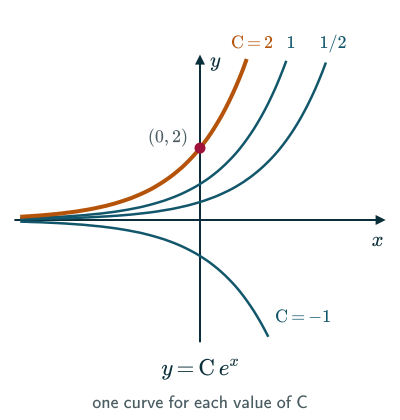
From NCERT Section 9.4 on, a given condition fixes the constants. For dy/dx = y, the general solution is y = Cex (its derivative, Cex, is y again), and the condition y = 2 when x = 0 gives C = 2: the thick curve in the figure.
Solved examples
Example 1: An exponential solution (NCERT Example 2, page 305)
Verify that y = e−3x is a solution of y″ + y′ − 6y = 0.
y′ = −3e−3x and y″ = 9e−3x. The left side is 9e−3x − 3e−3x − 6e−3x, which is 0.
Answer: L.H.S. = R.H.S. = 0, so it is a solution.
Example 2: Two arbitrary constants (NCERT Example 3, pages 305–306)
Verify that y = a cos x + b sin x, where a, b ∈ R, is a solution of y″ + y = 0.
y′ = −a sin x + b cos x, and y″ = −a cos x − b sin x, which is −y. So y″ + y = 0.
Answer: it is a solution for every a and b; with its two constants it is a general solution of this second order equation.
Example 3: An implicit solution (NCERT Exercise 9.2, Q7, page 306)
Verify that xy = log y + C is a solution of y′ = y2/(1 − xy), on a differentiable branch with y > 0 and xy ≠ 1.
Differentiate both sides with respect to x: y + xy′ = y′/y. Multiply by y: y2 + xy·y′ = y′, so y′(1 − xy) = y2.
Answer: y′ = y2/(1 − xy), as required.
Example 4: Watch the square root (NCERT Exercise 9.2, Q6, page 306)
Verify that y = x sin x is a solution of xy′ = y + x√(x2 − y2).
y′ = sin x + x cos x, so the left side is x sin x + x2 cos x, that is, y + x2 cos x. On the right, x2 − y2 = x2 cos2 x, so the root is |x cos x|. Where x cos x ≥ 0 the root is x cos x, and the right side is also y + x2 cos x.
Answer: a solution wherever x cos x ≥ 0 (and x ≠ 0).
NCERT slip (page 306): the question states the condition as (x ≠ 0 and x > y or x < −y). That condition does not decide the sign of x cos x. At x = 2, for example, y = 2 sin 2 ≈ 1.82, so x > y, yet the left side is about 0.15 and the right side about 3.48. In an exam, do the working above and add one line: √(x2 cos2 x) equals x cos x only when x cos x ≥ 0.
Example 5: Choose the correct answer (NCERT Exercise 9.2, Q11, page 306)
The number of arbitrary constants in the general solution of a differential equation of fourth order is (A) 0; (B) 2; (C) 3; (D) 4.
For the regular equations considered in NCERT, the general solution of an equation of order n has n arbitrary constants.
Answer: (D).
Common mistakes to avoid
Common mistake
Looking for a number
The solution of a differential equation is a function, not a value of x. Substitute the function and its derivatives, and check the equation for all x in the domain.
Common mistake
Constants in a particular solution
A particular solution has no arbitrary constants: they have all been given values. y = 3 cos x − sin x has none, though it comes from the general solution y = a cos x + b sin x of Example 2, which has two.
Common mistake
Dropping the sign of a square root
√(u2) is |u|, not u. Example 4 shows a check that holds only where the sign is right.
Quick revision summary
- A solution is a function y = φ(x) that makes L.H.S. = R.H.S. when it and its derivatives are substituted; its graph is a solution curve.
- The general solution contains arbitrary constants, n of them for an equation of order n; a particular solution has none.
- For y″ + y = 0, y = a sin (x + b) is the general solution and y = 2 sin (x + π/4) a particular one.
- Implicit solutions such as xy = log y + C are checked by differentiating the relation as it stands.
Formula sheet
- solution: substitute y and its derivatives; L.H.S. = R.H.S.
- general solution of order n: n arbitrary constants
- particular solution: no arbitrary constants
Questions students ask
What is an arbitrary constant in a differential equation?
An arbitrary constant is a constant in the general solution of a differential equation, such as C, a or b, that may take any real value, each value giving one solution curve: the equation leaves it free, unlike a constant written in the equation itself. In dy/dx = 3y the 3 is fixed, while in its general solution y = Ce3x the C is arbitrary: C = 5 gives the curve through (0, 5), and C = 0 gives the solution y = 0. Each integration in solving brings in one such constant, and NCERT’s Summary (page 336) asks a general solution to contain as many as the order of the equation.
How do you check that a solution is the general solution and not just one solution?
A solution is the general solution only if it satisfies the equation for every value of its constants and has as many independent arbitrary constants as the order, the count in NCERT’s Summary (page 336). Constants that merge count as one: y = ae3x + b satisfies y″ = 9y for all a and b, but it equals (aeb)e3x, that is Ce3x, with a single constant, so it is not the general solution of this second order equation. The general solution is y = Ae3x + Be−3x, with two independent constants, and the merged form misses solutions such as y = e−3x.
What is a singular solution of a differential equation?
Beyond the NCERT text, a singular solution is a solution that no choice of constants in the general solution gives, so it is neither the general solution nor a particular one. For y = xy′ − (y′)2, the general solution is the family of lines y = Cx − C2 (each has y′ = C), yet the parabola y = x2/4 also fits: y′ = x/2 makes the right side x2/2 − x2/4, which is x2/4. No value of C gives this parabola, which touches every line of the family: it has no arbitrary constant, yet, unlike a particular solution in NCERT’s sense (page 305), it is not obtained from the general solution by giving C a value.
Is formation of differential equations deleted from NCERT Class 12 and the JEE Main syllabus?
Yes, formation of differential equations is no longer in NCERT Class 12: NCERT’s 2022 list of rationalised content (page 44) dropped the old Section 9.4 on it, and the 2026–27 reprint has none, though its introduction (page 300) still names it. The JEE Main 2027 syllabus, Unit 9, omits it, listing “Ordinary differential equations, their order and degree, the solution of differential equation by the method of separation of variables, solution of a homogeneous and linear differential equation” of the type dy/dx + p(x)y = q(x). Beyond the NCERT text, forming means differentiating once per arbitrary constant and eliminating them: y = ax + b gives y′ = a, then y″ = 0.
Does every given condition pick out exactly one particular solution?
No, a given condition fixes the arbitrary constant only when solving for it gives exactly one value, so check that the value exists and is unique. Every y = Cx2 satisfies xy′ = 2y (its derivative is 2Cx), and y = 12 when x = 2 fixes C = 3. But y = 0 when x = 0 holds for every C, and y = 1 when x = 0 for none, since at x = 0 the equation itself forces y = 0.
Practice questions
Try each question first, then open the answer to check your working.
-
Q1. Verify that y = ex + 1 is a solution of y″ − y′ = 0 (NCERT Exercise 9.2, Q1, page 306).
Show answerHide answer
y′ = ex and y″ = ex, so y″ − y′ = 0.
-
Q2. Verify that y = cos x + C is a solution of y′ + sin x = 0 (NCERT Exercise 9.2, Q3, page 306).
Show answerHide answer
y′ = −sin x, so y′ + sin x = 0 for every value of C.
-
Q3. Verify that y = Ax is a solution of xy′ = y, where x ≠ 0 (NCERT Exercise 9.2, Q5, page 306).
Show answerHide answer
y′ = A, so xy′ = Ax, which is y.
-
Q4. The number of arbitrary constants in the particular solution of a differential equation of third order is (A) 3; (B) 2; (C) 1; (D) 0 (NCERT Exercise 9.2, Q12, page 306).
Show answerHide answer
A particular solution has no arbitrary constants: (D).